
This object, or the text that describes it, is deemed offensive and discriminatory. We are committed to improving our records, and work is ongoing.
Oroonoko: or the Royal Slave
Print
1791 (printed)
1791 (printed)
| Artist/Maker | |
| Place of origin |
Oroonoko: or the Royal Slave was written by Aphra Behn and published in 1688. The novel tells the story of a tragic love affair between Oroonoko, an African prince, and Imoinda, the daughter of an African general. In the story the lovers are forced into slavery and transported to Surinam in the West Indies, then an English colony based on sugarcane plantations. The lovers make a death pact in preference to a life lived under slavery. Oroonoko kills Imoinda before suffering an inhumane death in a public execution.
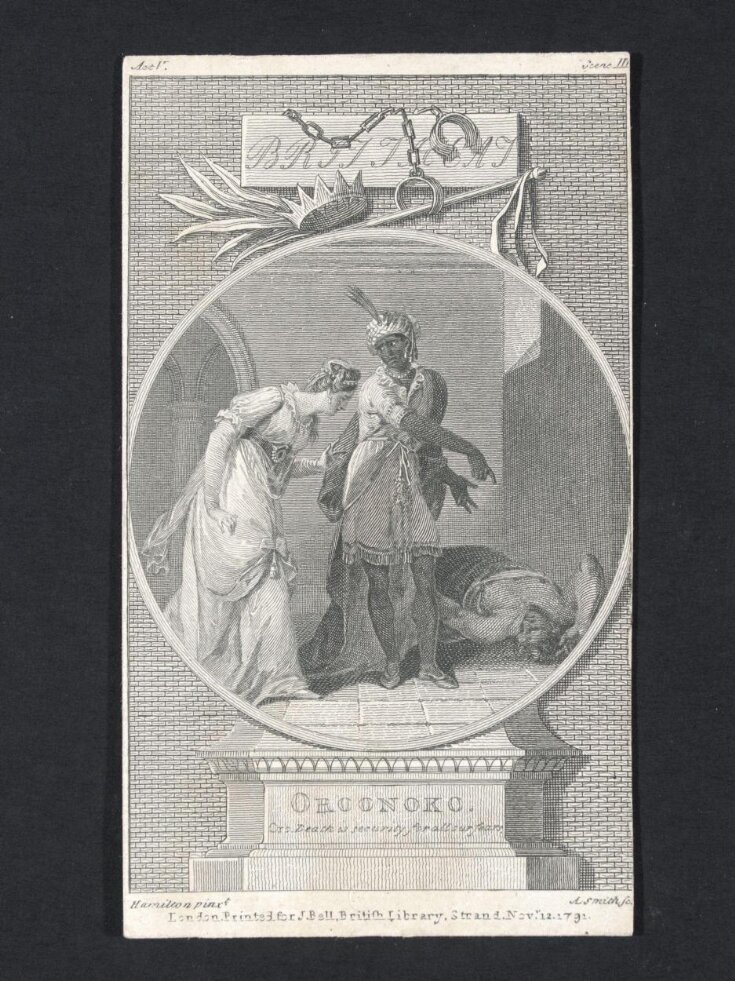
Behn’s novel was not immediately successful but a 1695 adaptation for stage by Thomas Southerne brought the story to a wider audience and was a great success. After the play was staged, a new edition of the novel appeared and it remained in print throughout the 18th century. The adaptation was generally faithful to the novel, with one significant exception: it makes Imoinda white instead of black, therefore the male lead would perform in blackface to a white heroine. This print, an illustration to act v, scene iii of Southerne’s stage adaptation, presents Oroonoko in the guise of the ‘noble savage’, with European facial features and wearing elaborate dress including a feathered turban.
Behn’s novel was not immediately successful but a 1695 adaptation for stage by Thomas Southerne brought the story to a wider audience and was a great success. After the play was staged, a new edition of the novel appeared and it remained in print throughout the 18th century. The adaptation was generally faithful to the novel, with one significant exception: it makes Imoinda white instead of black, therefore the male lead would perform in blackface to a white heroine. This print, an illustration to act v, scene iii of Southerne’s stage adaptation, presents Oroonoko in the guise of the ‘noble savage’, with European facial features and wearing elaborate dress including a feathered turban.
Object details
| Categories | |
| Object type | |
| Titles |
|
| Materials and techniques | Engraving on paper |
| Brief description | Print, illustration to the 1695 stage adaptation of Aphra Behn's 'Oroonoko: or the Royal Slave' |
| Physical description | Printed illustration to stage adaptation of Aphra Behn's 'Oroonoko: or the Royal Slave', showing Oroonoko, in the guise of 'noble savage' pointing (a white) Imoinda to a dead body laying on the ground |
| Dimensions |
|
| Marks and inscriptions | (At bottom: 'London Printed for J. Bell, British Library, Strand, Nov. 12 1791 / Hamilton pinxt. A Smith') |
| Object history | Probably an illustration to a reprint of the stage adaptation by Thomas Southerne, 'Oroonoko, Adapted for Theatrical Representation as performed at the Theatres-Royal, Drury-Lane and Covent Garden. Regulated from the Prompt-Books, by Permission of the Managers', 1791. The depicted scene is act v, scene iii |
| Historical context | Blackface is a style of theatrical makeup that originated in the United States around 1830 and which was based on racist stereotypes of African Americans. It was most commonly used in the minstrel performance tradition. White performers (and sometimes black) used burnt cork, greasepaint or shoe polish to blacken their skin and exaggerate their lips. The look was completed with ‘woolly’ wigs, gloves, tailcoats and/or ragged clothes. Blackface was a performance tradition in American theatre for over 100 years and was also popular overseas. Stereotypes embodied in the stock characters of blackface minstrelsy played a significant role in cementing and proliferating racist attitudes. |
| Literary reference | Oroonoko: or the Royal Slave by Aphra Behn |
| Summary | Oroonoko: or the Royal Slave was written by Aphra Behn and published in 1688. The novel tells the story of a tragic love affair between Oroonoko, an African prince, and Imoinda, the daughter of an African general. In the story the lovers are forced into slavery and transported to Surinam in the West Indies, then an English colony based on sugarcane plantations. The lovers make a death pact in preference to a life lived under slavery. Oroonoko kills Imoinda before suffering an inhumane death in a public execution. Behn’s novel was not immediately successful but a 1695 adaptation for stage by Thomas Southerne brought the story to a wider audience and was a great success. After the play was staged, a new edition of the novel appeared and it remained in print throughout the 18th century. The adaptation was generally faithful to the novel, with one significant exception: it makes Imoinda white instead of black, therefore the male lead would perform in blackface to a white heroine. This print, an illustration to act v, scene iii of Southerne’s stage adaptation, presents Oroonoko in the guise of the ‘noble savage’, with European facial features and wearing elaborate dress including a feathered turban. |
| Collection | |
| Accession number | E.756-1887 |
About this object record
Explore the Collections contains over a million catalogue records, and over half a million images. It is a working database that includes information compiled over the life of the museum. Some of our records may contain offensive and discriminatory language, or reflect outdated ideas, practice and analysis. We are committed to addressing these issues, and to review and update our records accordingly.
You can write to us to suggest improvements to the record.
Suggest feedback
You can write to us to suggest improvements to the record.
Suggest feedback
| Record created | July 3, 2007 |
| Record URL |
Download as: JSONIIIF Manifest
