
Button
19th century (made)
| Artist/Maker | |
| Place of origin |
Lapland and Iceland are the most remote areas of north-west Europe. Their traditional jewellery retains many medieval characteristics lost elsewhere.
Buttons and clasps were mostly used for decoration. Women in Iceland wore large buttons of this kind, typically in sets of three, to hold their decorative aprons in place at the waistband. Many were round or hemispherical, but shallow, drum-shaped buttons like this one are typically and uniquely Icelandic.
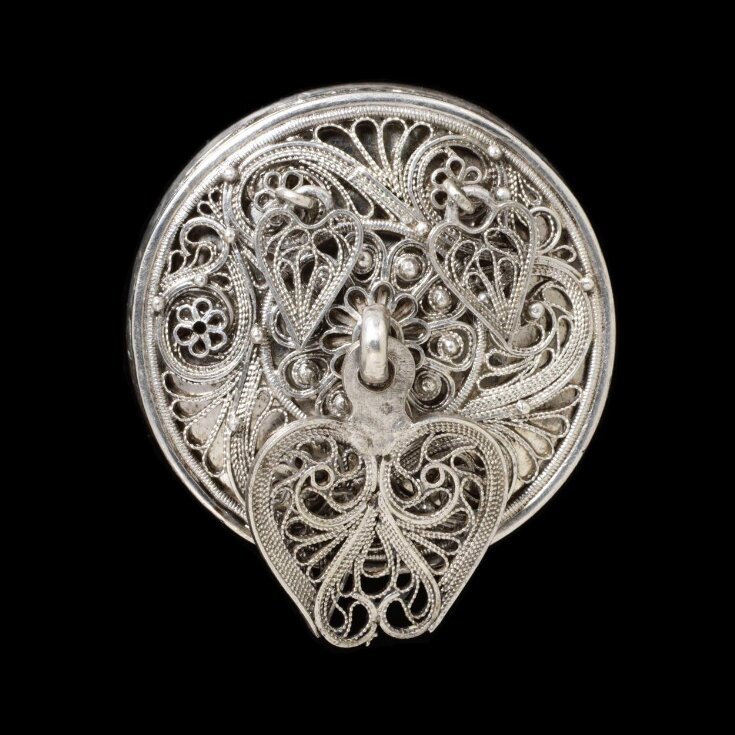
Icelandic silversmiths had worked occasionally in filigree since the Middle Ages, but by the middle of the 19th century it had become their favourite technique. This button shows all the characteristics of Icelandic filigree. The pattern is clear, regular, and slightly asymmetric. It has small pendant filigree hearts (three are missing) in the same technique. It is made of open filigree, which is riveted to the front of the hollow button, not soldered. It could only come from Iceland.
Buttons and clasps were mostly used for decoration. Women in Iceland wore large buttons of this kind, typically in sets of three, to hold their decorative aprons in place at the waistband. Many were round or hemispherical, but shallow, drum-shaped buttons like this one are typically and uniquely Icelandic.
Icelandic silversmiths had worked occasionally in filigree since the Middle Ages, but by the middle of the 19th century it had become their favourite technique. This button shows all the characteristics of Icelandic filigree. The pattern is clear, regular, and slightly asymmetric. It has small pendant filigree hearts (three are missing) in the same technique. It is made of open filigree, which is riveted to the front of the hollow button, not soldered. It could only come from Iceland.
Object details
| Categories | |
| Object type | |
| Materials and techniques | Silver sheet with openwork filigree |
| Brief description | Large silver drum-shaped button with filigree decoration and three pendant filigree hearts, Iceland, 19th century. |
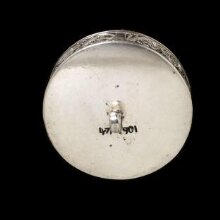
| Physical description | Hollow drum-shaped button decorated with open filigree on the front and sides. One large and two (originally five) smaller heart-shaped pendants of filigree hanging from the front. |
| Dimensions |
|
| Production | Worn by women |
| Subject depicted | |
| Summary | Lapland and Iceland are the most remote areas of north-west Europe. Their traditional jewellery retains many medieval characteristics lost elsewhere. Buttons and clasps were mostly used for decoration. Women in Iceland wore large buttons of this kind, typically in sets of three, to hold their decorative aprons in place at the waistband. Many were round or hemispherical, but shallow, drum-shaped buttons like this one are typically and uniquely Icelandic. Icelandic silversmiths had worked occasionally in filigree since the Middle Ages, but by the middle of the 19th century it had become their favourite technique. This button shows all the characteristics of Icelandic filigree. The pattern is clear, regular, and slightly asymmetric. It has small pendant filigree hearts (three are missing) in the same technique. It is made of open filigree, which is riveted to the front of the hollow button, not soldered. It could only come from Iceland. |
| Collection | |
| Accession number | 471-1901 |
About this object record
Explore the Collections contains over a million catalogue records, and over half a million images. It is a working database that includes information compiled over the life of the museum. Some of our records may contain offensive and discriminatory language, or reflect outdated ideas, practice and analysis. We are committed to addressing these issues, and to review and update our records accordingly.
You can write to us to suggest improvements to the record.
Suggest feedback
You can write to us to suggest improvements to the record.
Suggest feedback
| Record created | June 29, 2007 |
| Record URL |
Download as: JSONIIIF Manifest
