Door Knocker
1575-1600 (made)
| Artist/Maker | |
| Place of origin |
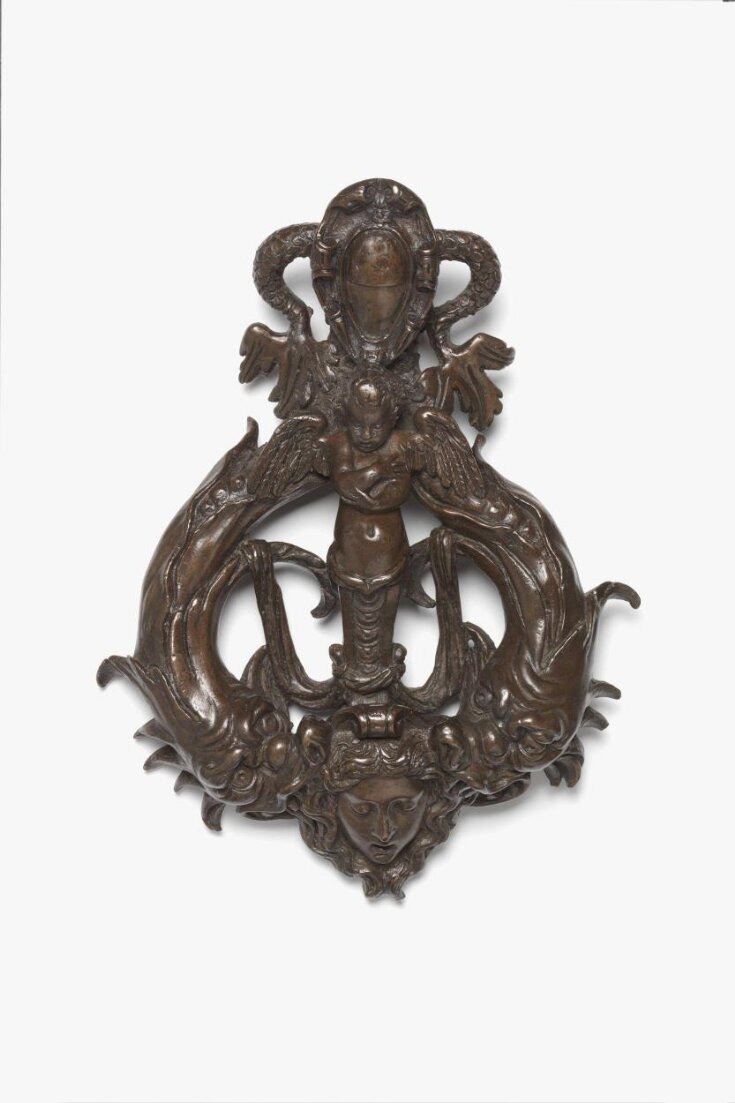
This doorknocker is typical of the elaborate style now known as Mannerism. In the middle is a putto (boy) with outstretched wings. At the base is a female head. The sides are formed by two dolphins whose tails support a cartouche (an oval shield with a rolled border). Within the cartouche is a coat of arms.
Object details
| Categories | |
| Object type | |
| Materials and techniques | cast bronze |
| Brief description | Door Knocker, bronze, Italy (Venice), ca. 1575-1600 |
| Physical description | Lyre-shaped, the sides formed by two dolphins whose tails support a cartouche with a coat-of-arms, party-per-fess. In the middle is a cherub terminal figure whose base rests on a female head |
| Dimensions |
|
| Style | |
| Credit line | Andrew Whilford Anderson Bequest |
| Object history | Bequeathed by Mr. A. W. Anderson. |
| Subjects depicted | |
| Summary | This doorknocker is typical of the elaborate style now known as Mannerism. In the middle is a putto (boy) with outstretched wings. At the base is a female head. The sides are formed by two dolphins whose tails support a cartouche (an oval shield with a rolled border). Within the cartouche is a coat of arms. |
| Collection | |
| Accession number | M.30-1951 |
About this object record
Explore the Collections contains over a million catalogue records, and over half a million images. It is a working database that includes information compiled over the life of the museum. Some of our records may contain offensive and discriminatory language, or reflect outdated ideas, practice and analysis. We are committed to addressing these issues, and to review and update our records accordingly.
You can write to us to suggest improvements to the record.
Suggest feedback
You can write to us to suggest improvements to the record.
Suggest feedback
| Record created | June 29, 2007 |
| Record URL |
Download as: JSONIIIF Manifest
