Silk Velvet Furnishing Fabric
1570-1600 (made)
| Artist/Maker | |
| Place of origin |
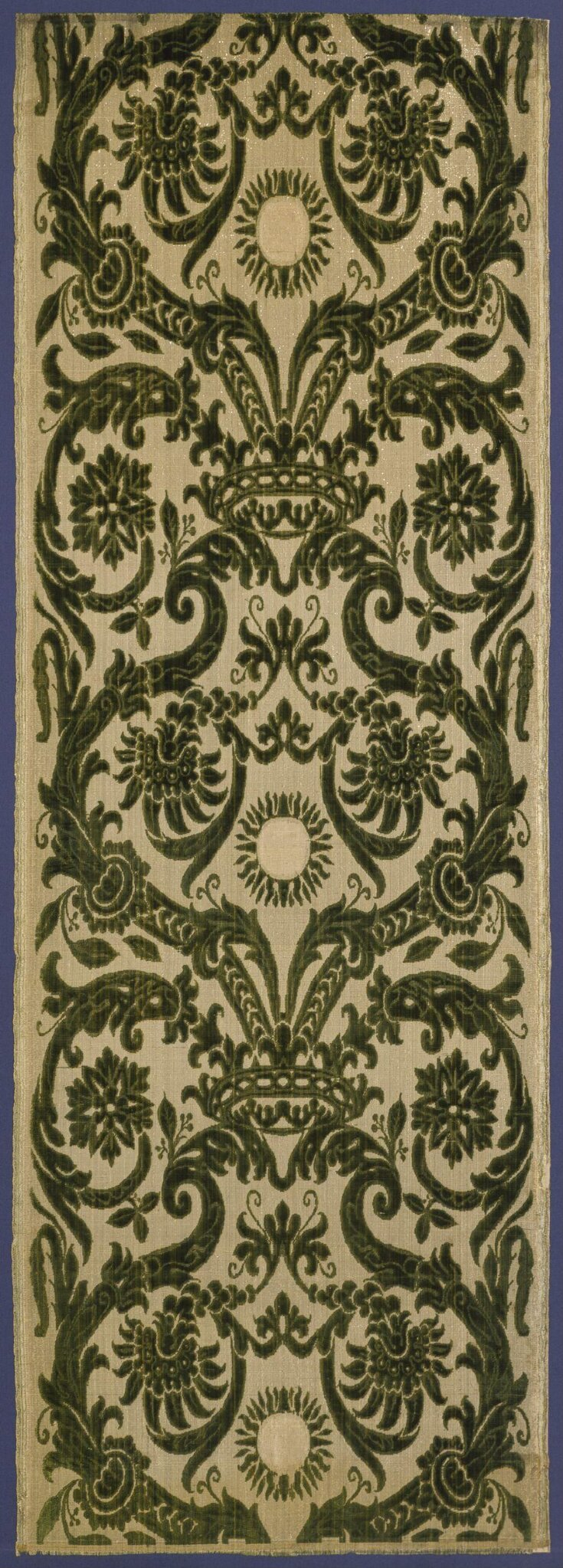
This silk was probably intended for use as a furnishing textile, as the vertical disposition and scale of the pattern are suited to wall hangings or curtains. This type of silk product was one of the richest because the making of velvet required skilled weavers and took a long time. Under the best circumstances, a weaver could progress at the rate of no more than 60 metres in a year.
Not surprisingly, velvet weavers earned more than those who specialised in other silk textiles, and their earnings increased in direct proportion to the difficulty of the work involved; in the velvet hierarchy, at the bottom sat the weavers of solid velvets, at the top the weavers of pile-on-pile velvets with brocading and bouclé gold wefts. The former earned about one third of the wages of the latter.
In western Europe, expertise in velvet-weaving was restricted at this period to various Italian cities (Lucca, Florence, Genoa, Venice) and to certain centres in Spain (e.g. Valencia), some of which had gained their knowledge through the import of Italian craftsmen.
Not surprisingly, velvet weavers earned more than those who specialised in other silk textiles, and their earnings increased in direct proportion to the difficulty of the work involved; in the velvet hierarchy, at the bottom sat the weavers of solid velvets, at the top the weavers of pile-on-pile velvets with brocading and bouclé gold wefts. The former earned about one third of the wages of the latter.
In western Europe, expertise in velvet-weaving was restricted at this period to various Italian cities (Lucca, Florence, Genoa, Venice) and to certain centres in Spain (e.g. Valencia), some of which had gained their knowledge through the import of Italian craftsmen.
Object details
| Categories | |
| Object type | |
| Materials and techniques | Cut and uncut velvet, woven in silk and metal thread |
| Brief description | Furnishing fabric, green & gold silk velvet, with a pattern of scrolling stems, flowers and crowns, probably 1570-1629, Italy |
| Physical description | Cut and uncut voided silk velvet with a gold ground. The pattern is a point repeat (i.e. symmetrical about a vertical axis), comprising compartments topped with coronets from which curvaceous foliage and flowers scroll and above which sits a sun motif. The length comprises three full repeats of the pattern which does not repeat widthwise. The selvedges are primarily gold but seem to have a green stripe. The glitter of the gold is still apparent. |
| Dimensions |
|
| Style | |
| Gallery label | HANGING
Velvet, with a ground of silver-gilt and pattern in cut and uncut silk pile.
Italian (Genoa or Florence), 1550-1600
147-1880
Large-scale stylised floral patterns of this kind, often incorporating crowns, can be seen as a development from the 'pomegranate' pattterns of the Renaissance. These types of patterns contrast with the parallel development of much smaller formal patterns.(pre 2000) |
| Object history | Bought from the Robinson Collection. Historical significance: A fine and well-preserved example of one of the most expensive and luxurious textiles made in the Renaissance. |
| Historical context | This silk was probably intended for use as a furnishing textile, the vertical disposition and scale of the pattern being suited to wall-hangings or curtains. In the hierarchy of silk products, it was one of the richest because the technique of velvet weaving required skilled weavers (often specialised in this particular technique) and the making of the velvet took a long time (under optimal circumstances, a weaver could progress at the rate of no more than 200 feet in a year). This velvet is particularly complex because it comprises different forms of pile and incorporates metallic threads. It conforms to the usual widths of the period for such textiles (54-60 centimetres). In Western Europe, expertise in velvet-weaving was restricted at this period to various Italian cities (e.g. Lucca, Florence, Genoa, Venice) and to certain centres in Spain, some of which had gained their knowledge through the import of Italian craftsmen (e.g. Valencia). The first records of velvet production in Lucca, Venice, Florence, and Genoa date to the beginning of the fourteenth century, as do the first records of their presence in royal and papal inventories. While Lucca was the earliest centre, the other three cities competed for leadership in the fifteenth and sixteenth century. Not surprisingly, velvet weavers earned more than their confreres who specialised in other silk textiles, and their earnings increased in direct proportion to the difficulty of the work involved: in the velvet hierarchy, at the bottom sat the weavers of solid velvets, at the top the weavers of pile-on-pile velvets with brocading and bouclé gold wefts. The former earned about one third of the wages of the latter. In the sixteenth century sumptuary laws attempted - unsuccessfully - to reduce excessive expenditure on clothing and furnishings, restricting the use of such textiles in dress and forbidding it in canopies, blankets, curtains, and cushions. For further detail, see Roberta Orsi Landini. 'The Triumph of Velvet. Italian production of velvet in the Renaissance'. In Fabrizio de' Marinis, ed. Velvet. History, Techniques, Fashions. Milan: Idea Books, 1994, pp.20-49. |
| Production | Place or production is based on the centres most active in Europe at this time. |
| Subjects depicted | |
| Summary | This silk was probably intended for use as a furnishing textile, as the vertical disposition and scale of the pattern are suited to wall hangings or curtains. This type of silk product was one of the richest because the making of velvet required skilled weavers and took a long time. Under the best circumstances, a weaver could progress at the rate of no more than 60 metres in a year. Not surprisingly, velvet weavers earned more than those who specialised in other silk textiles, and their earnings increased in direct proportion to the difficulty of the work involved; in the velvet hierarchy, at the bottom sat the weavers of solid velvets, at the top the weavers of pile-on-pile velvets with brocading and bouclé gold wefts. The former earned about one third of the wages of the latter. In western Europe, expertise in velvet-weaving was restricted at this period to various Italian cities (Lucca, Florence, Genoa, Venice) and to certain centres in Spain (e.g. Valencia), some of which had gained their knowledge through the import of Italian craftsmen. |
| Collection | |
| Accession number | 147-1880 |
About this object record
Explore the Collections contains over a million catalogue records, and over half a million images. It is a working database that includes information compiled over the life of the museum. Some of our records may contain offensive and discriminatory language, or reflect outdated ideas, practice and analysis. We are committed to addressing these issues, and to review and update our records accordingly.
You can write to us to suggest improvements to the record.
Suggest feedback
You can write to us to suggest improvements to the record.
Suggest feedback
| Record created | December 15, 1999 |
| Record URL |
Download as: JSONIIIF Manifest
