-
Seed Time
Herring, John Frederick - Enlarge image
Seed Time
- Object:
Oil painting
- Date:
1854-1856 (painted)
- Artist/Maker:
Herring, John Frederick (Sr.), born 1795 - died 1865 (painter (artist))
- Materials and Techniques:
Oil on canvas
- Credit Line:
Presented by Miss Mercy Mayhew in memory of her late brother Colonel Alfred H. Mayhew of the Bombay Staff Corps
- Museum number:
P.19-1915
- Gallery location:
In Storage
Date
1854-1856 (painted)
Artist/maker
Herring, John Frederick (Sr.), born 1795 - died 1865 (painter (artist))
Materials and Techniques
Oil on canvas
Marks and inscriptions
'J F Herring. Senr./1854-6'
Dimensions
Height: 106.7 cm estimate, Width: 183.1 cm estimate
Object history note
Presented by Miss Mercy Mayhew in memory of her late brother Colonel Alfred H. Mayhew of the Bombay Staff Corps, 1915
Descriptive line
Oil painting, 'Seed Time', John Frederick Herring Sr., 1854-1856
[Frame dimensions 147 x 224 cm]
Bibliographic References (Citation, Note/Abstract, NAL no)
Parkinson, R., Victoria and Albert Museum, Catalogue of British Oil Paintings 1820-1860, London: HMSO, 1990, p. 126
The following is the full text of the entry:
"HERRING, John Frederick (1795-1865)
Herring was born in Surrey, but brought up in London. The fastest mode of transport at any time possesses a unique fascination for the young, and as a boy Herring was absorbed by the glamour of the crack coaches of the turnpike age which he saw daily outside his father's fringe-making shop in Newgate Street. He drew horses for his own diversion from an early age, and had his first lessons in drawing from a family friend, the driver of the London to Woking coach. When aged 19 he went to Doncaster and obtained work as a coachman for five or six years. While thus employed he painted a series of inn signs and coach panels. In 1815 he was commissioned by a Doncaster publisher to paint the winner of the St Leger: the first of a long series, for print publishers of portraits of winners of the St Leger from 1815-43 and the Derby, 1827-49. In 1830 he moved to Newmarket, and in 1833 returned to London where, conscious of a lack of professional training, he studied at the age of 38 under Abraham Cooper, RA. His paintings had become immensely popular, and he received commissions from George IV, William IV and Queen Victoria. In about 1847 he settled at Meopham in Kent and turned to rural subjects - stables, farmyards, domestic animals and agricultural and hunting scenes. He was the father of three sons who painted after their father's style: John Frederick junior, with whom he quarrelled; Charles who died at the age of 28, and Benjamin, who specialised in racing scenes. Herring occasionally collaborated with Landseer and John Phillips. He died at Meopham Park, near Tunbridge Wells on 23 September, 1865. His studio sale was at Christie's 3 February 1866. Through the widely disseminated medium of engravings, (many of which have never stopped being produced) his work was known by, and influenced, both Manet and Degas.
LIT: A M W Stirling A Painter of Dreams, and other biographical studies; Christopher Neve A Victorian Peaceable Kingdom: J F Herring at Meopham Park Country Life Annual, 1970; 0 R Beckett J F Herring and Sons 1981.
Seed Time
P19-1915 Neg 50621
Canvas (prepared by Charles Roberson, 51 Long Acre), 106.7 x 183.1 cm (42 x 72 ins)
Signed and dated 'J F Herring. Senr./1854-6' br
Presented by Miss Mercy Mayhew in memory of her late brother Colonel Alfred H. Mayhew of the Bombay Staff Corps 1915
A pair with Harvest Time Yale Center for British Art, New Haven, Connecticut, signed and dated 1859 (42 x 72 ins, no 288 in Beckett repr p143).
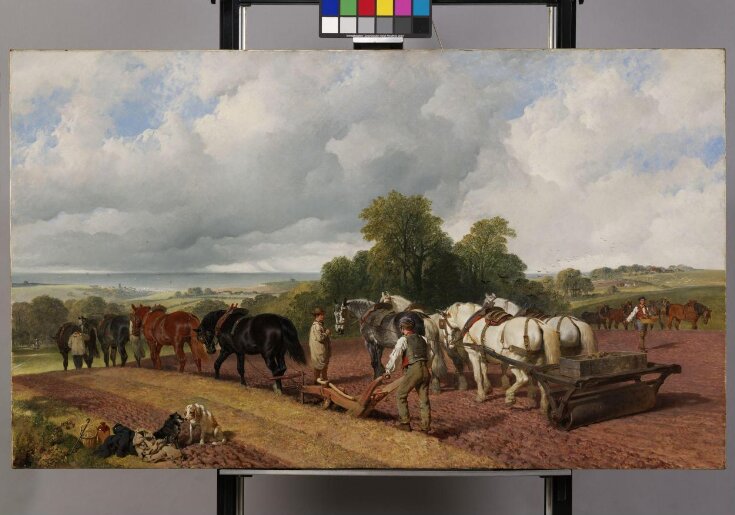
Together with Harvest Time this painting offers a detailed treatment of mid-19th-century agricultural methods, all the accepted cultivation procedures of the time being portrayed simultaneously. On the left the stubble is being ploughed up, in the centre is the cambridge roller, suitably weighted down with stones on the box on top of the equipment. Seed is being sown broadcast by the men walking from left to right, and in the mid-distance a team of horses is being got ready to harrow the tilth after the sowing. In reality it is a little unlikely that all four processes would have taken place simultaneously, although not completely unfeasible, as the pace is dictated by a horse's gait. Indeed the picture can be seen as both a visual lecture on farming methods, and a conscious attempt on Herring's part to eulogise the peace of the Kentish weald after the rick burning disturbances of the 1820s and 1830s.
PROV: John Tyson, sold Christies 1872, (£252).; Tom Nickalls; sold Christie's 4 June, 1909, Lot 32 (£105).
LIT: M H Grant Old English Landscape Painters 1925, pl 199; Gertrude Jekyll Old English Household Life 1925."
100 Great Paintings in The Victoria & Albert Museum. London: V&A, 1985, p.152
The following is the full text of the entry:
"John Frederick Herring, Senior 1795-1865
British School
SEED TIME
Signed and dated 1854-6
Oil on canvas, 106.2 X 183 cm
P.19-1915.Given by Miss Mercy Mayhew in memory of the late Captain Alfred H. Mayhew.
The works of J F Herring follow in the genre of British animal painting already established by artists such as Francis Barlow, George Stubbs, Ben Marshall and James Ward, a genre which responded to a native enthusiasm for sporting life and country pursuits, and to its patrons' demand for clear, accurate portrayals of memorable animals and events in the sporting and farming calendar. Herring took up painting in 1815, after an early career as a coach painter and later coach driver, and, despite little formal training, won speedy success with his naturalistic and polished portraits of celebrated racehorses. He also made a name for himself in the depiction of coaching, hunting and farmyard scenes, one critic complaining that 'Herring grows more and more of an agriculturalist', as he devoted increasing attention to rural subjects.
Seed Time shows ploughing and sowing in the Weald of Kent, and it is a finely balanced composition in which men, horses and machinery progress across the landscape in a stately sequence. The single file of four horses drawing the wooden plough, with their driver and the ploughman, lead the eye gently leftwards down the valley and to the coast beyond. That movement is reinforced by the four-horse team of Shires pulling the weighted roller that follows after the plough, breaking up the clods of newly turned earth. A counter movement is set up by the besmocked figure at the head of the Shires, who, in turning to face his team, leads the spectator's eye to the sower broadcasting his seed. Behind the sower hovers a flight of eager crows, and they, together with a further team of horses in the middle distance, give the painting its balancing pull to the right.
There is no doubt that for all its naturalism the painting has a picturesque quality that makes no concessions to the rigours and hardships involved in working the land. The artful foreground grouping of the two dogs, with the walking stick, food basket, drinking bottle and coats, not only echoes the undulating shapes of the landscape, but also provides a reassuring note of domesticity. Kindly sunshine bathes the scene, illuminating the Weald in sparkling detail, highlighting the procession of plough and roller, and burnishing the horses' coats. With expressive, yet meticulous brushwork, Herring conveys a rosy picture of rural England that must even then have provided a pleasant antidote to the prospect of encroaching industrialism.
Margaret Timmers"
Materials
Oil paint; Canvas
Techniques
Oil painting
Subjects depicted
Farming; Sowing
Categories
Paintings
Collection code
PDP

