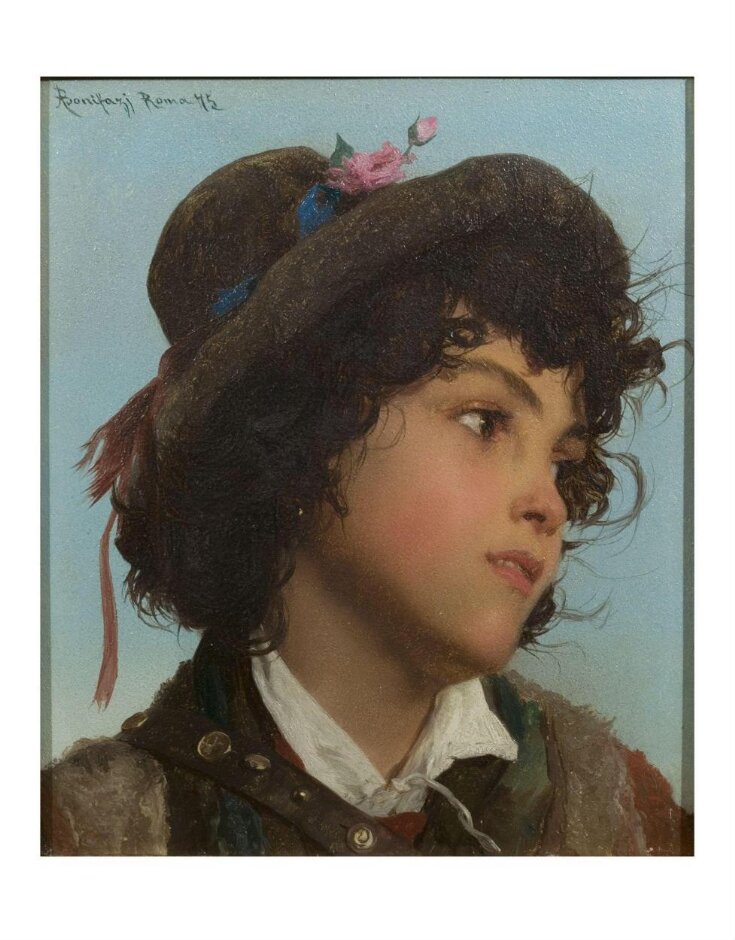

Head of an Italian Boy
Oil Painting
1875 (painted)
1875 (painted)
| Artist/Maker | |
| Place of origin |
Adriano Bonifazi (1858-1914) was an Italian painter who worked in Capri and Rome and primarily produced idealised or Romantic 'portraits' of young boys and girls, often in rustic dress. Rather than naturalistic identifiable portraits, Bonifazi often painted pendants, that is paired paintings, depicting a young girl and a young boy, in an Romantic vein, offering flowers to their beloved or looking whistfully out of the picture space.
While there is no clearly definable ‘style’ in Romantic art, the movement became the dominant cultural tendency in the Western world in the late 18th and early 19th centuries, causing a re-evaluation of the nature of art and the role of the artist in society. Romanticism does however characterize an attitude to form, themes and subjects and reveals a tendency to extremes, whether of painterliness or of detail and is generally bound up with a concern to evoke sensuous experience, spiritual transformation or both. Bonifazi's paintings of beautiful children and young adults attempt to capture an idea of innocence or amourous emotion more than depict a particular individual.
While there is no clearly definable ‘style’ in Romantic art, the movement became the dominant cultural tendency in the Western world in the late 18th and early 19th centuries, causing a re-evaluation of the nature of art and the role of the artist in society. Romanticism does however characterize an attitude to form, themes and subjects and reveals a tendency to extremes, whether of painterliness or of detail and is generally bound up with a concern to evoke sensuous experience, spiritual transformation or both. Bonifazi's paintings of beautiful children and young adults attempt to capture an idea of innocence or amourous emotion more than depict a particular individual.
Object details
| Category | |
| Object type | |
| Title | Head of an Italian Boy (generic title) |
| Materials and techniques | Oil on panel |
| Brief description | Oil painting, 'Head of an Italian Boy', A. Bonifazi, 1875 |
| Physical description | A bust length 'portrait' of a young boy, turned towards the right, with dark curly hair and wearing a hat decorated with ribbons and flowers, a white shirt, brown tunic and animal skin (?); a leather strap across his right shoulder; against a pale blue ground |
| Dimensions |
|
| Style | |
| Marks and inscriptions | 'A. Bonifazi Roma 75' (Signed and dated by the artist, upper left) |
| Credit line | Bequeathed by Joshua Dixon |
| Object history | Bequeathed by Joshua Dixon, 1886 Joshua Dixon (1811-1885), was the son of Abraham Dixon of Whitehaven and brother of George Dixon (who was head of the foreign merchants firm of Rabone Brothers in Birmingham 1883-98). Educated at Leeds Grammar School, and was deputy chairman of the London, Chatham and Dover Railway Company 1869-70. Died Winslade, near Exeter, 7 December 1885. Bequeathed all his collection of drawings, watercolours and oil paintings to the Bethnal Green Museum; they have since been transferred to the V&A. He also collected engravings, Japanese vases and panels, and bronze and marble sculpture. Ref: Parkinson, Ronald, Catalogue of British Oil Paintings 1820-1860, (Victoria & Albert Museum, HMSO, London, 1990), p.xx. Historical significance: Adriano Bonifazi (1858-1914) was an Italian painter who worked in Capri and Rome and primarily produced idealised or Romantic 'portraits' of young boys and girls, often in rustic dress. Rather than naturalistic portraits, Bonifazi's works often a pair depicting a young girl and a young boy, in an Romantic vein, offering flowers to their beloved or looking whistfully out of the picture space. While there is no clearly definable ‘style’ in Romantic art, the movement became the dominant cultural tendency in the Western world in the late 18th and early 19th centuries, causing a re-evaluation of the nature of art and the role of the artist in society. Romanticism does however characterize an attitude to form, themes and subjects and reveals a tendency to extremes, whether of painterliness or of detail and is generally bound up with a concern to evoke sensuous experience, spiritual transformation or both. Bonifazi's paintings of beautiful children and young adults attempt to capture an idea of innocence or amourous emotion more than depict a particular individual. |
| Historical context | In his encyclopaedic work, Historia Naturalis, the ancient Roman author Pliny the Elder described the origins of painting in the outlining of a man's projected shadow in profile. In the ancient period, profile portraits were found primarily in imperial coins. With the rediscovery and the increasing interest in the Antique during the early Renaissance, artists and craftsmen looked back to this ancient tradition and created medals with profile portraits on the obverse and personal devise on the reverse in order to commemorate and celebrate the sitter. Over time these profile portraits were also depicted on panel and canvas and progressively evolved towards three-quarter and eventually frontal portraits. These portraits differ in many ways from the notion of portraiture commonly held today as they especially aimed to represent an idealised image of the sitter and reflect therefore a different conception of identity. The sitter's likeness was more or less recognisable but his particular status and familiar role were represented in his garments and attributes referring to his character. |
| Subjects depicted | |
| Summary | Adriano Bonifazi (1858-1914) was an Italian painter who worked in Capri and Rome and primarily produced idealised or Romantic 'portraits' of young boys and girls, often in rustic dress. Rather than naturalistic identifiable portraits, Bonifazi often painted pendants, that is paired paintings, depicting a young girl and a young boy, in an Romantic vein, offering flowers to their beloved or looking whistfully out of the picture space. While there is no clearly definable ‘style’ in Romantic art, the movement became the dominant cultural tendency in the Western world in the late 18th and early 19th centuries, causing a re-evaluation of the nature of art and the role of the artist in society. Romanticism does however characterize an attitude to form, themes and subjects and reveals a tendency to extremes, whether of painterliness or of detail and is generally bound up with a concern to evoke sensuous experience, spiritual transformation or both. Bonifazi's paintings of beautiful children and young adults attempt to capture an idea of innocence or amourous emotion more than depict a particular individual. |
| Bibliographic reference | Kauffmann, C.M., Catalogue of Foreign Paintings, II. 1800-1900, London: Victoria and Albert Museum, 1973, p. 12, cat. no. 34. |
| Collection | |
| Accession number | 1073-1886 |
About this object record
Explore the Collections contains over a million catalogue records, and over half a million images. It is a working database that includes information compiled over the life of the museum. Some of our records may contain offensive and discriminatory language, or reflect outdated ideas, practice and analysis. We are committed to addressing these issues, and to review and update our records accordingly.
You can write to us to suggest improvements to the record.
Suggest feedback
You can write to us to suggest improvements to the record.
Suggest feedback
| Record created | April 18, 2007 |
| Record URL |
Download as: JSONIIIF Manifest
