Fruit and flowers
Oil Painting
1662 (painted)
1662 (painted)
| Artist/Maker | |
| Place of origin |
Jan Davidsz. de Heem (1606-1684) was born in Utrecht but trained in Leyden before settling in the early 1630s in Antwerp. He returned to Utrecht quite often and had there a workshop with collaborators and pupils, the most famous being Abraham Mignon. Two of his sons also became painters: Cornelis de Heem and Jan Jansz. de Heem.
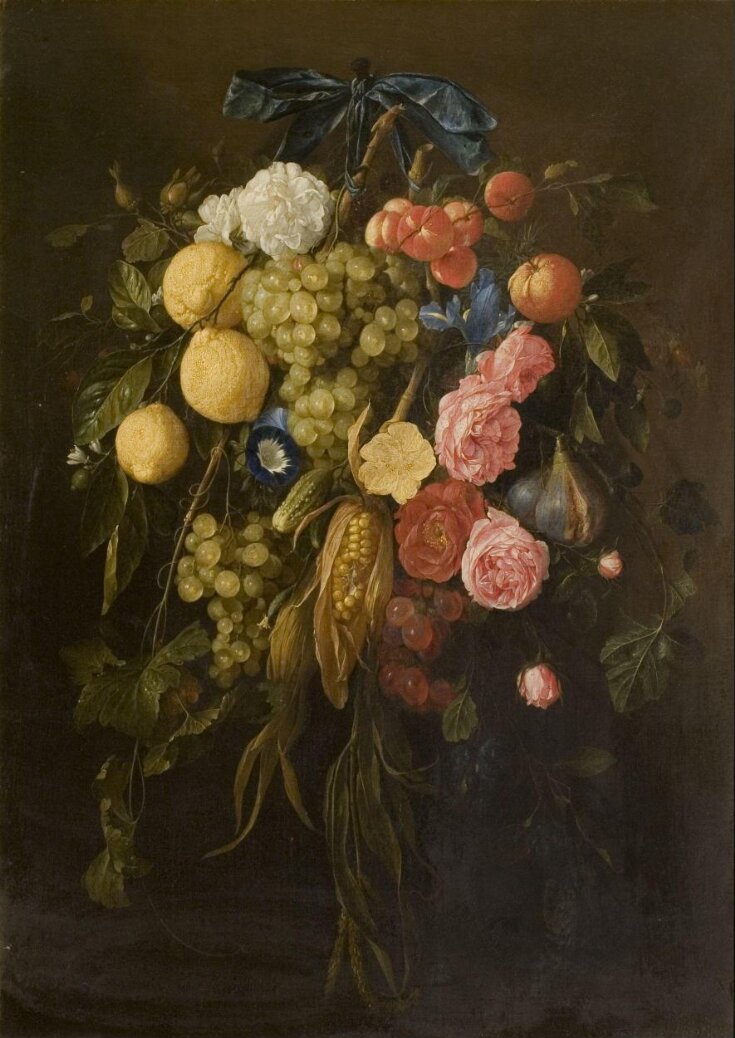
This painting shows a bunch of fruits and flowers tied to a nail by a blue ribbon and suspended against a neutral receding background that enables the festoon's colours to bright more intensely. The arrangement of fruits and flowers from different times of the year such as the orange usually grown during the winter and the figs from the end of the summer is typical of the artist's inventive trend that tend to combine every rare and precious items he could gather. The only incongruity is the lack of insects that usually creep across or fly around the composition. The freshness and the particularly realistic fruits and flowers contributed to Jan Davidsz. de Heem's popularity that made him one of the greatest 17th-century still-life painters. This painting is a good example of his ability to merge the colourful Flemish style with the relatively more sober and intimate traditional Dutch still-lifes, a genre painting that he began to execute in Leyden and developed chiefly in Antwerp from the 1640s onwards. This painting, signed and dated 1662, can be easily compared with similar compositions of the same period housed in the Museum Bredius and in the Musée des Beaux-Arts, Grenoble.
This painting shows a bunch of fruits and flowers tied to a nail by a blue ribbon and suspended against a neutral receding background that enables the festoon's colours to bright more intensely. The arrangement of fruits and flowers from different times of the year such as the orange usually grown during the winter and the figs from the end of the summer is typical of the artist's inventive trend that tend to combine every rare and precious items he could gather. The only incongruity is the lack of insects that usually creep across or fly around the composition. The freshness and the particularly realistic fruits and flowers contributed to Jan Davidsz. de Heem's popularity that made him one of the greatest 17th-century still-life painters. This painting is a good example of his ability to merge the colourful Flemish style with the relatively more sober and intimate traditional Dutch still-lifes, a genre painting that he began to execute in Leyden and developed chiefly in Antwerp from the 1640s onwards. This painting, signed and dated 1662, can be easily compared with similar compositions of the same period housed in the Museum Bredius and in the Musée des Beaux-Arts, Grenoble.
Object details
| Category | |
| Object type | |
| Parts | This object consists of 2 parts.
|
| Title | Fruit and flowers (generic title) |
| Materials and techniques | Oil on canvas |
| Brief description | Oil painting, 'Fruit and Flowers', attributed to Cornelis de Heem, 1662. |
| Physical description | A bunch of fruits and flowers tied to a nail by a blue ribbon and suspended against a neutral receding background. |
| Dimensions |
|
| Style | |
| Marks and inscriptions | 'HEEM, 1662' (Signed lower right) |
| Object history | Purchased, 1858 Historical significance: Althought he was born in Utrecht and trained in Leyden, Jan Davidsz de Heem settled in Antwerp as early as 1636, where he developed his popular still-life paintings. He is therefore often considered as part of the Flemish school. He imported in Antwerp his ability to render matter and textures and acted as a link between the somewhat sober still-life painters in the North and their more exuberant counterparts in the South. In his Teutsche Academie published in 1675, Joachim von Sandrart, a contemporary of the painter and born in the same year, reports that de Heem moved to Antwerp because, 'there one can have the rare fruits including all manner of large plums, peaches, apricots, sour oranges, lemons, grapes, and other, in better quality and ripeness, (so as to) to reproduce them from life'. This painting illustrates well de Heem's taste for displaying rare and precious food items, and is a good example of the brilliant synthesis of Dutch precision and Flemish Baroque. He had a great influence on the development of Netherlandish painting during the 17th century, especially his large sumptuous still-lifes of the 1640s made a profound impression and many painters tried to imitate his work. His influence was strongest in Utrecht, Leyden and Antwerp where he had many followers. He was considered by his contemporaries and is still praised as one of the greatest still-life painters. |
| Historical context | Still-life reached the height of its popularity in Western Europe, especially in the Netherlands during the 17th century even though still-life subjects already existed in pre-Classical, Classical and Renaissance art. The term conventionally refers to the type of work in which an arrangement of diverse inanimate objects including fruits and shellfishes, vessels and artefacts are depicted. Dutch painters played a major role in its development, inventing many distinctive variations on the theme over the course of the century. The greatest names are the Haarlem painters such as Pieter Claesz. (1597/98-1661) and Willem Claesz. Heda (1593/94-1680/82) specialized in depicting monochrome still-life with neutral tones whereas Willem Kalf from Rotterdam concentrated his attention on the representation of luxury goods in a limited however contrasted palette. Jan Davidsz. de Heem had a deep influence on the development of Netherlandish paintings by combining the colourful Flemish style with the relatively more sober and intimate traditional Dutch still-lifes. Still-life paintings include vanitas or memento mori pictures that bear a moral meaning, i.e. reminding pictures of the human mortality and invitation to a meditation upon the passage of time. By the late 17th century, artists were refining their technique to ever-greater virtuosity, finding markets for their skills throughout Europe. These pieces were still popular in the 18th century, especially the fruit and flowers ones. |
| Subjects depicted | |
| Summary | Jan Davidsz. de Heem (1606-1684) was born in Utrecht but trained in Leyden before settling in the early 1630s in Antwerp. He returned to Utrecht quite often and had there a workshop with collaborators and pupils, the most famous being Abraham Mignon. Two of his sons also became painters: Cornelis de Heem and Jan Jansz. de Heem. This painting shows a bunch of fruits and flowers tied to a nail by a blue ribbon and suspended against a neutral receding background that enables the festoon's colours to bright more intensely. The arrangement of fruits and flowers from different times of the year such as the orange usually grown during the winter and the figs from the end of the summer is typical of the artist's inventive trend that tend to combine every rare and precious items he could gather. The only incongruity is the lack of insects that usually creep across or fly around the composition. The freshness and the particularly realistic fruits and flowers contributed to Jan Davidsz. de Heem's popularity that made him one of the greatest 17th-century still-life painters. This painting is a good example of his ability to merge the colourful Flemish style with the relatively more sober and intimate traditional Dutch still-lifes, a genre painting that he began to execute in Leyden and developed chiefly in Antwerp from the 1640s onwards. This painting, signed and dated 1662, can be easily compared with similar compositions of the same period housed in the Museum Bredius and in the Musée des Beaux-Arts, Grenoble. |
| Bibliographic references |
|
| Collection | |
| Accession number | 4641-1858 |
About this object record
Explore the Collections contains over a million catalogue records, and over half a million images. It is a working database that includes information compiled over the life of the museum. Some of our records may contain offensive and discriminatory language, or reflect outdated ideas, practice and analysis. We are committed to addressing these issues, and to review and update our records accordingly.
You can write to us to suggest improvements to the record.
Suggest feedback
You can write to us to suggest improvements to the record.
Suggest feedback
| Record created | February 27, 2007 |
| Record URL |
Download as: JSONIIIF Manifest
