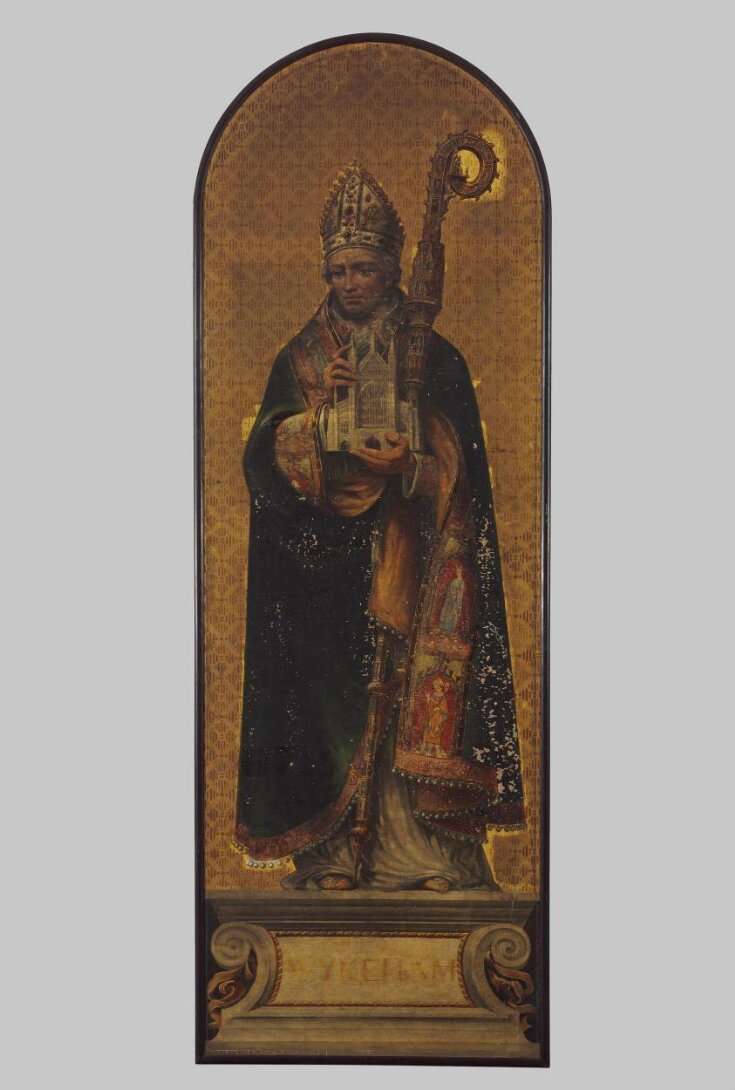
William of Wykeham
Oil Painting
ca. 1867 (painted)
ca. 1867 (painted)
| Artist/Maker |
Kensington Valhalla portrait of William of Wykeham
Object details
| Categories | |
| Object type | |
| Titles |
|
| Materials and techniques | Oil on canvas |
| Brief description | Oil painting, 'William of Wykeham' (design for the Kensington Valhalla), Richard Burchett, about 1866-7 |
| Physical description | Kensington Valhalla portrait of William of Wykeham |
| Dimensions |
|
| Style | |
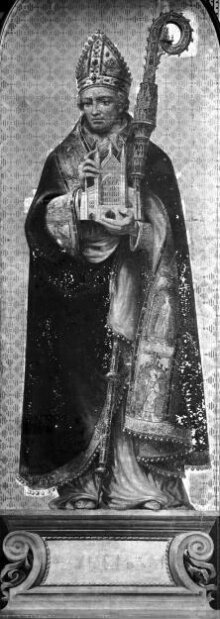
| Object history | Commissioned for the decoration of the South Court of the South Kensington Museum Historical significance: William of Wykeham (1324-1404) was twice Chancellor of England, Bishop of Winchester, and founder of Winchester College and New College Oxford. One of the greatest figures in the arts of his day, he was patron of the rebuilding of the nave of Winchester Cathedral. Work to transform the Norman nave at Winchester was undertaken by the Master Mason William Wynford, but Burchett presents Wykeham as the 'architect' in the wider sense of the word. Wykeham is one of three architects in this series of great artists: the others are Inigo Jones and Sir Christopher Wren. Wykeham is represented by Burchett in the traditional manner of a bishop-saint, holding his crosier and a model of his cathedral. The likeness of Wykeham is probably taken from a mezzotint of around 1710-20 by John Faber Sr, which ultimately derives from his tomb effigy in Winchester Cathedral. Richard Burchett (1815-1875) studied art at Birkbeck Mechanics Institute in Chancery Lane, London. In about 1841, he joined the Government School of Design at Somerset House, becoming an Assistant Master in 1845. In 1851, after the School's move to South Kensington, he was appointed Headmaster of the Department of Practical Art. He exhibited five works at the RA between 1847 and 1873. He worked on the decorations of the Palace of Westminster 1855-9, the dome of the 1862 Great Exhibition building, and painted a window for the Greenwich Hospital. Burchett was primarily a teacher and administrator; his portrait appears alongside Henry Cole's in Val Prinsep's painting The Distribution of Art Prizes. Burchett was given two medieval English subjects, William of Wykeham and William Torel. |
| Historical context | Commissioned between 1862 and 1871, the 'Kensington Valhalla' (so named by The Builder, an allusion to the eternal home of heroes in Norse mythology) is a series of life-size portraits of famous artists. These portraits, executed in mosaic, were made to fit into the arcade niches that ran round the upper level of the South Court of the Museum. The Valhalla included not only painters and sculptors, such as Leonardo, Michelangelo and Donatello, but also figures from the applied arts such as the potter Bernard Palissy. The project had a self-validatory function: it reflected the established canon of great artists, predominantly those of the Italian Renaissance, whose work the museum was collecting where possible. But by including craftsmen within the pantheon, Henry Cole and the South Kensington Museum modified and expanded this canon, asserting their belief in the connection between the fine and applied arts - a tenet which lay at the heart of the institution. A number of established contemporary artists were approached to produce highly-finished oil-painted portraits on which the mosaics could be based. As early as January 1862, Daniel Maclise was offered a payment of £70, although his name does not figure among the artists whose work was eventually translated into mosaic. Also invited but not ultimately to participate were William Holman Hunt, Ford Madox Brown and, perhaps most surprisingly, James McNeill Whistler. Of the participants, Frederic Leighton, E.J. Poynter and G.F. Watts were the highest profile painters commissioned for the project, with Val Prinsep, F. R. Pickersgill, Charles West Cope, Eyre Crowe and William Frederick Yeames, all historical genre painters, in the next rank. In addition to these external commissions, a high proportion - almost a third - of the artists involved in the project were employed by the Museum or the School of Art. Godfrey Sykes, who designed two portraits (although only one was used), had been recruited by Henry Cole in 1859 to assist with decorative schemes, and became a key figure in the decoration of the Museum buildings; he devised the elaborate scheme of decoration in the South Court. Sykes's principal assistants, Reuben Townroe and James Gamble, both designed Valhalla portraits (although only Townroe's was used). Francis Moody, who designed three portraits, was employed at the Museum as another of Sykes's assistants, helping to carry out the decoration of the Museum and heading a team of student workers. Richard Burchett, who designed four portraits, was the Headmaster of the Art School at South Kensington, and Eyre Crowe, who designed two, had acted since 1859 as occasional examiner and inspector there. Richard Redgrave, responsible for one portrait, was the first Keeper of the paintings collection at the Museum, and held several positions in the Art School including Headmaster. Henry Bowler, also responsible for one portrait, was the Museum's Inspector for Art then later Assistant Director for Art. William Bell Scott, who had taught at the Department of Science and Art-run Newcastle School of Art for twenty years, acted as an examiner in the 1860s. The Valhalla itself includes many famous artists, but there are also one or two of some obscurity. Phidias and Apelles were the pre-eminent sculptor and painter of Greek Antiquity. The rest are European artists of the Middle Ages and later, mostly painters. The sculptors include Nicola Pisano, Ghiberti, Donatello, Luca della Robbia, who specialised in glazed and coloured terracotta sculpture, Michelangelo and the English Grinling Gibbons. Jean Goujon was a 16th-century French sculptor who worked on the earliest part of the Louvre. There are only three architects, and all, oddly, are English: William of Wykeham (who was in fact a patron of architects rather than a practitioner), Inigo Jones and Sir Christopher Wren. There are also three ceramic artists. Fra Beato Giacomo da Ulma seems almost unknown in art history outside this Valhalla, but is said to have been a Dominican Friar of the late 15th and early 16th centuries who painted on glass at Bologna. Better documented are the majolica painter Maestro Giorgio of Gubbio and Bernard Palissy, the French potter of the 16th century, known for his enamelled earthenware encrusted with modelled reptiles. Three metalworkers might equally well be regarded as sculptors: William Torrel, who made the bronze effigies of Henry II and Queen Eleanor in Westminster Abbey in the 1290s; Torrigiano, the Italian Renaissance sculptor who made the monument to Henry VII and his Queen in the Henry VII Chapel in Westminster Abbey; and Peter Vischer of Nuremberg, who made the bronze monument to St Sebald, in the church of St Sebald in Nuremberg. Netherlandish art is represented solely by Lancelot Blondeel, sculptor and painter of Bruges; a design for a portrait of Jan van Eyck by Francis Moody seems never to have been executed. There are ten Italian painters of the Renaissance; one German, Hans Holbein; and one Spanish, Velásquez. The two English painters are Hogarth and Reynolds. Where possible, artists were matched with sitters appropriate to their own work. So Leighton was commissioned to paint Cimabue, the subject of his first major work, Cimabue's Madonna carried through Florence which had brought his work to prominence for the first time when it was shown at the Royal Academy in 1855; Edward Armitage, a vigorous promoter of mural painting, was commissioned to paint the greatest muralist of the Italian Renaissance, Benozzo Gozzoli; and Poynter, who had made his name with compositions of classical subjects, was matched with the Ancient Greeks Apelles and Phidias. Because of the uniformity demanded by a large portrait series, the artists' poses and gestures are mostly invented. The faces, hair and headgear are mostly derived, or adapted, from printed sources, in particular the woodcuts which illustrate Vasari's Lives of the Artists, or in the case of later artists, engravings after portraits or self-portraits. The costume details of the Italian Renaissance artists are taken from one of the published compilations of historical costume which were popular with historical genre painters, whilst the costumes of later artists is usually taken from printed portraits. The mosaics themselves remained in place in the South Court until 1949, when they were taken down and stored. Some are now on display in other galleries of the museum. Currently the paintings made as full-scale designs for these mosaics are displayed in various locations in the Museum, including the Lecture Theatre, the staircase to the west of the Grand Entrance and the landing outside the entrance to the National Art Library. |
| Associated object | |
| Bibliographic references |
|
| Collection | |
| Accession number | P.15-1934 |
About this object record
Explore the Collections contains over a million catalogue records, and over half a million images. It is a working database that includes information compiled over the life of the museum. Some of our records may contain offensive and discriminatory language, or reflect outdated ideas, practice and analysis. We are committed to addressing these issues, and to review and update our records accordingly.
You can write to us to suggest improvements to the record.
Suggest feedback
You can write to us to suggest improvements to the record.
Suggest feedback
| Record created | February 12, 2007 |
| Record URL |
Download as: JSONIIIF Manifest
