


Evening Coat
1960s (made)
| Artist/Maker | |
| Place of origin |
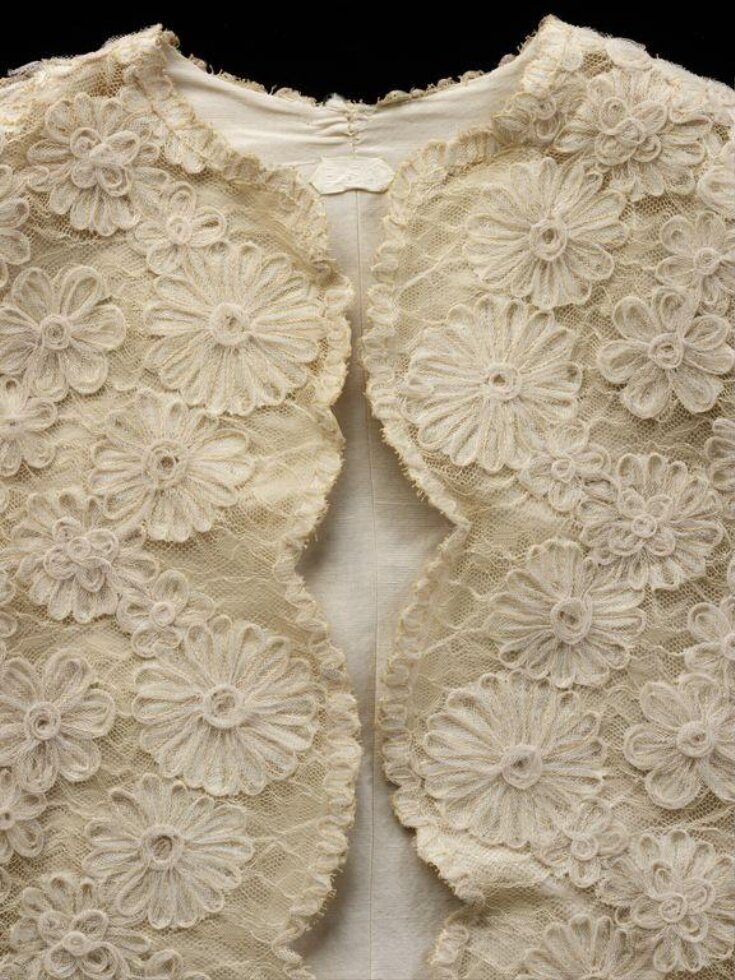
This evening coat is a typical example of three-dimensional embroidered decoration applied to a very simply cut coat, as designed and made in Balenciaga's couture houses in late 1950s and 1960s. Although most of the clothes sold in Madrid echoed the pioneering designs shown in Paris each season, this particular piece seems to have been particular to the Spanish house. Originally, it had no ostrich feather trim around the sleeves, the only decorative edging being a scalloped finish like that round the front and neck edge.
This evening coat belonged to the film star Ava Gardner who died in 1991. It has a label with the word EISA sewn in at the back of the neck. EISA was the label under which Balenciaga's three houses in Spain (Barcelona, Madrid and San Sebastian) traded. Ava Gardner lived in Madrid for a number of years, and is known to have socialised in the infamous cafe Chicote as well as Balenciaga's premises across the road at Gran Via 9.
This evening coat belonged to the film star Ava Gardner who died in 1991. It has a label with the word EISA sewn in at the back of the neck. EISA was the label under which Balenciaga's three houses in Spain (Barcelona, Madrid and San Sebastian) traded. Ava Gardner lived in Madrid for a number of years, and is known to have socialised in the infamous cafe Chicote as well as Balenciaga's premises across the road at Gran Via 9.
Object details
| Categories | |
| Object type | |
| Materials and techniques | Silk organza, ostrich feathers and net with applied pattern of net rouleaux |
| Brief description | Cream-coloured full-length evening coat, designed by Cristóbal Balenciaga for Eisa, designed in Paris, probably made in Madrid, 1960s |
| Physical description | Cream-coloured full-length evening coat with three-quarter length sleeves which are trimmed with pinky ostrich feathers. The net base is covered in flowers and 'grapes' which have been tamboured into place giving the surface a three dimensional quality. The edges of the coat (neck, front opening and hemline) have a scalloped edge. The net outer layer is attached to a silk organza lining. The designer's label is sewn on behind the neck - it is the white version of the EISA label. |
| Production type | Haute couture |
| Marks and inscriptions | 'Eisa' (Label sewn on behind the neck) |
| Gallery label | Evening coat
Net and ostrich feathers, lined with silk organza
Cristóbal Balenciaga (Eisa label), Madrid, about 1964
Given by Mrs Beatrice Cole and Mrs Myra Pearce, in memory of Miss Ava Gardner
V&A: T.294-1990(12/05/2017) |
| Credit line | Given by Mrs Beatrice Cole and Mrs Myra Pearce, in memory of Miss Ava Gardner |
| Object history | Registered File number 1990/1420. Given to the museum after Hollywood actress Ava Gardner's death by Mrs Myra Pearce in her memory; along with four other evening gowns. The actress Ava Gardner (1922-90) moved to Madrid in the 1950s. She found Spain ‘unspoiled . . . dramatic . . . and so god-damn cheap to live in, that it was almost unbelievable’. She bought Balenciaga designs both in Paris and at Eisa, which may have appealed to what she called her ‘frugal side’. Gardner moved from Madrid to London in 1968, living around the corner from the V&A until her death in 1990. She donated several items of clothing to the museum before her death and made provision for a further selection to be made by the Museum afterwards. Gardner referred to her couture garments as her ‘babies’ and insisted on opening her wardrobes daily to let them ‘breathe’. If the cost of his Paris salon was out of reach, there were other ways to buy a Balenciaga design. Some were sold less expensively under Balenciaga’s label Eisa in Spain, where labour costs were lower and cheaper fabrics might be used. The coat carries a label, EISA. This was the label under which Balenciaga worked in Spain; the client resided in Madrid and was known to move in social circles that congregated around the cafe Chicote (opposite Balenciaga's premises) in Madrid. Historical significance: Significant because of association with a known wearer who clearly adapted the coat from the original design by adding a new trim, and because it seems to be an example of a garment (or textile) that was peculiar to the Madrid house of Balenciaga. In the Archives Balenciaga in Paris, no example of exactly the same design is available. The scalloped edge and cut are similar to a coat in the autumn/winter collections in Paris in 1964, but the fabric is totally different. |
| Historical context | Cristóbal Balenciaga was one of the major couturier of the 20th century, especially post war in the 1950s and 1960s. He was unusual among couturiers for running a house in Paris (from 1937) and three houses in Spain (in Barcelona, Madrid and San Sebastian). The houses in Spain probably benefited from the influx of Americans after the War when the Hollywood film industry discovered the benefits of using Spain as a filming location. Ava Gardner was one American who became devoted to Spain, moving to Madrid in the early 1950s and living there until moving to London, where she lived in South Kensington not far from the V&A, a museum she appreciated. She ordered clothes from both Balenciaga's Paris house and Madrid house. Those from the latter would have cost her substantially less then those from former. This coat is probably that worn in a photograph published in Miller (1993 and 2007) although the coat in that photograph does not have an ostrich trim round the sleeves. |
| Production | Attribution note: designed in Paris, made in Madrid. |
| Subjects depicted | |
| Association | |
| Summary | This evening coat is a typical example of three-dimensional embroidered decoration applied to a very simply cut coat, as designed and made in Balenciaga's couture houses in late 1950s and 1960s. Although most of the clothes sold in Madrid echoed the pioneering designs shown in Paris each season, this particular piece seems to have been particular to the Spanish house. Originally, it had no ostrich feather trim around the sleeves, the only decorative edging being a scalloped finish like that round the front and neck edge. This evening coat belonged to the film star Ava Gardner who died in 1991. It has a label with the word EISA sewn in at the back of the neck. EISA was the label under which Balenciaga's three houses in Spain (Barcelona, Madrid and San Sebastian) traded. Ava Gardner lived in Madrid for a number of years, and is known to have socialised in the infamous cafe Chicote as well as Balenciaga's premises across the road at Gran Via 9. |
| Bibliographic references |
|
| Collection | |
| Accession number | T.294-1990 |
About this object record
Explore the Collections contains over a million catalogue records, and over half a million images. It is a working database that includes information compiled over the life of the museum. Some of our records may contain offensive and discriminatory language, or reflect outdated ideas, practice and analysis. We are committed to addressing these issues, and to review and update our records accordingly.
You can write to us to suggest improvements to the record.
Suggest feedback
You can write to us to suggest improvements to the record.
Suggest feedback
| Record created | February 7, 2007 |
| Record URL |
Download as: JSON
