
L'Amour Moissonneur
Oil Painting
mid 19th century (painted)
mid 19th century (painted)
| Artist/Maker | |
| Place of origin |
François Boucher (1703-1770) was born in Paris and probably received his first artistic training from his father who was a painter before attending the Académie de France in Rome. He may also have travelled to Naples, Venice and Bologna. Around 1731 Boucher returned to Paris where he rapidly gained the royal favour and interest from the private collectors. He was a very prolific artist and produced a wide range of artworks from pastoral paintings, porcelain and tapestry designs as well as stage designs influencing deeply the new Rococo movement.
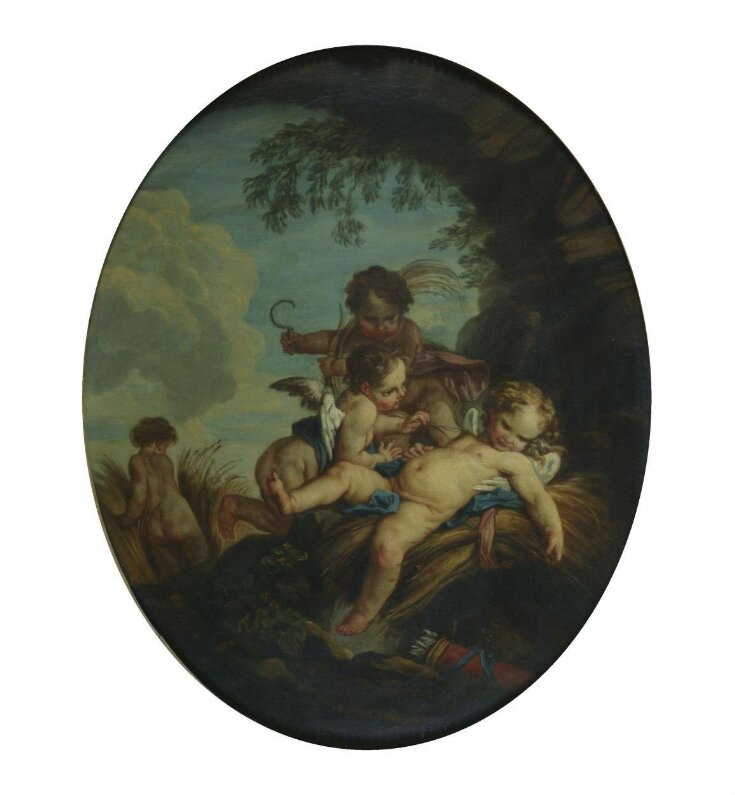
This painting is a copy after a composition currently in the Museum of Fine Arts, Houston. It represents amorini teasing each other in a wheat field and is intended as an allegory of Summer. The original painting was in fact part of a cycle representing allegories of the four seasons. This work is a fine example of the early career of Boucher, who already pervaded his oeuvre with mischievous pastoral scenes which would become the hallmark of his art and eventually of the whole Rococo period.
This painting is a copy after a composition currently in the Museum of Fine Arts, Houston. It represents amorini teasing each other in a wheat field and is intended as an allegory of Summer. The original painting was in fact part of a cycle representing allegories of the four seasons. This work is a fine example of the early career of Boucher, who already pervaded his oeuvre with mischievous pastoral scenes which would become the hallmark of his art and eventually of the whole Rococo period.
Object details
| Category | |
| Object type | |
| Titles |
|
| Materials and techniques | Oil on canvas |
| Brief description | Oil painting, 'L'Amour Moissonneur (Cherub Harvesters)', after François Boucher, mid 19th century |
| Physical description | Cherubs teasing each other in a wheat field, one of them is shown asleep on a bundle, his quiver lying on the ground while other two are tickling him with a straw. |
| Dimensions |
|
| Styles | |
| Credit line | Bequeathed by John Jones |
| Object history | Bequeathed by John Jones, 1882 Ref : Parkinson, Ronald, Catalogue of British Oil Paintings 1820-1860. Victoria & Albert Museum, HMSO, London, 1990. p.xix-xx John Jones (1800-1882) was first in business as a tailor and army clothier in London 1825, and opened a branch in Dublin 1840. Often visited Ireland, travelled to Europe and particularly France. He retired in 1850, but retained an interest in his firm. Lived quietly at 95 Piccadilly from 1865 to his death in January 1882. After the Marquess of Hertford and his son Sir Richard Wallace, Jones was the principal collector in Britain of French 18th century fine and decorative arts. Jones bequeathed an important collection of French 18th century furniture and porcelain to the V&A, and among the British watercolours and oil paintings he bequeathed to the V&A are subjects which reflect his interest in France. See also South Kensington Museum Art Handbooks. The Jones Collection. With Portrait and Woodcuts. Published for the Committee of Council on Education by Chapman and Hall, Limited, 11, Henrietta Street. 1884. Chapter I. Mr. John Jones. pp.1-7. Chapter II. No.95, Piccadilly. pp.8-44. This gives a room-by-room guide to the contents of John Jones' house at No.95, Piccadilly. Chapter VI. ..... Pictures,... and other things, p.138, "The pictures which are included in the Jones bequest are, with scarcely a single exception, valuable and good; and many of them excellent works of the artists. Mr. Jones was well pleased if he could collect enough pictures to ornament the walls of his rooms, and which would do no discredit to the extraordinary furniture and other things with which his house was filled." Historical significance: This painting is a copy after a composition by François Boucher formerly in the Rothschild collection, Paris and currently in the Museum of Fine Arts, Houston (BF.1988.5). The painting depicts naked amorini or cherubs teasing each other in a wheat field, one of them is shown asleep on a bundle, his quiver lying on the floor while other two are trying to wake him up. The composition appears in reverse, which suggests that 494-1882 was not made after the original painting but after the engraving made by Bernard François Lépicié in 1734 (Cabinet des dessins, Louvre, Paris, Inv. 18855L.R). Although the Houston painting is square, the present copy was painted in an oval. However another version of The Cherub Harvesters square in format, signed and dated 1731, is also known and was formerly in the Contini-Bonacossi in Florence. The original painting was originally part of a set of four large paintings made by Boucher for the lawyer François Derbais (Boucher, 1986) upon his return from Rome. Among these were the Houston painting, The Cherub Fowlers (formerly in private collection, Switzerland), The Cherub Swimmers (a version of which is known at Weddeston Manor, England) and The Cherub Grape-Pickers (Private collection, Switzerland). They formed altogether representations of the four seasons: The Cherub Harvesters is clearly a representation of summer, whose traditional attribute is wheat. As such they may have been made as decorative panels to be inserted in the ceiling or over doors. 594-1882 forms a pendant with 595-1882 which is a copy after The Cherub Fowlers. Boucher’s The Cherub Harvesters and The Cherub Fowlers were indeed engraved by Bernard François Lépicié in 1734 and these engravings, interpreted as a set, most likely served as models for the V&A paintings. The other two paintings of the cycle were also engraved however by different artists: The Cherub Grape-Pickers by Fessart in 1741 and The Cherub Swimmers by Sornique and Aveline in 1741. A tapestry derived from The Cherub Harvesters also appeared on the art market at the sale of the C. Lelong collection, Paris, 27 Apr.-1 May 1903. These paintings from Boucher’s early career anticipates somehow the pastoral imagery pervaded with putti, mythological figures, shepherds and shepherdesses in idyllic landscapes that would contribute to characterised the Rococo movement, of which Boucher became one of the greatest exponents. These clearly late copies may have been done during the Rococo revival in the first half of the 19th century. |
| Historical context | Pastoral is a genre of painting whose subject is the idealized life of shepherds and shepherdesses set in an ideally beautiful and idyllic landscape. These scenes are reminiscent of the Arcadia, the Antique Golden Age that the Roman author Virgil (1St BC) described in the Eclogues and were at the time illustrated on the Roman wall paintings. The pastoral was reborn during the Renaissance, especially in Venice, in the oeuvre of such painters as Titian (ca. 1488-1576) and Giorgione (1477-1510), and gradually evolved over the centuries. In the 17th century in fact, the Arcadian themes were illustrated in the Roman school led by the painter Claude Lorrain (1604-1682) whereas a century later, Antoine Watteau (1684-1721) and his followers forged the new genre of fêtes galantes, which appears as a derivation of the pastoral. The pastoral became the hallmark of the Rococo movement in which François Boucher's (1703-1770) elegant eroticism found his true expression. This tradition, which had became an illustration of the carefree aristocratic world, died with the French revolution and was never revived although the celebration of the timeless Mediterranean world in the oeuvre of such painter as Henri Matisse (1869-1954) may be seen as a continuing interest for the theme. |
| Subjects depicted | |
| Summary | François Boucher (1703-1770) was born in Paris and probably received his first artistic training from his father who was a painter before attending the Académie de France in Rome. He may also have travelled to Naples, Venice and Bologna. Around 1731 Boucher returned to Paris where he rapidly gained the royal favour and interest from the private collectors. He was a very prolific artist and produced a wide range of artworks from pastoral paintings, porcelain and tapestry designs as well as stage designs influencing deeply the new Rococo movement. This painting is a copy after a composition currently in the Museum of Fine Arts, Houston. It represents amorini teasing each other in a wheat field and is intended as an allegory of Summer. The original painting was in fact part of a cycle representing allegories of the four seasons. This work is a fine example of the early career of Boucher, who already pervaded his oeuvre with mischievous pastoral scenes which would become the hallmark of his art and eventually of the whole Rococo period. |
| Associated object | 495-1882 (Set) |
| Bibliographic references |
|
| Collection | |
| Accession number | 494-1882 |
About this object record
Explore the Collections contains over a million catalogue records, and over half a million images. It is a working database that includes information compiled over the life of the museum. Some of our records may contain offensive and discriminatory language, or reflect outdated ideas, practice and analysis. We are committed to addressing these issues, and to review and update our records accordingly.
You can write to us to suggest improvements to the record.
Suggest feedback
You can write to us to suggest improvements to the record.
Suggest feedback
| Record created | February 5, 2007 |
| Record URL |
Download as: JSONIIIF Manifest
