Miniature Dress
ca. 1950 (made)
| Artist/Maker | |
| Place of origin |
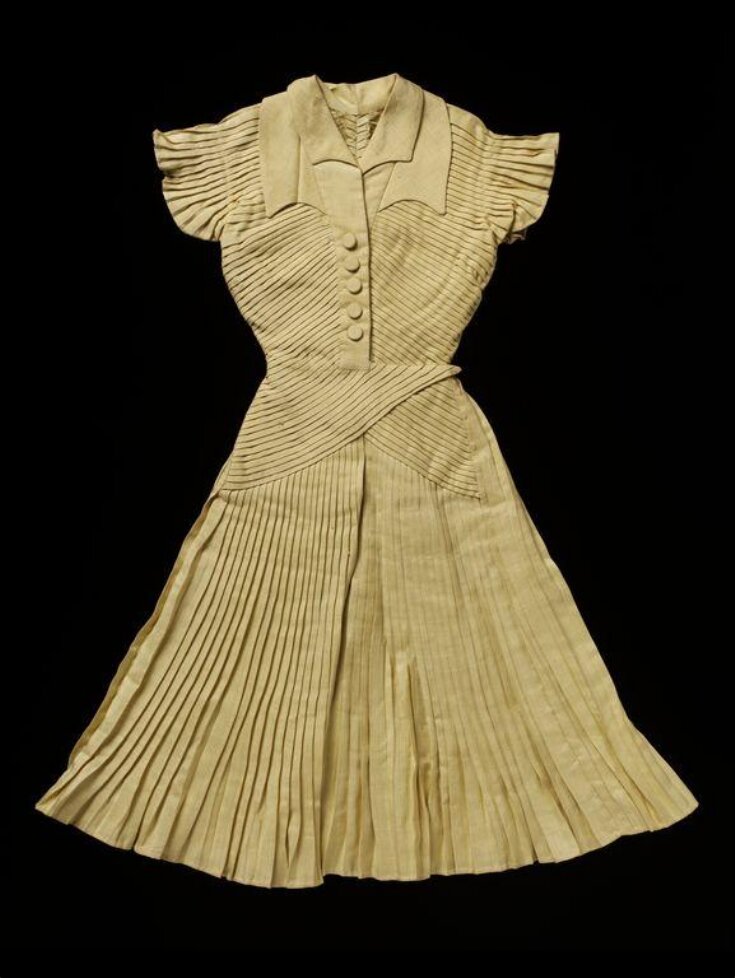
This is a quarter-scale couture reproduction of a late 1940s Jacques Fath afternoon dress. Fath designed his clothes to emphasise and flatter the feminine figure. Here, tightly pleated yellow silk tussah clings about the hips, flares out at the hemline, and lends elasticity to the small-waisted bodice.
These scaled copies use the same fabrics and show the same superb craftsmanship as their full size equivalents. We have four of these miniature dresses which the donor acquired from the archive of the wholesale house of Dorville. Wholesalers would buy the copyrights to couture dresses so that they could sell modified ready-to-wear copies. It is thought that these quarter-scale dresses were sold alongside the patterns to show how the dress looked when made up.
These scaled copies use the same fabrics and show the same superb craftsmanship as their full size equivalents. We have four of these miniature dresses which the donor acquired from the archive of the wholesale house of Dorville. Wholesalers would buy the copyrights to couture dresses so that they could sell modified ready-to-wear copies. It is thought that these quarter-scale dresses were sold alongside the patterns to show how the dress looked when made up.
Object details
| Categories | |
| Object type | |
| Materials and techniques | Pleated silk, hand and machine sewn |
| Brief description | Miniature afternoon dress designed by Jacques Fath, late 1940s |
| Physical description | Miniature afternoon dress. Yellow silk tussah, entirely pleated except for double collar and front bodice facings. Yoke extended from front facings to double as collar. Five covered buttons down front facing, concealing press studs. No armscye seam, shoulder fabric of bodice horizontally knife pleated with cap sleeves incorporated. These are held in place with tape attached to interior. Waist seam straight across front, but U-curve in behind. Pleating of bodice, front and back, radiating sunray-style with collar as focus. Front of hips of skirt feature overlapping panels of curved knife-pleated fabric, top layer held in place with a snap at left hip.Pleating of skirt causes hem to flare out. Unlined except for panels on skirt and reinforcing tape on armscyes. |
| Dimensions |
|
| Production type | Haute couture |
| Marks and inscriptions | '54' (Handwritten number on linen tape inside skirt) |
| Gallery label | [Ready-to-wear Vitrine]
Licensed miniature models
Various couturiers for Dorville
London
About 1950
These dresses were made for the wholesale company Dorville to show what the garments would look like without the expense of a full size model.
1. Cocktail dress and jacket in fine wool with polka dot silk
Christian Dior (1905-57)
V&A: T.18:1, 2-2007
2. Day dress in pleated silk tussah
Jacques Fath (1912-54)
V&A: T.19-2007
3. Evening dress in silk jersey
Madame Grès (1903-93)
V&A: T.20:1-2007
All given by David Sassoon(22/09/2007-06/01/2008) |
| Credit line | Given by Mr David Sassoon |
| Object history | Given by David Sassoon of Bellville Sassoon Lorcan Mullany, who acquired these from the ready to wear house of Dorville in the early-mid-1970s. Historical significance: Fascinating example of miniature couture dressmaking from the period. |
| Historical context | According to donor, these dresses were bought with the toiles by wholesale companies who copied and adapted these dresses for the ready to wear market. During the post-war fabric shortages, items such as this would have provided a way to show a wholesale-purchaser what the dress looked like without the expense of making a full-size dress with all the attendant usage of fabric. The ready to wear houses and representatives would buy couture models to reproduce and copy. An early theory was that the dress was intended for the Théâtre de la Mode travelling exhibitions (of 1944 and 1946),but didn't make the final cut. Théâtre de la Mode was intended to show the world that Paris still had mastery over dressmaking and couture, and featured quarter-scale dolls dressed in the very best miniature garments that Paris could procure. A connection is unlikely, as while the dress demonstrates superb couture craftsmanship and perfect miniature scaling, it does not appear it would fit one of the very small-waisted Théâtre de la Mode mannikins, making the theory unpalpable. The Maryland Museum, who own the 1946 Théâtre de la Mode mannikins, have confirmed that these objects are not connected to the Théâtre de la Mode. What is clear is that they are amazingly well-made, beautifully hand-finished, exact scale models of couture dresses, using the same fabrics as their full size equivalents. |
| Summary | This is a quarter-scale couture reproduction of a late 1940s Jacques Fath afternoon dress. Fath designed his clothes to emphasise and flatter the feminine figure. Here, tightly pleated yellow silk tussah clings about the hips, flares out at the hemline, and lends elasticity to the small-waisted bodice. These scaled copies use the same fabrics and show the same superb craftsmanship as their full size equivalents. We have four of these miniature dresses which the donor acquired from the archive of the wholesale house of Dorville. Wholesalers would buy the copyrights to couture dresses so that they could sell modified ready-to-wear copies. It is thought that these quarter-scale dresses were sold alongside the patterns to show how the dress looked when made up. |
| Collection | |
| Accession number | T.19-2007 |
About this object record
Explore the Collections contains over a million catalogue records, and over half a million images. It is a working database that includes information compiled over the life of the museum. Some of our records may contain offensive and discriminatory language, or reflect outdated ideas, practice and analysis. We are committed to addressing these issues, and to review and update our records accordingly.
You can write to us to suggest improvements to the record.
Suggest feedback
You can write to us to suggest improvements to the record.
Suggest feedback
| Record created | January 24, 2007 |
| Record URL |
Download as: JSON
