
Temple cloth
Temple Cloth
19th century (made)
19th century (made)
| Artist/Maker | |
| Place of origin |
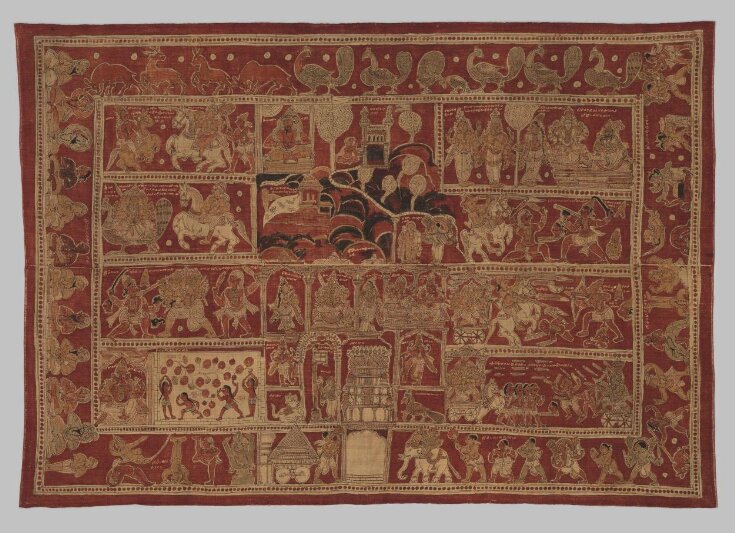
A large painted cotton (kalamkari) cloth designed for hanging in Hindu temples during religious festivals. This cloth, according to its Tamil inscriptions as translated by Dr Mangalam Mathrubutham, depicts the Subrahmanya temple at Tirupparankunram, Madurai. This is denoted by the temple gate-tower (gopura) in the lower register, flanked by a temple car (ratha), awaiting decoration in the next annual temple festival. These cloths are both decorative and instructional, recounting great events from the epic literature of Hinduism for the benefit of the devotees who would have an opportunity to enjoy and study them whilst waiting for their turn to see the icon of the god (‘take darshana’) in the temple sanctuary.
This example has a central assembly of five presiding deities: Devayani Amman, Subrahmanayasvami, Valli Amman, Durgai Amman and Vigheshvara. The
composition is organised into four registers in which selected scenes from the exploits of Subramanyana, otherwise known as Skanda (Sanskrit) or Murgan (Tamil), the god of war. Glosses written in Tamil accompany each scene identifying the episode depicted. For example, a battle scene centre-right depicts Arumurugan battling Simhamukhasura, a powerful demon. Other battle scenes occupy further panels. Murugan is seen on his peacock vahana upper-left, and so on. The border design has a recurring design of animals – peacocks and deer – and Hindu holymen (rishis), some meditating, some in discourse and others performing yogic austerities in a variety of remarkable (and often acrobatic) postures.
This example has a central assembly of five presiding deities: Devayani Amman, Subrahmanayasvami, Valli Amman, Durgai Amman and Vigheshvara. The
composition is organised into four registers in which selected scenes from the exploits of Subramanyana, otherwise known as Skanda (Sanskrit) or Murgan (Tamil), the god of war. Glosses written in Tamil accompany each scene identifying the episode depicted. For example, a battle scene centre-right depicts Arumurugan battling Simhamukhasura, a powerful demon. Other battle scenes occupy further panels. Murugan is seen on his peacock vahana upper-left, and so on. The border design has a recurring design of animals – peacocks and deer – and Hindu holymen (rishis), some meditating, some in discourse and others performing yogic austerities in a variety of remarkable (and often acrobatic) postures.
Object details
| Categories | |
| Object type | |
| Title | Temple cloth (generic title) |
| Materials and techniques | Painted cotton |
| Brief description | Kalamkari temple cloth of hand-painted cotton depicting Sri Subrahmanyasvami Temple, Tirupparankunram, made in the Madurai area, Tamil Nadu, 19th century |
| Physical description | Brahmanical temple cloth of coarse cotton fabric painted, chiefly in red and black, with representations of various Hindu deities, depicting scenes of the life of subrahmanya, mythological battle scenes and a view of the Thiruparankundram Hills in Madurai. Rectangular cotton textile painted with figures in red and black dyes. |
| Dimensions |
|
| Marks and inscriptions | (Inscriptions are in Tamil) |
| Credit line | Purchased from Alfred Fleming (Dealer), 53 Castle Road, Southsea, Portsmouth |
| Subject depicted | |
| Summary | A large painted cotton (kalamkari) cloth designed for hanging in Hindu temples during religious festivals. This cloth, according to its Tamil inscriptions as translated by Dr Mangalam Mathrubutham, depicts the Subrahmanya temple at Tirupparankunram, Madurai. This is denoted by the temple gate-tower (gopura) in the lower register, flanked by a temple car (ratha), awaiting decoration in the next annual temple festival. These cloths are both decorative and instructional, recounting great events from the epic literature of Hinduism for the benefit of the devotees who would have an opportunity to enjoy and study them whilst waiting for their turn to see the icon of the god (‘take darshana’) in the temple sanctuary. This example has a central assembly of five presiding deities: Devayani Amman, Subrahmanayasvami, Valli Amman, Durgai Amman and Vigheshvara. The composition is organised into four registers in which selected scenes from the exploits of Subramanyana, otherwise known as Skanda (Sanskrit) or Murgan (Tamil), the god of war. Glosses written in Tamil accompany each scene identifying the episode depicted. For example, a battle scene centre-right depicts Arumurugan battling Simhamukhasura, a powerful demon. Other battle scenes occupy further panels. Murugan is seen on his peacock vahana upper-left, and so on. The border design has a recurring design of animals – peacocks and deer – and Hindu holymen (rishis), some meditating, some in discourse and others performing yogic austerities in a variety of remarkable (and often acrobatic) postures. |
| Bibliographic references |
|
| Collection | |
| Accession number | IM.29-1911 |
About this object record
Explore the Collections contains over a million catalogue records, and over half a million images. It is a working database that includes information compiled over the life of the museum. Some of our records may contain offensive and discriminatory language, or reflect outdated ideas, practice and analysis. We are committed to addressing these issues, and to review and update our records accordingly.
You can write to us to suggest improvements to the record.
Suggest feedback
You can write to us to suggest improvements to the record.
Suggest feedback
| Record created | January 5, 2007 |
| Record URL |
Download as: JSONIIIF Manifest
