
Towel
15th century to 16th century (made)
| Artist/Maker | |
| Place of origin |
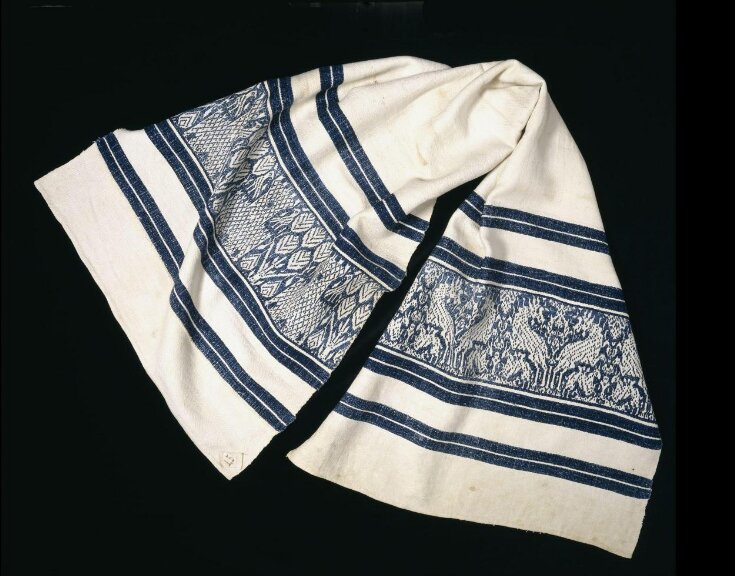
The name usually given in English to textiles like these is 'Perugia towels', deriving from tovaglie perugine. Tovaglia is usually translated as tablecloth, and tovagliolo as napkin, but their use was in both ecclesiastical and secular contexts. Their function included napkin and table cover, as well as altar cloth and sacristy hand towel. They were woven in mixed twill, ofter diaper, with white linen warp and weft, and had the characteristic feature of bands of pattern created with a supplementary weft of cotton, almost always dyed blue with indigo or woad, though occasionally in red or brown.
An inventory of 1482 describes two napkins being '...in the style of Perugia' (banbagia a la perugina)so the association of such blue-banded textiles with this region may date back to at least the 15th century.
An inventory of 1482 describes two napkins being '...in the style of Perugia' (banbagia a la perugina)so the association of such blue-banded textiles with this region may date back to at least the 15th century.
Object details
| Categories | |
| Object type | |
| Materials and techniques | Woven cotton and linen |
| Brief description | woven linen, 1400-1500s, Italian; Perugia, bands blue linen, animals castles birds |
| Physical description | Linen towel |
| Dimensions |
|
| Gallery label | Towel, Known as a Perugia Towel
15th or 16th century
Linen towels, often with woven decoration, came in a variety of sizes to perform different functions. Contemporary letters refer to towels ‘for wiping the sweat off your face’ or ‘to put round your shoulders when you comb your hair’. People did not wash their hair, but rubbed it with substances like bran and used combs or a cloth to remove them. [61 words]
Italy
Woven linen and cotton
V&A: 1017-1900(5 Oct 2006 - 7 Jan 2007) |
| Credit line | Given by Dudley Myers |
| Summary | The name usually given in English to textiles like these is 'Perugia towels', deriving from tovaglie perugine. Tovaglia is usually translated as tablecloth, and tovagliolo as napkin, but their use was in both ecclesiastical and secular contexts. Their function included napkin and table cover, as well as altar cloth and sacristy hand towel. They were woven in mixed twill, ofter diaper, with white linen warp and weft, and had the characteristic feature of bands of pattern created with a supplementary weft of cotton, almost always dyed blue with indigo or woad, though occasionally in red or brown. An inventory of 1482 describes two napkins being '...in the style of Perugia' (banbagia a la perugina)so the association of such blue-banded textiles with this region may date back to at least the 15th century. |
| Bibliographic reference | Ajmar-Wollheim, Marta and Flora Dennis, At Home in Renaissance Italy, London: V&A Publishing, 2006.
|
| Collection | |
| Accession number | 1017-1900 |
About this object record
Explore the Collections contains over a million catalogue records, and over half a million images. It is a working database that includes information compiled over the life of the museum. Some of our records may contain offensive and discriminatory language, or reflect outdated ideas, practice and analysis. We are committed to addressing these issues, and to review and update our records accordingly.
You can write to us to suggest improvements to the record.
Suggest feedback
You can write to us to suggest improvements to the record.
Suggest feedback
| Record created | December 18, 2006 |
| Record URL |
Download as: JSONIIIF Manifest
