
Furnishing Fabric
1820-1830 (made)
| Artist/Maker | |
| Place of origin |
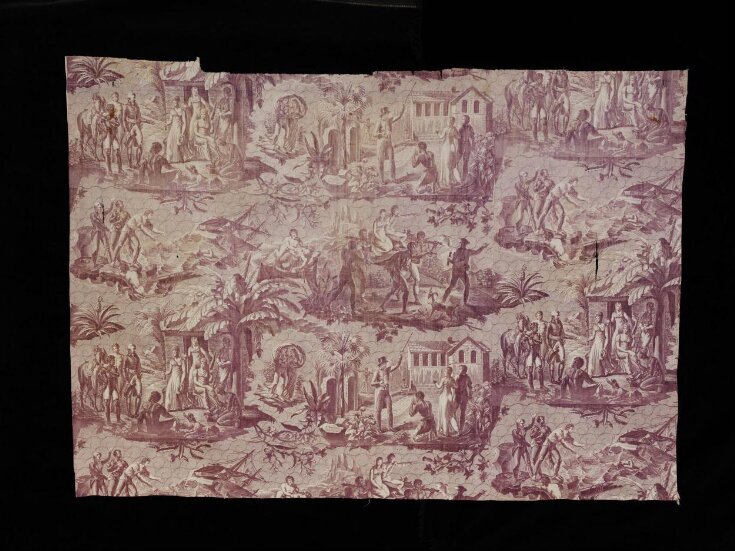
This furnishing fabric shows scenes from Jacques-Henri Bernardin de Saint-Pierre's romantic novel, Paul et Virginie, published in Paris in 1788. The novel shows the influence of contemporary philosopher, Jean-Jacques Rousseau's concept of 'The Noble Savage', which encouraged a return to nature, where humans would not be exposed to the corrupting influences of modern society.
Paul and Virginie are two children raised in relative seclusion on the island of Mauritius. Free from the constraints and troubles of their European contemporaries, the children grow to be happy and fulfilled until Virginie returns to France to secure the fortune of an ailing relative, leaving Paul desolate. On her return to the island, the ship carrying Virginie is wrecked on the coast during a hurricane. As the ship sinks, one of the sailors urges Virginie to dive into the sea and let him swim her to shore. However, Virginie's modesty precludes her from undressing in front of the sailor and so she chooses to drown instead.
Popular works of fiction like Bernardin de Saint Pierre's often inspired designs for printed cottons. The romantic sensibility of the late eighteenth century, as encapsulated by Paul et Virginie, with its doomed lovers and tragic ending, would have held enduring appeal for the nineteenth-century designer of this fabric.
Paul and Virginie are two children raised in relative seclusion on the island of Mauritius. Free from the constraints and troubles of their European contemporaries, the children grow to be happy and fulfilled until Virginie returns to France to secure the fortune of an ailing relative, leaving Paul desolate. On her return to the island, the ship carrying Virginie is wrecked on the coast during a hurricane. As the ship sinks, one of the sailors urges Virginie to dive into the sea and let him swim her to shore. However, Virginie's modesty precludes her from undressing in front of the sailor and so she chooses to drown instead.
Popular works of fiction like Bernardin de Saint Pierre's often inspired designs for printed cottons. The romantic sensibility of the late eighteenth century, as encapsulated by Paul et Virginie, with its doomed lovers and tragic ending, would have held enduring appeal for the nineteenth-century designer of this fabric.
Object details
| Category | |
| Object type | |
| Materials and techniques | Roller-printed plain weave cotton |
| Brief description | Furnishing fabric, roller printed cotton depicting scenes from Jacques-Henri Bernardin de Saint-Pierre's romantic novel, Paul et Virginie, France, about 1820-30 |
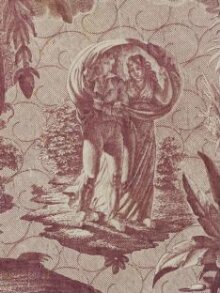
| Physical description | Length of furnishing fabric, roller-printed in violet on a white ground, with the selvedge visible on the left side. Two sections of the pattern have been stitched together down the centre and don't quite match. One and a half repeats in the length; the width of the repeat is more difficult to discern as the two pieces do not match. The pattern depicts scenes from Bernardin de Saint Pierre's romantic novel, Paul et Virginie, published in Paris in 1788. |
| Dimensions |
|
| Styles | |
| Subjects depicted | |
| Place depicted | |
| Literary reference | Bernardin de Saint-Pierre, Jacques-Henri, <i>Paul et Virginie</i>, Paris, 1788. |
| Summary | This furnishing fabric shows scenes from Jacques-Henri Bernardin de Saint-Pierre's romantic novel, Paul et Virginie, published in Paris in 1788. The novel shows the influence of contemporary philosopher, Jean-Jacques Rousseau's concept of 'The Noble Savage', which encouraged a return to nature, where humans would not be exposed to the corrupting influences of modern society. Paul and Virginie are two children raised in relative seclusion on the island of Mauritius. Free from the constraints and troubles of their European contemporaries, the children grow to be happy and fulfilled until Virginie returns to France to secure the fortune of an ailing relative, leaving Paul desolate. On her return to the island, the ship carrying Virginie is wrecked on the coast during a hurricane. As the ship sinks, one of the sailors urges Virginie to dive into the sea and let him swim her to shore. However, Virginie's modesty precludes her from undressing in front of the sailor and so she chooses to drown instead. Popular works of fiction like Bernardin de Saint Pierre's often inspired designs for printed cottons. The romantic sensibility of the late eighteenth century, as encapsulated by Paul et Virginie, with its doomed lovers and tragic ending, would have held enduring appeal for the nineteenth-century designer of this fabric. |
| Collection | |
| Accession number | 1681-1899 |
About this object record
Explore the Collections contains over a million catalogue records, and over half a million images. It is a working database that includes information compiled over the life of the museum. Some of our records may contain offensive and discriminatory language, or reflect outdated ideas, practice and analysis. We are committed to addressing these issues, and to review and update our records accordingly.
You can write to us to suggest improvements to the record.
Suggest feedback
You can write to us to suggest improvements to the record.
Suggest feedback
| Record created | December 7, 2006 |
| Record URL |
Download as: JSONIIIF Manifest
