Buddha head
Buddha Head
550-577 (made)
550-577 (made)
| Artist/Maker | |
| Place of origin |
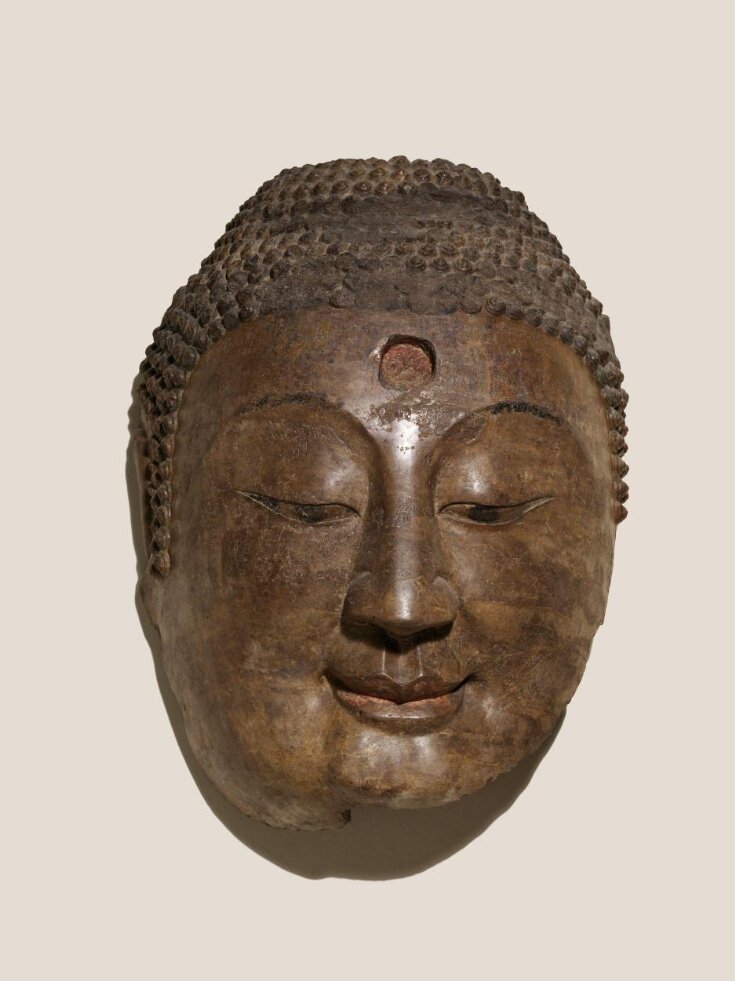
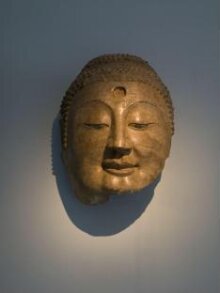
Traces of pigment accentuate the eyebrows, eyes and mouth of this huge head. The hairstyle is typical of the historical Buddha Sakyamuni, with tight curls and the prominent usnisa or topknot. The mark on the forehead, expressing wisdom and openness, originally incorporated an impressive jewel. Once part of a monumental figure in a cave complex, the head would have looked down from high. Its symmetrical composition and serene expression would have inspired Buddhist followers standing below.
Object details
| Categories | |
| Object type | |
| Title | Buddha head (generic title) |
| Materials and techniques | Carved grey limestone with traces of pigment |
| Brief description | Buddha head, carved grey limestone with traces of pigment, probably from Xiangtangshan, Hebei province, China, Northern Qi dynasty, 550-577. |
| Physical description | Large 3-dimensional rounded face/head of Buddha, fractured at the chin. There is colour visible on his lips, eyes and eyebrows, and his mouth is closed. His eyes look downwards. He has high arched brows, bobbled hair with an ushnisha (bun hairstyle). The eyebrows are curved in a butterfly shape, a Chinese sign of beauty, and the symmetrical composition and serene expression expresses Buddhist ideals - the renunciation of worldly desires and the attainment of enlightenment. |
| Dimensions |
|
| Style | |
| Gallery label |
|
| Credit line | Presented by Art Fund |
| Object history | Loaned to Burlington House Fair Exhibition Sept. 9-20, 1987, Royal Academy of Arts. A similar sculpture is A.27-1914, and there are also similar works at Philadelphia University and Cologne. It would have been part of an entire figure, and displayed high up. Historical significance: This piece is probably from the Xiangtangshan cave complex in northern China, of which the sculptures were scattered across international collections in the early 20th century. A Project was established to create a digital reconstruction of what the cave complex would have looked like (see references). |
| Production | This is probably from the Xiangtangshan cave temples in Northern China. |
| Subject depicted | |
| Summary | Traces of pigment accentuate the eyebrows, eyes and mouth of this huge head. The hairstyle is typical of the historical Buddha Sakyamuni, with tight curls and the prominent usnisa or topknot. The mark on the forehead, expressing wisdom and openness, originally incorporated an impressive jewel. Once part of a monumental figure in a cave complex, the head would have looked down from high. Its symmetrical composition and serene expression would have inspired Buddhist followers standing below. |
| Bibliographic references |
|
| Collection | |
| Accession number | A.98-1927 |
About this object record
Explore the Collections contains over a million catalogue records, and over half a million images. It is a working database that includes information compiled over the life of the museum. Some of our records may contain offensive and discriminatory language, or reflect outdated ideas, practice and analysis. We are committed to addressing these issues, and to review and update our records accordingly.
You can write to us to suggest improvements to the record.
Suggest feedback
You can write to us to suggest improvements to the record.
Suggest feedback
| Record created | November 16, 2006 |
| Record URL |
Download as: JSONIIIF Manifest
