Bodhidharma in Meditation
Figure
1484 (made)
1484 (made)
| Artist/Maker | |
| Place of origin |
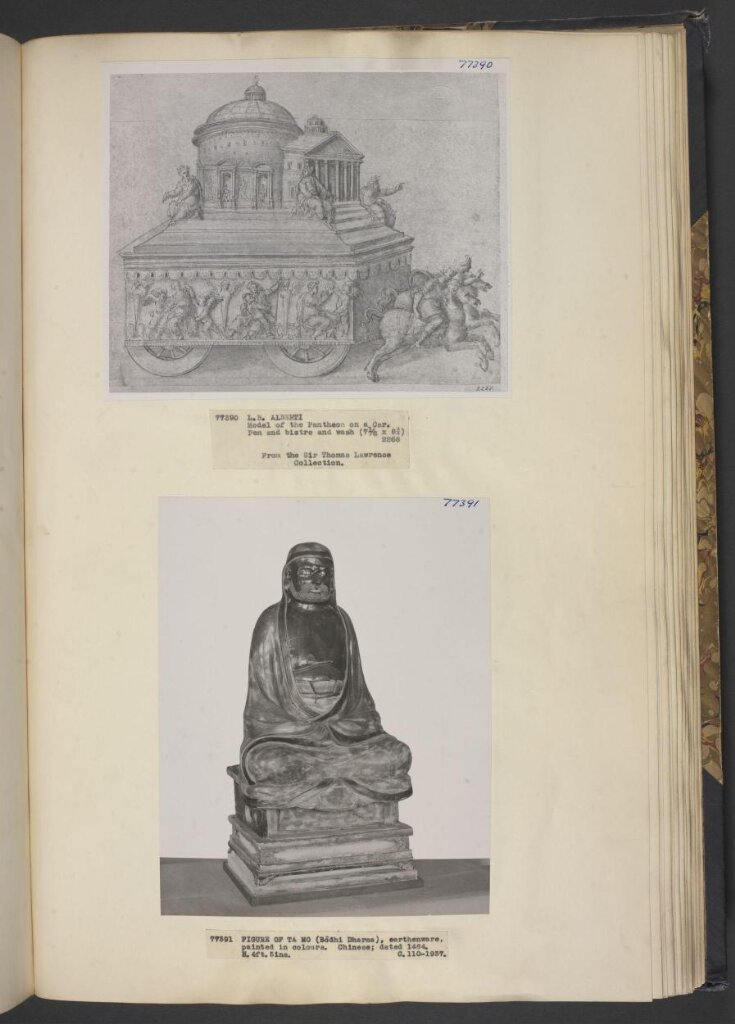
This unusual sculpture stands out, firstly as a Chinese depiction of an Indian figure, and secondly because of its large size and bright colours. The figure is Bodhidharma, a Buddhist monk who is believed to have travelled from India to China in 520, bringing meditational Buddhism with him. From his furrowed brow and closed eyes, we can tell that he is deep in meditation. He sits on a pedestal integral to the sculpture, with apertures for easy handling on either side and an inscription that records the date and donors, 'faithful Dang Yan and Madam Mai'.
Object details
| Categories | |
| Object type | |
| Title | Bodhidharma in Meditation (generic title) |
| Materials and techniques | Stoneware, lead glazed |
| Brief description | Bodhidharma sculpture, lead glazed stoneware, China, Ming dynasty, dated 1484 |
| Physical description | Brown monk with green robe sitting cross-legged in the lotus position, hands concealed. He has a beard and moustache, and eyes closed and brows furrowed. The figure sits on a 3-tiered pedestal integral to the sculpture. On the right side there is a description in Chinese characters. There are handles in the side of the base to make transportation easier. |
| Dimensions |
|
| Style | |
| Marks and inscriptions | The pedestal features a dedicatory description "Chenghua 20th year, faithful Dang Yan and Madam Mai. Priest Dao Ji. Craftsman Liu Zhen" |
| Gallery label | Bodhidharma
1484 (Ming dynasty)
North China
This unusual sculpture stands out, firstly as a Chinese depiction of an Indian figure, and secondly because of its large size and bright colours. The figure is Bodhidharma, a Buddhist monk who is believed to have travelled from India to China in 520, bringing meditational Buddhism with him. From his furrowed brow and closed eyes, we can tell that he is deep in meditation. He sits on a pedestal integral to the sculpture, with apertures for easy handling on either side and an inscription that records the date and donors, 'faithful Dang Yan and Madam Mai'.
Stoneware with brown and green glazes
Museum no. C.110-1937
Given by Messrs John Sparks |
| Credit line | Given by Messrs John Sparks |
| Object history | The Royal Scottish Museum was given a similar ceramic figure in 1937 by John Sparks on condition that they repair it, and asked for an information that the V&A held about it. See RP/1937/2920. John Sparks initially had two similar figures, of which the V&A's is one and the Royal Scottish Museum's is the other. The two figures 'arrived in this country in such a damaged state that the firm, John Sparks, who imported it are of opinion that although repairs are feasible the repaired figure would be difficult to sell. In these circumstances they have written to say that they would be willing to give the pieces to any Museum who could undertake the repairs.' Letter to W.C. Wallis of the Royal Scottish Museum from H.A. Kennedy. |
| Historical context | Ceramic religious figures have the advantage over their wooden counterparts, though making and successfully firing this exceptional large one must have posed formidable technical challenges to the potter. Such sculptures were offered by faithful Buddhist, who paid for their manufacture, and these specially commissioned pieces often bear an inscription to commemorate the occasion. On this figure the inscription is incised on the right-hand side of the pedestal, giving a date equivalent to 1484: "Chenghua 20th year, faithful Dang Yan and Madam Mai. Priest Dao Ji. Craftsman Liu Zhen". By a historical coincidence, three other Buddhist figures with similar inscriptions dated 1484 survived in the UK. This suggests that in this year the Buddhist priest Dao Ji persuaded several families to donate money towards the production of ceramic sculptures, the occasion probably being the completion of a new temple. Unlike other ceramics, religious figures of this size seldom changed hands and, once installed in a temple, under normal circumstances they would remain there. During the 1930s, however, when China was experiencing political turmoil, these four figures were shipped to the UK for sale on the art market. Bodhidharma was given to the V&A by the London dealer John Sparks in 1937 because the figure had been damaged in transit, thus difficult to sell. The other three are now in the British Museum, the Burrell Collection, Glasgow, and the Lady Lever Art Gallery, Liverpool. |
| Subjects depicted | |
| Summary | This unusual sculpture stands out, firstly as a Chinese depiction of an Indian figure, and secondly because of its large size and bright colours. The figure is Bodhidharma, a Buddhist monk who is believed to have travelled from India to China in 520, bringing meditational Buddhism with him. From his furrowed brow and closed eyes, we can tell that he is deep in meditation. He sits on a pedestal integral to the sculpture, with apertures for easy handling on either side and an inscription that records the date and donors, 'faithful Dang Yan and Madam Mai'. |
| Bibliographic reference | Liefkes, Reino and Hilary Young (eds.) Masterpieces of World Ceramics in the Victoria and Albert Museum. London: V&A Publishing, 2008, pp. 62-63.
|
| Collection | |
| Accession number | C.110-1937 |
About this object record
Explore the Collections contains over a million catalogue records, and over half a million images. It is a working database that includes information compiled over the life of the museum. Some of our records may contain offensive and discriminatory language, or reflect outdated ideas, practice and analysis. We are committed to addressing these issues, and to review and update our records accordingly.
You can write to us to suggest improvements to the record.
Suggest feedback
You can write to us to suggest improvements to the record.
Suggest feedback
| Record created | September 21, 2006 |
| Record URL |
Download as: JSONIIIF Manifest
