Panel
ca. 1400 (made)
| Artist/Maker | |
| Place of origin |
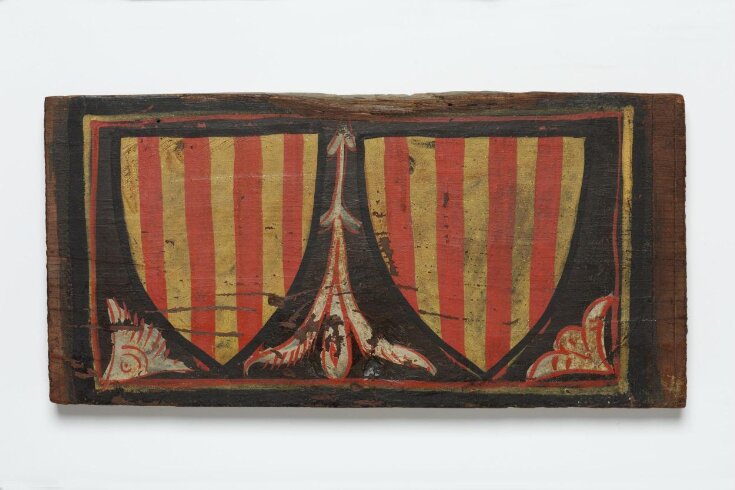
This panel formed part of a ceiling of a house in Catalonia, Spain, and would originally have been placed in one of the recesses between large supporting beams which spanned the room. Ceilings with painted beams and flat recesses made up of painted panels were more characteristic of Christian than Moorish buildings in the period between 1300 and 1500. This particular panel bears heraldic coats of arms of Catalonia, very much a sign of Christian ownership.
Object details
| Category | |
| Object type | |
| Materials and techniques | Wood (probably pine) with polychrome decoration in tempera |
| Brief description | Of wood (probably pine) with polychrome decoration in tempera, including the arms of Catalonia |
| Physical description | Rectangular panel, painted with two shields of the arms of Catalonia (red and yellow vertical stripes), separated from each other by a husk-like divice, with moresques in the bottom corner. |
| Dimensions |
|
| Marks and inscriptions | Coat of Arms of Catalonia |
| Object history | Bought with nine other panels (Museum Nos: 207 to 216 - 1894) from M. Stanislas Baron, Rue Grange-Batelière 28 (Paris) for £0. 8s. "Panel from a wooden ceiling, painted in yellow and red tempera colours on a black ground with two shields of the arms of Aragon, separated by a floral device. Painted by Moorish artists for the Spaniards. Hispano-Moresque; 15th century." Historical significance: Ceilings with painted beams and panels are more often associated with Christian Spain, and unlike most of the other pieces in this set, this panel is decorated with predominantly Chritian motifs, in the form of the heraldic arms of Catalonia. Nevertheless, the two shields are separated from eachother by Islamic motifs and the bottom two corners filled with moresque patterns. The Islamic style of decoration was to be found in interiors of houses, even in the predominantly Christian parts of Spain. |
| Historical context | Ceilings in Christian Spain, during the Middle ages, were often supported by large, decoratively painted beams with painted panels like this example recessed between them. Examples include the ceiling over the cloister of the Monastery of Santo Domingo de Silos, south of Burgos, and the one over the Chapel of Santa Agüeda in Barcelona. Just as complex geometrical ceilings, supported by box-core pendants and inscribed with Arabic calligraphy, were characteristic of Moorish buildings, those with painted beams and panels were more often owned by Christians, and found in larger and more important rooms. |
| Subject depicted | |
| Place depicted | |
| Summary | This panel formed part of a ceiling of a house in Catalonia, Spain, and would originally have been placed in one of the recesses between large supporting beams which spanned the room. Ceilings with painted beams and flat recesses made up of painted panels were more characteristic of Christian than Moorish buildings in the period between 1300 and 1500. This particular panel bears heraldic coats of arms of Catalonia, very much a sign of Christian ownership. |
| Bibliographic references |
|
| Collection | |
| Accession number | 216-1894 |
About this object record
Explore the Collections contains over a million catalogue records, and over half a million images. It is a working database that includes information compiled over the life of the museum. Some of our records may contain offensive and discriminatory language, or reflect outdated ideas, practice and analysis. We are committed to addressing these issues, and to review and update our records accordingly.
You can write to us to suggest improvements to the record.
Suggest feedback
You can write to us to suggest improvements to the record.
Suggest feedback
| Record created | September 18, 2006 |
| Record URL |
Download as: JSONIIIF Manifest
