
This object, or the text that describes it, is deemed offensive and discriminatory. We are committed to improving our records, and work is ongoing.
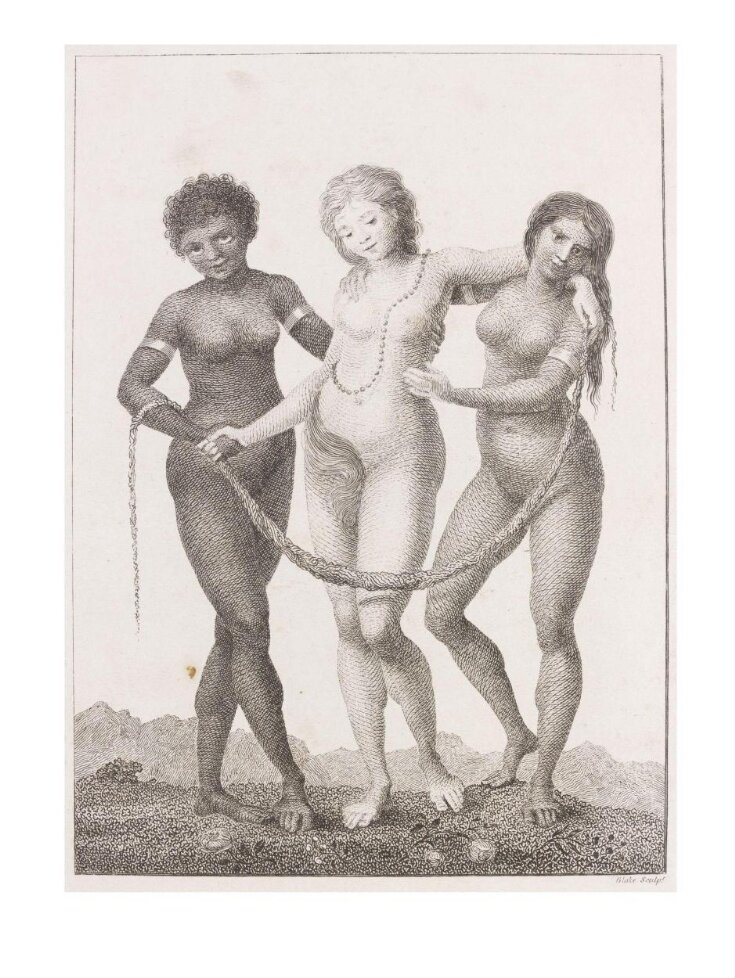
Europe supported by Africa and America
Print
1796 (made)
1796 (made)
| Artist/Maker |
The Dutch captured the British colony of Suriname during the Second Anglo-Dutch War (1667). Under the West India Company it was developed as a plantation slave society and became a primary destination for the Dutch slave trade. The brutal regime caused high mortality; despite the import of 300,000 slaves between 1668 and 1823, the population never grew beyond 50,000. ‘Maroonage’ became the major form of resistance. Fugitive slaves, or ‘maroons’, escaped inland to form permanent communities from where they waged a campaign of guerrilla warfare against the Dutch.
In 1774 the Scottish-Dutch soldier John Gabriel Stedman witnessed the brutal oppression of slaves during a campaign against the maroons, which he described in his Narrative of a Five Years Expedition Against the Revolted Negroes of Surinam. The book, which included illustrations by William Blake, was adopted by abolitionists, though Stedman was thought to support reform rather than abolition.
This allegorical image is in the tradition of ‘The Four Continents’, in which the continents are depicted as female figures. Blake, the abolitionist, has included gold arm bands on the arms of Africa and America to symbolise their enslavement to the central figure of Europe. However, the fact that Europe is being physically supported by her companions suggests the possibility of a more equitable relationship.
In 1774 the Scottish-Dutch soldier John Gabriel Stedman witnessed the brutal oppression of slaves during a campaign against the maroons, which he described in his Narrative of a Five Years Expedition Against the Revolted Negroes of Surinam. The book, which included illustrations by William Blake, was adopted by abolitionists, though Stedman was thought to support reform rather than abolition.
This allegorical image is in the tradition of ‘The Four Continents’, in which the continents are depicted as female figures. Blake, the abolitionist, has included gold arm bands on the arms of Africa and America to symbolise their enslavement to the central figure of Europe. However, the fact that Europe is being physically supported by her companions suggests the possibility of a more equitable relationship.
Delve deeper
Discover more about this object

Object details
| Categories | |
| Object type | |
| Title | Europe supported by Africa and America |
| Materials and techniques | Engraving |
| Brief description | 'Europe supported by Africa and America', print by William Blake, 1796 |
| Physical description | Print depicts a group of three nude standing women: a black woman to the left, a white woman at the centre and a dark-skinned woman to the right. The outside figures wear gold bands around their upper arms |
| Dimensions |
|
| Object history | NB: The term "negro" was used historically to describe people of black African heritage but, since the 1960s, has fallen from usage and, increasingly, is considered offensive. The term is repeated here in its original historical context. |
| Subject depicted | |
| Literary reference | The Four Continents |
| Summary | The Dutch captured the British colony of Suriname during the Second Anglo-Dutch War (1667). Under the West India Company it was developed as a plantation slave society and became a primary destination for the Dutch slave trade. The brutal regime caused high mortality; despite the import of 300,000 slaves between 1668 and 1823, the population never grew beyond 50,000. ‘Maroonage’ became the major form of resistance. Fugitive slaves, or ‘maroons’, escaped inland to form permanent communities from where they waged a campaign of guerrilla warfare against the Dutch. In 1774 the Scottish-Dutch soldier John Gabriel Stedman witnessed the brutal oppression of slaves during a campaign against the maroons, which he described in his Narrative of a Five Years Expedition Against the Revolted Negroes of Surinam. The book, which included illustrations by William Blake, was adopted by abolitionists, though Stedman was thought to support reform rather than abolition. This allegorical image is in the tradition of ‘The Four Continents’, in which the continents are depicted as female figures. Blake, the abolitionist, has included gold arm bands on the arms of Africa and America to symbolise their enslavement to the central figure of Europe. However, the fact that Europe is being physically supported by her companions suggests the possibility of a more equitable relationship. |
| Collection | |
| Accession number | E.1215F-1886 |
About this object record
Explore the Collections contains over a million catalogue records, and over half a million images. It is a working database that includes information compiled over the life of the museum. Some of our records may contain offensive and discriminatory language, or reflect outdated ideas, practice and analysis. We are committed to addressing these issues, and to review and update our records accordingly.
You can write to us to suggest improvements to the record.
Suggest feedback
You can write to us to suggest improvements to the record.
Suggest feedback
| Record created | August 24, 2006 |
| Record URL |
Download as: JSONIIIF Manifest
