Vase
1590-1630 (made)
| Artist/Maker | |
| Place of origin |
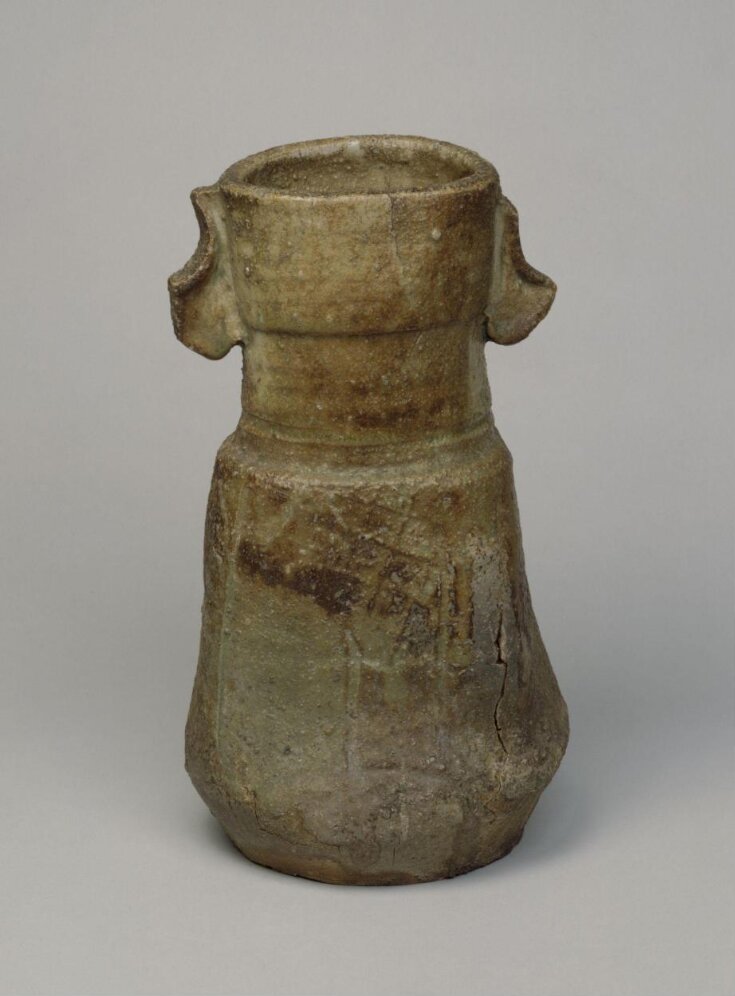
Iga wares are among the most compelling manifestations of the spirit of chanoyu that flourished under Furuta Oribe (1544-1615), the warrior tea master who succeeded Sen no Rikyū (1522-1591) as Japan’s leading arbiter of tea ceremony taste. They are typified by powerfully sculpted forms committed to the transformative power of wood-firing kilns within which fly ash melts and fuses, intense heat splits and ruptures, and shapes sag and distort. Not the introspective quietude of the Chōjiro teabowls favoured by Rikyū, but objects born out of revelry in the creative act and abandon to the forces of nature.
The kilns at which Iga wares were produced operated from the 1570s to the 1640s, after which they went into decline. They enjoyed the patronage first of Tsutsui Sadatsugu (1562-1615) and then, from 1608, of Tōdō Takatora (1556-1630), successive lords of the area in which they were located. The first mention of the term Iga ware occurs in a tea diary entry of 1581. This is followed by a lull until 1608, when it appears in a entry in Oribe’s tea diary. It then appears with increasing regularity, the indication being that the high point of Iga ware production corresponded to the period of patronage of Tōdō Takatora, which is to say from 1608 to 1630.
The kilns at which Iga wares were produced operated from the 1570s to the 1640s, after which they went into decline. They enjoyed the patronage first of Tsutsui Sadatsugu (1562-1615) and then, from 1608, of Tōdō Takatora (1556-1630), successive lords of the area in which they were located. The first mention of the term Iga ware occurs in a tea diary entry of 1581. This is followed by a lull until 1608, when it appears in a entry in Oribe’s tea diary. It then appears with increasing regularity, the indication being that the high point of Iga ware production corresponded to the period of patronage of Tōdō Takatora, which is to say from 1608 to 1630.
Object details
| Categories | |
| Object type | |
| Materials and techniques | Stoneware with a natural ash glaze, firing marks and paddled and incised decoration. |
| Brief description | Vase with lug handles, stoneware with natural ash glaze, Iga ware, Japanese, 1590-1630 |
| Physical description | Stoneware vase with lug handles, covered with a natural ash glaze, firing marks and paddled and incised decoration. |
| Dimensions |
|
| Styles | |
| Gallery label | Vase
Stoneware with natural ash glaze over incised and impressed decoration
Iga kilns
About 1590-1630(1986) |
| Object history | Purchased from the Japanese Commissioners for the Philadelphia Exposition of 1876, accessioned in 1877. This acquisition information reflects that found in the Asia Department registers, as part of a 2022 provenance research project. |
| Association | |
| Summary | Iga wares are among the most compelling manifestations of the spirit of chanoyu that flourished under Furuta Oribe (1544-1615), the warrior tea master who succeeded Sen no Rikyū (1522-1591) as Japan’s leading arbiter of tea ceremony taste. They are typified by powerfully sculpted forms committed to the transformative power of wood-firing kilns within which fly ash melts and fuses, intense heat splits and ruptures, and shapes sag and distort. Not the introspective quietude of the Chōjiro teabowls favoured by Rikyū, but objects born out of revelry in the creative act and abandon to the forces of nature. The kilns at which Iga wares were produced operated from the 1570s to the 1640s, after which they went into decline. They enjoyed the patronage first of Tsutsui Sadatsugu (1562-1615) and then, from 1608, of Tōdō Takatora (1556-1630), successive lords of the area in which they were located. The first mention of the term Iga ware occurs in a tea diary entry of 1581. This is followed by a lull until 1608, when it appears in a entry in Oribe’s tea diary. It then appears with increasing regularity, the indication being that the high point of Iga ware production corresponded to the period of patronage of Tōdō Takatora, which is to say from 1608 to 1630. |
| Bibliographic reference | Augustus Wollaston Franks and M. Shioda, Japanese Pottery. [London]: Chapman & Hall Ltd., 1880. South Kensington Museum Art Handbooks; 18.
Catalogue number: 46 |
| Collection | |
| Accession number | 205-1877 |
About this object record
Explore the Collections contains over a million catalogue records, and over half a million images. It is a working database that includes information compiled over the life of the museum. Some of our records may contain offensive and discriminatory language, or reflect outdated ideas, practice and analysis. We are committed to addressing these issues, and to review and update our records accordingly.
You can write to us to suggest improvements to the record.
Suggest feedback
You can write to us to suggest improvements to the record.
Suggest feedback
| Record created | December 15, 1999 |
| Record URL |
Download as: JSONIIIF Manifest
