
Sack
1760-1769 (made), ca. 1742 (hand woven)
| Artist/Maker | |
| Place of origin |
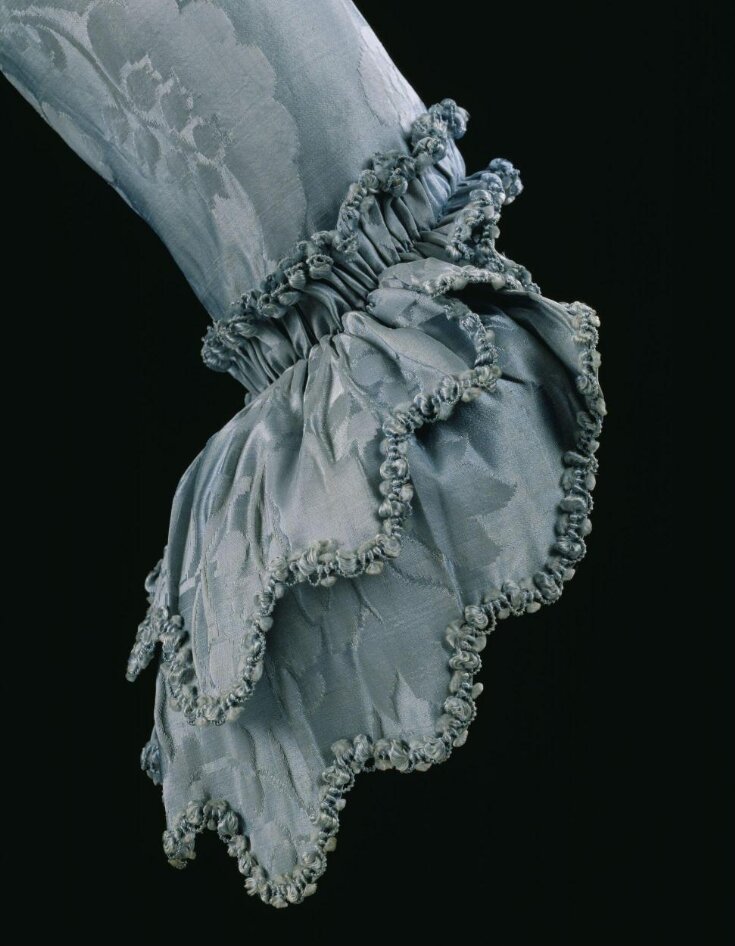
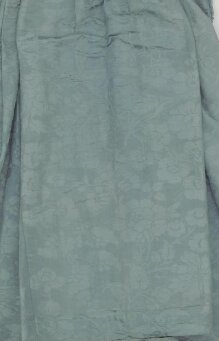
This modest sack of the 1760s is made of blue silk damask. The pattern of large flowers and leaves dates from about 1742. Silks pre-dating the construction of a particular dress, often by a decade or more, are quite common in 18th-century dress. Once woven, bolts of silk might be available for sale for many years, and it was not unusual for purchasers to store lengths of silk before making them up or giving them away as a gift. The high cost of woven silks meant that their value did not decrease, even as fashions changed. Characteristic of the 1760s are the double sleeve ruffles edged with a matching silk fringe.
Object details
| Categories | |
| Object type | |
| Parts | This object consists of 2 parts.
|
| Materials and techniques | Silk and linen, hand woven and hand sewn |
| Brief description | Sack back gown, British, 1760-1770, made with 1740s blue silk damask |
| Physical description | A woman's sack of blue silk damask, trimmed with blue fringe |
| Production type | Unique |
| Credit line | Given by the Surrey County Federation of Women's Institutes |
| Subjects depicted | |
| Summary | This modest sack of the 1760s is made of blue silk damask. The pattern of large flowers and leaves dates from about 1742. Silks pre-dating the construction of a particular dress, often by a decade or more, are quite common in 18th-century dress. Once woven, bolts of silk might be available for sale for many years, and it was not unusual for purchasers to store lengths of silk before making them up or giving them away as a gift. The high cost of woven silks meant that their value did not decrease, even as fashions changed. Characteristic of the 1760s are the double sleeve ruffles edged with a matching silk fringe. |
| Bibliographic reference | Hart, Avril and Susan North, Historical Fashion in Detail: The 17th and 18th Centuries, London: V&A Publications, 1998, p. 94
|
| Collection | |
| Accession number | T.122-1957 |
About this object record
Explore the Collections contains over a million catalogue records, and over half a million images. It is a working database that includes information compiled over the life of the museum. Some of our records may contain offensive and discriminatory language, or reflect outdated ideas, practice and analysis. We are committed to addressing these issues, and to review and update our records accordingly.
You can write to us to suggest improvements to the record.
Suggest feedback
You can write to us to suggest improvements to the record.
Suggest feedback
| Record created | August 15, 2006 |
| Record URL |
Download as: JSONIIIF Manifest
