
Mantua
1775-1785 (embroidering), 1775 - 1785 (sewing), 1870 - 1910 (altered)
| Artist/Maker | |
| Place of origin |
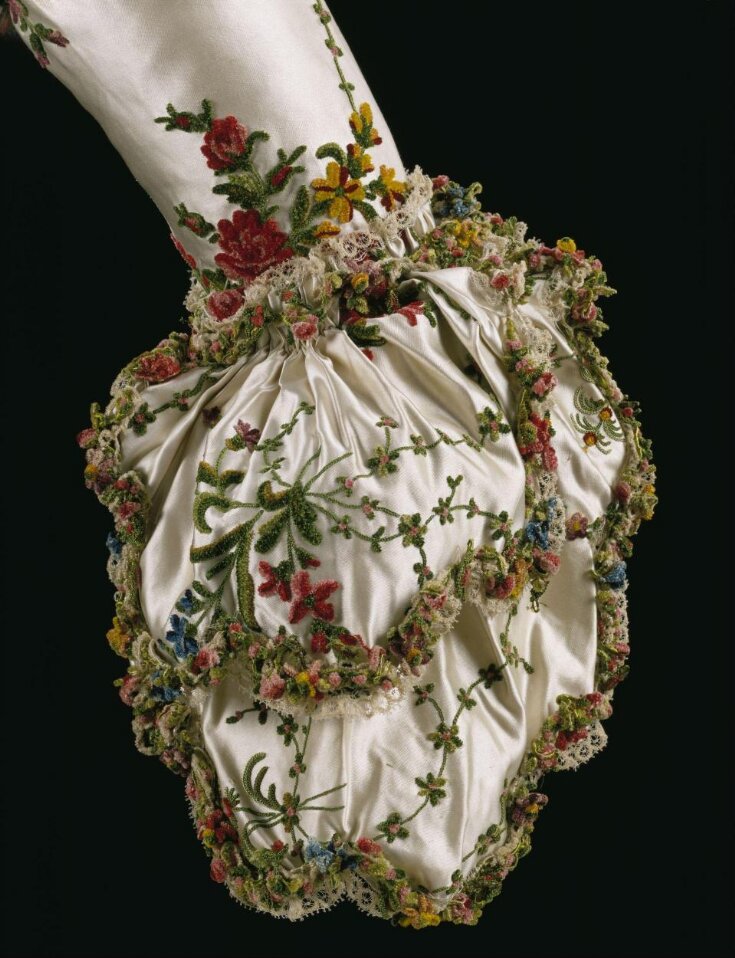
The tangled garden of chenille decoration on this court mantua enhances the white silk satin fabric. It is tamboured (chain stitched with a hook instead of a needle) with coloured silk and chenille threads, in a meandering pattern of flowers and leaves. A fringe of chenille threads, wound into the shapes of more flowers and leaves, trims the mantua. Bobbin lace of silk and chenille edges the fringe and neckline.
The quality of the needlework suggests French production. In style, the design reflects the woven silk patterns of the 1750s, designs that remained fashionable in embroidery until the 1790s. The mantua was probably made in the late 1770s and the bodice modified slightly in the 1780s. Its petticoat of matching fabric suffered extensive alterations for fancy dress in the late 19th century.
The quality of the needlework suggests French production. In style, the design reflects the woven silk patterns of the 1750s, designs that remained fashionable in embroidery until the 1790s. The mantua was probably made in the late 1770s and the bodice modified slightly in the 1780s. Its petticoat of matching fabric suffered extensive alterations for fancy dress in the late 19th century.
Object details
| Categories | |
| Object type | |
| Parts | This object consists of 6 parts.
|
| Materials and techniques | Silk linen, silk thread, linen thread, lead; hand-woven and braided, hand-sewn; hand bobbin lace, machine-sewn |
| Brief description | A woman's mantua and petticoat parts, British, 1775-85 of French silk satin tamboured with chenille thread, chenille fringe, 1780-85; altered 1870-1910 |
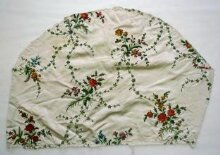
| Physical description | A woman's court mantua of white silk satin tamboured in a pattern of floral sprigs with chenille silk thread. The mantua is open at the front with elbow-length sleeves with double scalloped sleeve ruffles. The bodice fronts meet in the centre.The mantua back is comprised of two widths of silk, pleated above the waist and extending into a long train below. The bodice and sleeves are lined with bleached linen; the lower part of the train is faced with white silk taffeta. The sleeves are weighted with lead discs. A broad ruffle of silk extends from the bottom of the bodice at centre front around the back at the waist. A wired fringe of chenille and floss silk in the form of flowers edges the train, the sleeve ruffles, the ruffle at the waist and the neckline. A narrow border of silk bobbin lace trims the train,the sleeve ruffles and the neckline. Pleat marks on the bodice front indicate that the mantua originally had robings and was probably worn iwth a stomacher. The robings were opened out and pieced so the bodice fronts met in the centre, probably in the early 1780s. The mantua and petticoat were altered for fancy dress in the late 19th century. The petticoat was unpicked and resewn with a sewing machine; only part of it remains. A pair of full sleeves in the 1890s style, were cut out, probably from the petticoat, and sewn up (since unpicked). These were not sewn into the mantua, as its original sleeves and armhole seams remain. A stomacher was constructed, either from the original stomacher or from the petticoat, to accommodate a late 19th century corset |
| Dimensions |
|
| Production type | Unique |
| Credit line | Given by Major W. S. Gosling |
| Subjects depicted | |
| Summary | The tangled garden of chenille decoration on this court mantua enhances the white silk satin fabric. It is tamboured (chain stitched with a hook instead of a needle) with coloured silk and chenille threads, in a meandering pattern of flowers and leaves. A fringe of chenille threads, wound into the shapes of more flowers and leaves, trims the mantua. Bobbin lace of silk and chenille edges the fringe and neckline. The quality of the needlework suggests French production. In style, the design reflects the woven silk patterns of the 1750s, designs that remained fashionable in embroidery until the 1790s. The mantua was probably made in the late 1770s and the bodice modified slightly in the 1780s. Its petticoat of matching fabric suffered extensive alterations for fancy dress in the late 19th century. |
| Bibliographic reference | Hart, Avril and Susan North, Historical Fashion in Detail: The 17th and 18th Centuries, London: V&A Publications, 1998, p. 92
|
| Collection | |
| Accession number | T.13-1952 |
About this object record
Explore the Collections contains over a million catalogue records, and over half a million images. It is a working database that includes information compiled over the life of the museum. Some of our records may contain offensive and discriminatory language, or reflect outdated ideas, practice and analysis. We are committed to addressing these issues, and to review and update our records accordingly.
You can write to us to suggest improvements to the record.
Suggest feedback
You can write to us to suggest improvements to the record.
Suggest feedback
| Record created | August 15, 2006 |
| Record URL |
Download as: JSONIIIF Manifest
