
Suit
1750s (made)
| Artist/Maker | |
| Place of origin |
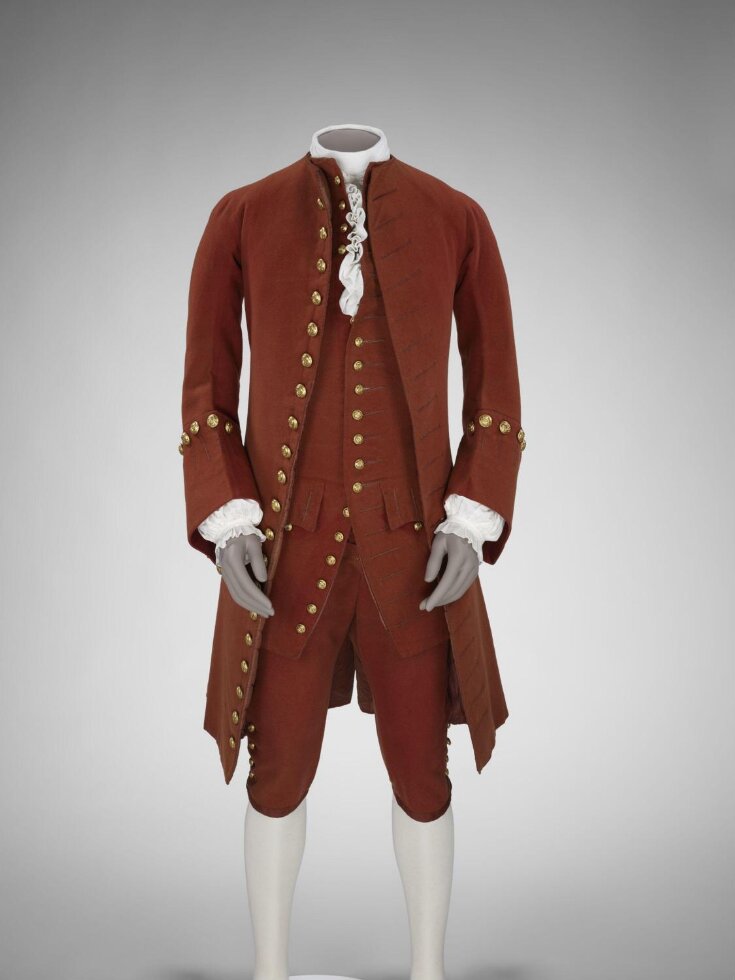
It was common practice to leave the side and back seams of men’s coats open in the 18th century. This tradition derived from 17th-century riding coats, as it allowed the garment to drape comfortably while seated on a horse. Open seams also accommodated the sword worn by all gentlemen during this period. The fashion of the 1740s for extravagant full-skirted coats waned in the 1750s and 1760s. Side pleats were not as deep as the silhouette became more slender.
The coat forms part of a suit with breeches and waistcoat, all made of felted superfine terracotta-coloured woollen broadcloth. Silver-gilt buttons comprise the only adornment. Such an ensemble would have been worn as formal daywear in Britain.
The coat forms part of a suit with breeches and waistcoat, all made of felted superfine terracotta-coloured woollen broadcloth. Silver-gilt buttons comprise the only adornment. Such an ensemble would have been worn as formal daywear in Britain.
Object details
| Categories | |
| Object type | |
| Parts | This object consists of 5 parts.
|
| Materials and techniques | Wool, linen, silk, cotton, wood, silver-gilt; hand-woven broadcloth, twill and fustian, hand-sewn, cast and gilt silver |
| Brief description | A man's coat, breeches and waistcoat with detached sleeves, 1750s, Britlish; terracotta brown wool with cast silver-gilt buttons |
| Physical description | A man's coat, breeches and waistcoat with detached sleeves of terracotta-brown woollen broadcloth. The coat has a round neck, bound with a narrow strip of wool. The two-piece, shaped sleeves are slightly wider below the elbow, reaching to the wrist with deep closed cuffs (16.5 cm at top, 19 cm at bottom). The coat is cut to fit the torso, curving slightly from neck to hem. The wide skirts below the hip are set in two pleats at the front and one pleat at the back of the side openings (18.5 cm deep). There is an inverted pleat either side of the centre back opening of the skirts. There is a scalloped pocket flap at hip level on each front. The sleeves are pockets are lined with glazed brown linen, the coat, pocket flaps and cuffs with brown silk twill. The front edges and back vent are interlined, probably with buckram; the side openings are reinforced with brown linen tape. Twenty buttons, cast and gilt over a wooden core, edge the right front, with 20 corresponding buttonholes on the left front, one the top 12 are cut. Five buttonholes decorate the pocket flaps, the outside ones cut with 5 corresponding cast gilt buttons on the coat below the pocket flaps. There are five uncut buttonholes with 5 cast gilt buttons holding each cuff at the top. There is a button at the top of the pleats, one holding the pleats at the bottom, and two on the coat back, on each side. There are 9 uncut buttonholes on each side of the back vent. The raw edge of the wool has been left at the hem, but the front edges, cuffs and pocket flaps are folded and hemmed. The waistcoat is made of 2 fronts and 2 backs, all of the terracotta broadcloth. The neck is bound with a narrow strip of wool. The waistcoat is cut to fit the torso, the fronts curving from neck to hem with a short seam from one edge of each pocket to the side seams. The fronts have skirts below the hip; the waistcoat reaches to about mid-thigh. There is a scalloped pocket flap at hip level on each front. The torso is lined with bleached linen,the pockets with glazed brown linen, the skirts with brown silk twill. The front edges are faced with brown silk twill. Twenty buttons, cast and gilt over a wooden core, slightly smaller than the coat buttons, are sewn to the right front, with 20 corresponding, the top 14 are cut. The waistcoat sleeves are made of pieced broadcloth in two, curved pieces, reaching to above the wrist without a cuff. There is an opening in the back seam above the wrist with a buttonhole and one small cast gilt button (button on left missing). The sleeves are lined with bleached linen, and the openings at the wrist faced with brown silk twill. Stitch marks and remains of brown linen thread indicate that the sleeves were once attached to the waistcoat. These were sewn only at the sleeve head; short stubs of linen tape on the underside of the sleeve and waistcoat armholes, once held the sleeves in place. The legs of the breeches are cut in 4 shaped pieces, the backs higher than the fronts. The waistband is in 2 pieces, with the backs eased in. There are 4 pockets; one in the waistband, one in the waistband/leg seam with a button flap on each side of the front, and one in the side seam of the right leg. The fronts fasten with a narrow fall and a small cast gilt button either side, and 2 larger cast gilt buttons on the waistband. There are two worked eyelets at the centre back edge of each waistband. The legs fasten with 4 small cast gilt buttons on the backs above the knee, with 4 corresponding buttonholes on the fronts. There is a buckle band of knitted terracotta-coloured silk. The leg openings are faced and fall front lined with brown silk twill. The waistbands and pockets are lined with linen. A triangle of brown silk twill fills the gap at the centre back between the waistband edges. The left side of the centre back seam is reinforced with brown linen twill tape. |
| Production type | Unique |
| Summary | It was common practice to leave the side and back seams of men’s coats open in the 18th century. This tradition derived from 17th-century riding coats, as it allowed the garment to drape comfortably while seated on a horse. Open seams also accommodated the sword worn by all gentlemen during this period. The fashion of the 1740s for extravagant full-skirted coats waned in the 1750s and 1760s. Side pleats were not as deep as the silhouette became more slender. The coat forms part of a suit with breeches and waistcoat, all made of felted superfine terracotta-coloured woollen broadcloth. Silver-gilt buttons comprise the only adornment. Such an ensemble would have been worn as formal daywear in Britain. |
| Bibliographic reference | Hart, Avril & Susan North. Historical Fashion in Detail: The 17th and 18th Centuries. London: V&A Publications, 1998, pp.46 & 84
|
| Collection | |
| Accession number | T.329 to D-1985 |
About this object record
Explore the Collections contains over a million catalogue records, and over half a million images. It is a working database that includes information compiled over the life of the museum. Some of our records may contain offensive and discriminatory language, or reflect outdated ideas, practice and analysis. We are committed to addressing these issues, and to review and update our records accordingly.
You can write to us to suggest improvements to the record.
Suggest feedback
You can write to us to suggest improvements to the record.
Suggest feedback
| Record created | August 15, 2006 |
| Record URL |
Download as: JSONIIIF Manifest
