Sweetmeat Stand
ca. 1735 (made)
| Artist/Maker | |
| Place of origin |
The hugely talented and prolific modeller J.J. Kändler (1706-1775) worked for the Meissen porcelain factory between 1731 and 1775, a period of forty-four years in which he created over 2000 original models for figures, animals, groups and functional pieces such as this sweetmeat stand. In so doing he single-handedly established most of the sculptural conventions that governed the production of the earliest European porcelain figures.
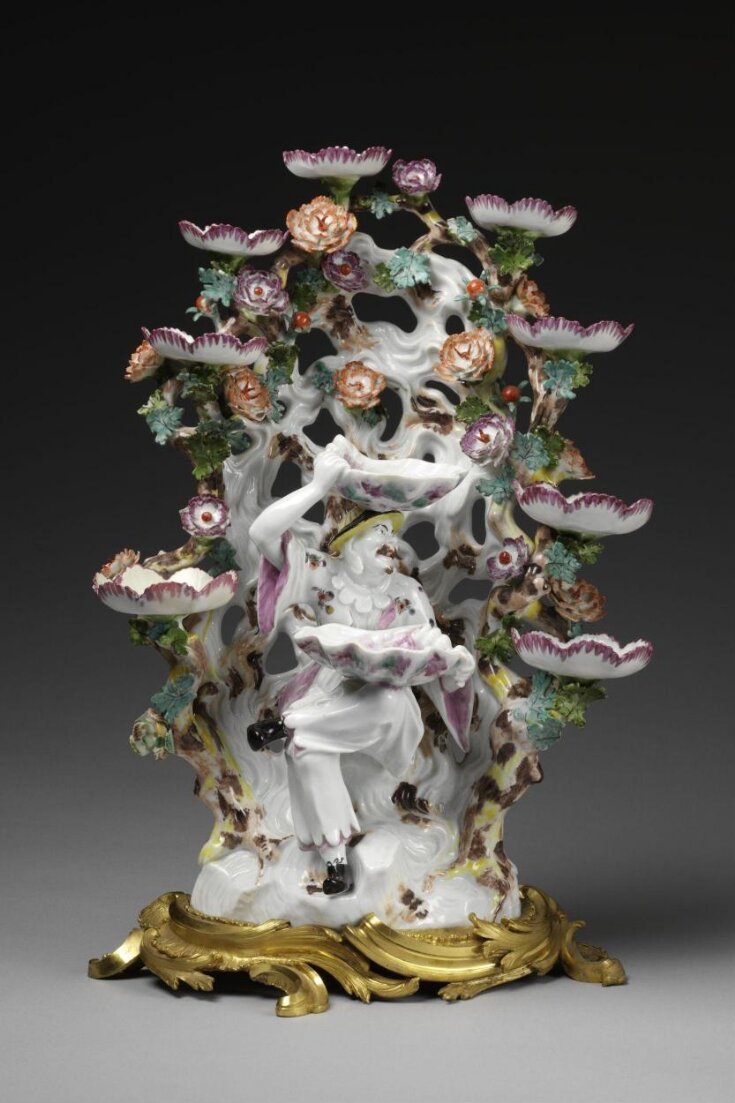
The original sculpted model for this piece was listed in Kändler’s workbook in May 1735, where he described it as an ‘Indian grotto’ with shells and leaves for holding sweetmeats. He supplied two separately modelled and detachable seated figures – described as ‘Japanese’ – so that the factory could make these sweetmeat stands in matching pairs with male and female figures. Meissen factory documents often use the terms ‘Indian’ and ‘Chinese’ interchangeably for anything Chinese, and although Kändler described his figures as Japanese, the man’s scallop-bordered tunic and trousers are very similar to those of Meissen porcelain figures that were clearly intended as Chinese.
The term ‘sweetmeat’ was used for several different types of sweet delicacies, including cakes and pastries, sweets, and nuts and fruit preserved in sugar. They were served in the final, dessert course of a grand meal.
The original sculpted model for this piece was listed in Kändler’s workbook in May 1735, where he described it as an ‘Indian grotto’ with shells and leaves for holding sweetmeats. He supplied two separately modelled and detachable seated figures – described as ‘Japanese’ – so that the factory could make these sweetmeat stands in matching pairs with male and female figures. Meissen factory documents often use the terms ‘Indian’ and ‘Chinese’ interchangeably for anything Chinese, and although Kändler described his figures as Japanese, the man’s scallop-bordered tunic and trousers are very similar to those of Meissen porcelain figures that were clearly intended as Chinese.
The term ‘sweetmeat’ was used for several different types of sweet delicacies, including cakes and pastries, sweets, and nuts and fruit preserved in sugar. They were served in the final, dessert course of a grand meal.
Object details
| Categories | |
| Object type | |
| Parts | This object consists of 2 parts.
|
| Materials and techniques | Hard-paste porcelain, with gilt-brass (ormolu) base |
| Brief description | Large sweetmeat stand with figure of a man in Chinese dress, hard-paste porcelain with 19th-century gilt brass base, modelled by J.J. Kändler, Meissen porcelain factory, Meissen, ca. 1735. |
| Physical description | Large sweetmeat stand with detatchable figure of a man in Chinese dress, hard-paste porcelain with 19th-century gilt-brass (ormolu) base, modelled by J.J. Kändler, Meissen porcelain factory, Meissen, ca. 1735. |
| Dimensions |
|
| Credit line | Purchased with Art Fund support |
| Historical context | The stand would have been one of a pair and its companion would have had a female figure. They were presumably set on a table set against a wall. It would have been used for sweet delicacies, such as small cakes and pastries, sweets, and nuts or fruit preserved in sugar. It would have been used in the final, dessert course of a grand meal. |
| Subject depicted | |
| Summary | The hugely talented and prolific modeller J.J. Kändler (1706-1775) worked for the Meissen porcelain factory between 1731 and 1775, a period of forty-four years in which he created over 2000 original models for figures, animals, groups and functional pieces such as this sweetmeat stand. In so doing he single-handedly established most of the sculptural conventions that governed the production of the earliest European porcelain figures. The original sculpted model for this piece was listed in Kändler’s workbook in May 1735, where he described it as an ‘Indian grotto’ with shells and leaves for holding sweetmeats. He supplied two separately modelled and detachable seated figures – described as ‘Japanese’ – so that the factory could make these sweetmeat stands in matching pairs with male and female figures. Meissen factory documents often use the terms ‘Indian’ and ‘Chinese’ interchangeably for anything Chinese, and although Kändler described his figures as Japanese, the man’s scallop-bordered tunic and trousers are very similar to those of Meissen porcelain figures that were clearly intended as Chinese. The term ‘sweetmeat’ was used for several different types of sweet delicacies, including cakes and pastries, sweets, and nuts and fruit preserved in sugar. They were served in the final, dessert course of a grand meal. |
| Bibliographic reference | Passion for Porcelain: masterpieces of ceramics from the British Museum and the Victoria and Albert Museum.
pp.284-285 |
| Collection | |
| Accession number | C.124&A-1977 |
About this object record
Explore the Collections contains over a million catalogue records, and over half a million images. It is a working database that includes information compiled over the life of the museum. Some of our records may contain offensive and discriminatory language, or reflect outdated ideas, practice and analysis. We are committed to addressing these issues, and to review and update our records accordingly.
You can write to us to suggest improvements to the record.
Suggest feedback
You can write to us to suggest improvements to the record.
Suggest feedback
| Record created | August 15, 2006 |
| Record URL |
Download as: JSONIIIF Manifest
