
Sack
1755 - 1760 (weaving), 1760 - 1765 (sewing), 1770s (altered), 1870 - 1910 (altered)
| Artist/Maker | |
| Place of origin |
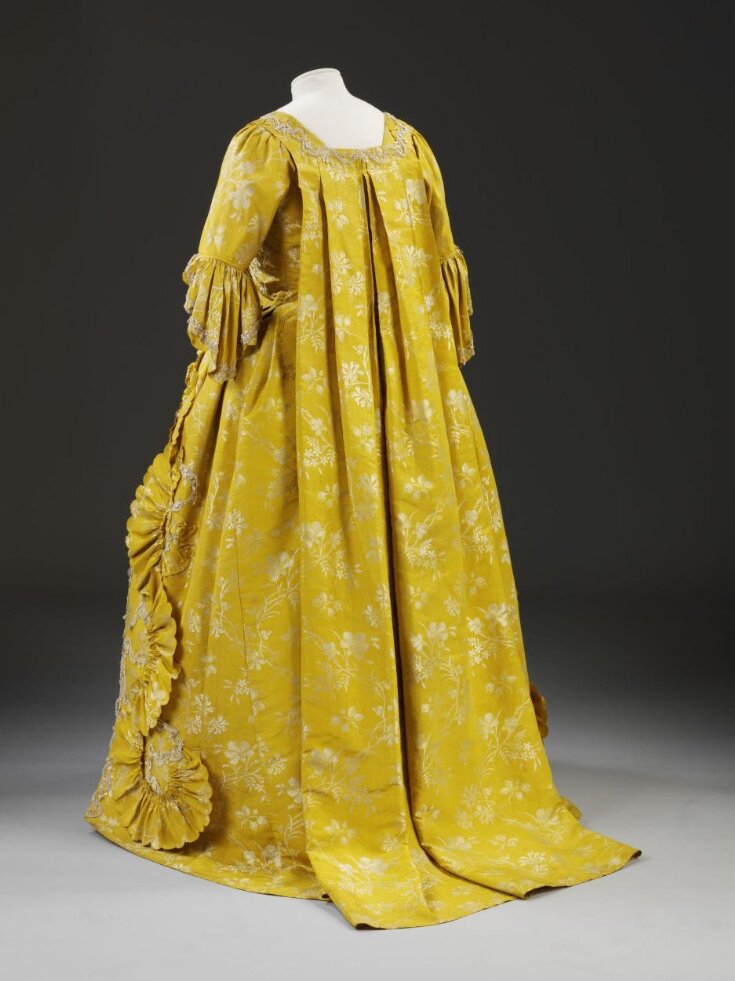
The style and decoration of this sack characterise women’s fashion of the early 1760s. Adorning the front are wide strips of silk, the raw edges pinked and scalloped. These have been gathered and sewn on in serpentine curves. A narrow strip of gathered silk and an elaborate white silk braid further enrich the decorative effect. The curvilinear arrangement of this appliqué reflects the principles of Rococo design.
The sack has been made from a floral patterned silk woven in Spitalfields, London. In the article on silk designing from a contemporary handbook to art and manufacture, George Smith's Laboratory or School of Arts, the author recommends that pattern-drawers should take advantage of the seasonal variety offered by nature. 'Every season of the year produces .... plants, flowers and shrubs, as afford greater varieties than we are able to imitate. Summer will in like manner furnish a manufacturer with a vast variety of new and beautiful objects...and the produce of flowers thereof...will charm the eye.' The naturalistic drawing of the flowers in this dress fabric, including honeysuckle and rosebuds, illustrates this characteristic of English silks very well.
The sack has been made from a floral patterned silk woven in Spitalfields, London. In the article on silk designing from a contemporary handbook to art and manufacture, George Smith's Laboratory or School of Arts, the author recommends that pattern-drawers should take advantage of the seasonal variety offered by nature. 'Every season of the year produces .... plants, flowers and shrubs, as afford greater varieties than we are able to imitate. Summer will in like manner furnish a manufacturer with a vast variety of new and beautiful objects...and the produce of flowers thereof...will charm the eye.' The naturalistic drawing of the flowers in this dress fabric, including honeysuckle and rosebuds, illustrates this characteristic of English silks very well.
Object details
| Categories | |
| Object type | |
| Parts | This object consists of 2 parts.
|
| Materials and techniques | Silk, linen, silk thread, linen thread; hand-woven, hand-sewn |
| Brief description | Woman's sack and petticoat, 1760-65, British; yellow silk figured with white floral trails, Spitalfields, 1755-60; altered 1870-1910 |
| Physical description | A woman's sack and petticoat of yellow plain-woven silk with a supplementary weft of white silk making the pattern, which is of floral trails including honeysuckle and rosebuds. The sack is open at the front with robings to the waist and elbow-length sleeves with a single, scalloped and pinked sleeve ruffled. The bodice and sleeves are lined with bleached linen. The back has two double box pleats stitched at the neckline. There is a waist seam from the front opening to the bodice side-back seam. The sack is made of 4 widths of silk with partial panel and triangular gore of silk on each side of the front. A narrow ruching of pinked scalloped silk adorns the robings and back neck, arranged in a serpentine line, with a fringe of white silk gimp and floss knots sewn on top. A wide ruching of scalloped pinked silk, arranged in reversing curves, decorated the skirt fronts. A length of the silk gimp edges each skirt front and serpentine curves of fringe are sewn to the skirt fronts. The silk gimp also edges the sleeve ruffles. The petticoat is made of 5 widths of silk, with a box pleat at the centre front and flat pleats at the sides and back. The waist is bound with linen tape which forms the ties at the back waist. There are pocket openings on either side. The front of the petticoat is decorated with a deep flounce of scalloped, pinked silk, edged at the bottom with the white silk gimp and arranged in a serpentine line. At some point in the 1770s or 1780s, the petticoat was lengthened at the waistline and waist binding re-sewn. Some of the stitching holding the ruching of the front skirts was unpicked. The sack was altered for fancy dress in the late 19th century. Two darts (now unpicked) were machine-sewn into the bodice fronts and a hook and eye sewn to the bottom of the front robings. |
| Dimensions |
|
| Production type | Unique |
| Object history | Purchased. Registered File number 1990/2183. Two lace borders that were attached to the gown as cuffs when it arrived were detached as they were not original to it. They have been given the numbers T.183:1&2-1991. |
| Historical context | The flowing style of the sack dominated women’s fashions during the 18th century. It developed from a loose negligee or robe volante and became a more formal style from the 1740s until 1790. The double box arrangement of the pleats at the back of are typical of the construction of the sack in the mid century. Most sacks of this period were made of four widths of silk at the back and two at the front. The lengths of silk were cut to accommodate the height of the wearer. By adjusting the depth and placement of the pleats at the waist and shoulder, the sack would be made to conform to the shape and measurements of the woman for whom it was made. This sack and petticoat would have been worn with a hooped petticoat, acting as a support and creating the silhouette of both garments. |
| Subjects depicted | |
| Summary | The style and decoration of this sack characterise women’s fashion of the early 1760s. Adorning the front are wide strips of silk, the raw edges pinked and scalloped. These have been gathered and sewn on in serpentine curves. A narrow strip of gathered silk and an elaborate white silk braid further enrich the decorative effect. The curvilinear arrangement of this appliqué reflects the principles of Rococo design. The sack has been made from a floral patterned silk woven in Spitalfields, London. In the article on silk designing from a contemporary handbook to art and manufacture, George Smith's Laboratory or School of Arts, the author recommends that pattern-drawers should take advantage of the seasonal variety offered by nature. 'Every season of the year produces .... plants, flowers and shrubs, as afford greater varieties than we are able to imitate. Summer will in like manner furnish a manufacturer with a vast variety of new and beautiful objects...and the produce of flowers thereof...will charm the eye.' The naturalistic drawing of the flowers in this dress fabric, including honeysuckle and rosebuds, illustrates this characteristic of English silks very well. |
| Bibliographic reference | Hart, Avril and Susan North. Historical Fashion in Detail: The 17th and 18th Centuries. London: V&A Publications, 1998, pp. 34 & 50 |
| Collection | |
| Accession number | T.426&A-1990 |
About this object record
Explore the Collections contains over a million catalogue records, and over half a million images. It is a working database that includes information compiled over the life of the museum. Some of our records may contain offensive and discriminatory language, or reflect outdated ideas, practice and analysis. We are committed to addressing these issues, and to review and update our records accordingly.
You can write to us to suggest improvements to the record.
Suggest feedback
You can write to us to suggest improvements to the record.
Suggest feedback
| Record created | August 15, 2006 |
| Record URL |
Download as: JSONIIIF Manifest
