Helen of Troy
Bust
after 1812 (made)
after 1812 (made)
| Artist/Maker | |
| Place of origin |
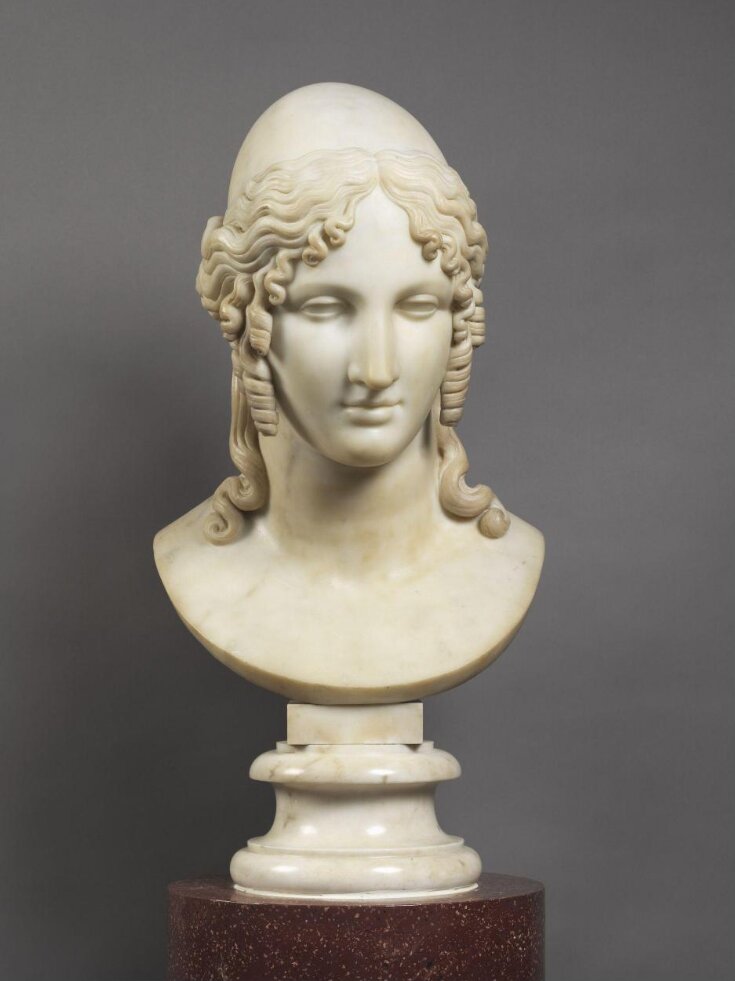
In mythology, Helen was the daughter of the god Jupiter and was famed for her great beauty. Jupiter, taking the form of a swan, seduced Leda, who gave birth to Helen from an egg, as well as Clytemnestra and Castor and Pollux, hence the eggshell seen here on Helen's head. Helen was married to Menelaus, the King of Sparta. Whilst her husband was away, she was abducted by the Trojan prince Paris, to whom she was later married. So began a long war between the Greeks and Trojans. A number of other versions of this head are known, one of which is in the Palazzo Albrizzi in Venice. It was seen by the poet Lord Byron in 1812, who wrote:
‘In this beloved marble view
Above the works and thoughts of Man,
What nature could, but would not, do
And beauty and Canova can!’
Another version is in the collection of Lord Londonderry, having been presented to Robert Stewart, Viscount Castlereagh, later 2nd Marquess of Londonderrry, in 1816 (see 'Canova Ideal Heads', ed. K. Eustace (exh. cat.), The Ashmolean Museum, Oxford, 1997, pp. 84-5, cat. no. 4). The V&A's Helen was presented to the Museum by the National Portrait Gallery in 1930, having been purchased at auction for its pedestal in 1929 from Stratton Park, Hampshire.
‘In this beloved marble view
Above the works and thoughts of Man,
What nature could, but would not, do
And beauty and Canova can!’
Another version is in the collection of Lord Londonderry, having been presented to Robert Stewart, Viscount Castlereagh, later 2nd Marquess of Londonderrry, in 1816 (see 'Canova Ideal Heads', ed. K. Eustace (exh. cat.), The Ashmolean Museum, Oxford, 1997, pp. 84-5, cat. no. 4). The V&A's Helen was presented to the Museum by the National Portrait Gallery in 1930, having been purchased at auction for its pedestal in 1929 from Stratton Park, Hampshire.
Delve deeper
Discover more about this object

Object details
| Categories | |
| Object type | |
| Title | Helen of Troy (generic title) |
| Materials and techniques | Carved marble |
| Brief description | Bust, marble, of Helen of Troy, by Antonio Canova (Italian), after 1812 |
| Physical description | Bust in marble of Helen of Troy looking downwards, the face framed in long ringlets. The top of the head covered with half an eggshell, reflecting the story of her birth, her mother being Leda, her father Jupiter, taking the form of a swan. |
| Dimensions |
|
| Gallery label | Antonio Canova (1757–1822)
Helen of Troy
After 1812
In Greek mythology, Helen, the daughter of the god Jupiter, was famed for her beauty. She was married to Menelaus, King of Sparta, but the Trojan prince Paris abducted her, triggering a ten-year war between the Greeks and Trojans. Canova, who was the most celebrated sculptor in Europe in the 1810s, carved several versions of this bust. Lord Byron wrote a poem in 1812 after seeing one of the versions in Venice.
Rome
Marble
Possibly formerly in the Earl of Northbrook’s collection in Stratton Park, Hampshire(2021) |
| Object history | Probably purchased in 1822 from the workshop by Sir Thomas Baring (1772-1848) or Sir Francis Thornhill Baring (1796-1866), 1st Baron of Northbrook; by descent to Francis George Baring (1850-1929), 2nd Earl of Northbrook Stratton Park Sale, 27-29 November 1930; purchased by the National Portrait Gallery, London; transfered to the V&A in 1930. |
| Subject depicted | |
| Summary | In mythology, Helen was the daughter of the god Jupiter and was famed for her great beauty. Jupiter, taking the form of a swan, seduced Leda, who gave birth to Helen from an egg, as well as Clytemnestra and Castor and Pollux, hence the eggshell seen here on Helen's head. Helen was married to Menelaus, the King of Sparta. Whilst her husband was away, she was abducted by the Trojan prince Paris, to whom she was later married. So began a long war between the Greeks and Trojans. A number of other versions of this head are known, one of which is in the Palazzo Albrizzi in Venice. It was seen by the poet Lord Byron in 1812, who wrote: ‘In this beloved marble view Above the works and thoughts of Man, What nature could, but would not, do And beauty and Canova can!’ Another version is in the collection of Lord Londonderry, having been presented to Robert Stewart, Viscount Castlereagh, later 2nd Marquess of Londonderrry, in 1816 (see 'Canova Ideal Heads', ed. K. Eustace (exh. cat.), The Ashmolean Museum, Oxford, 1997, pp. 84-5, cat. no. 4). The V&A's Helen was presented to the Museum by the National Portrait Gallery in 1930, having been purchased at auction for its pedestal in 1929 from Stratton Park, Hampshire. |
| Bibliographic references |
|
| Collection | |
| Accession number | A.46-1930 |
About this object record
Explore the Collections contains over a million catalogue records, and over half a million images. It is a working database that includes information compiled over the life of the museum. Some of our records may contain offensive and discriminatory language, or reflect outdated ideas, practice and analysis. We are committed to addressing these issues, and to review and update our records accordingly.
You can write to us to suggest improvements to the record.
Suggest feedback
You can write to us to suggest improvements to the record.
Suggest feedback
| Record created | August 14, 2006 |
| Record URL |
Download as: JSONIIIF Manifest
