
Kimono
1910-1930 (made)
| Artist/Maker | |
| Place of origin |
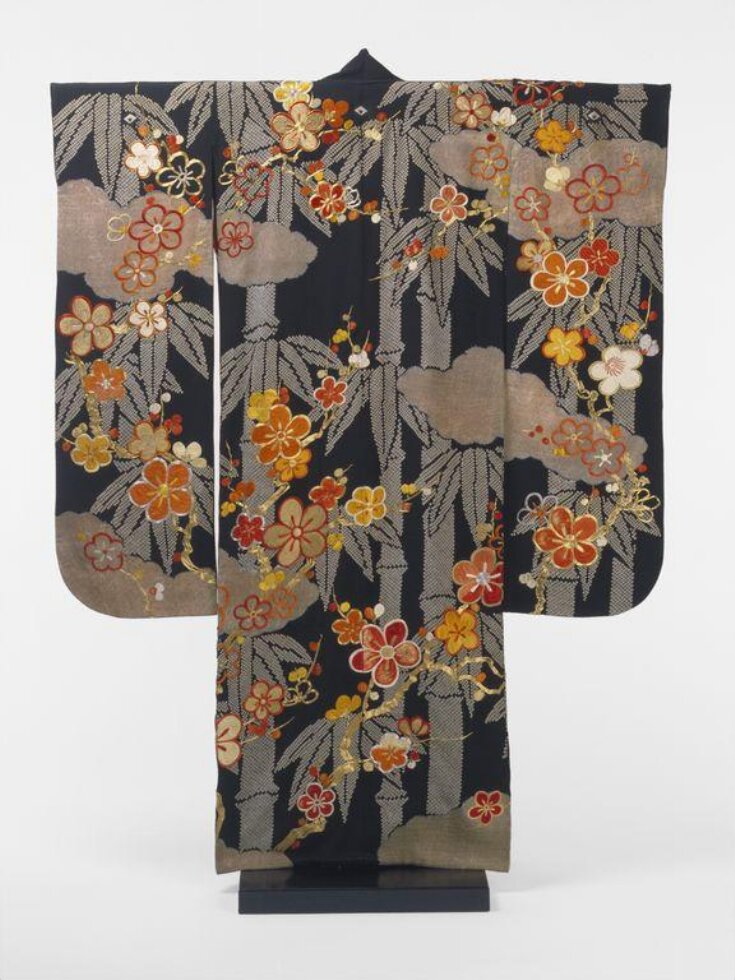
The striking pattern of this kimono reveals the dynamism of Japanese textile design in the early 20th century. A traditional motif of bamboo, plum blossoms and clouds has been dramatically enlarged, the bold design reflecting the confident spirit of the period. The bamboo has been executed in a method of tie-dyeing called shibori, while the plum blossoms are lavishly embroidered in orange, yellow and gold. These auspicious motifs and expensive techniques suggest this may have been a garment for a very special occasion, or perhaps that the young woman who wore it was a geisha.
Object details
| Categories | |
| Object type | |
| Materials and techniques | Plain weave crepe silk with tie-dying (<i>shibori</i>) and embroidery in silk and metallic threads |
| Brief description | Kimono, plain weave crepe silk with resist-dyed and embroidered decoration of bamboo and plum, Japan, 1910-1930 |
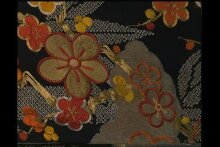
| Physical description | Kimono for a young woman (furisode) of heavy black silk crêpe (chirimen) with an overall design of bamboo and flowering plums. Lined with red plain-weave silk. Large areas of golden beige, representing clouds, have been reserved by means of stitch-resist shibori. Surface gold has then been painted on and randomly scored. In these areas the fabric is quite stiff. The bamboo trunks and leaves have also been resist-dyed, although it is unclear whether the technique used is kanoko shibori or is created using stencils. The lack of regularity and the slight surface texture suggest kanoko shibori, although the latter may have been approximated by using a blunt tool to press the central dot from behind. The cloud and bamboo design continues on the reverse of the skirt. Flowering plums are embroidered over the clouds and bamboo in various shades of orange, yellow, red, cream and green untwisted silk which is couched down diagonally with fine thread of the same colour. The branches and edges of the flowers are in gold and silver thread which is couched down with yellow and white thread respectively. Gold and silver thread is also used for some of the flowers and appears to have been passed through the fabric itself. There are five diamond shaped mon of hanging wisteria. These have been resisted out and the black lines of the design have been printed or stencilled on. The five mon, long sleeves, black ground, and rich design suggest that this kimono would have been worn at a formal occasion. |
| Dimensions |
|
| Subjects depicted | |
| Summary | The striking pattern of this kimono reveals the dynamism of Japanese textile design in the early 20th century. A traditional motif of bamboo, plum blossoms and clouds has been dramatically enlarged, the bold design reflecting the confident spirit of the period. The bamboo has been executed in a method of tie-dyeing called shibori, while the plum blossoms are lavishly embroidered in orange, yellow and gold. These auspicious motifs and expensive techniques suggest this may have been a garment for a very special occasion, or perhaps that the young woman who wore it was a geisha. |
| Collection | |
| Accession number | FE.17-1994 |
About this object record
Explore the Collections contains over a million catalogue records, and over half a million images. It is a working database that includes information compiled over the life of the museum. Some of our records may contain offensive and discriminatory language, or reflect outdated ideas, practice and analysis. We are committed to addressing these issues, and to review and update our records accordingly.
You can write to us to suggest improvements to the record.
Suggest feedback
You can write to us to suggest improvements to the record.
Suggest feedback
| Record created | August 2, 2006 |
| Record URL |
Download as: JSON
