
Altar Frontal
12th century (embroidered)
| Artist/Maker | |
| Place of origin |
Altar frontals were introduced as liturgical furnishings in the fifth century. These textiles, often richly worked, introduced a welcome note of colour and ornament to the church interior, but their purpose was principally symbolic. The altar they covered, considered by the church to be Christ's table, was vested with a great spiritual significance. The sanctity of the altar was thus conveyed by the fine materials and elaborate techniques employed in the frontal that covered it. This particular altar frontal was identified by Donald King as the earliest example of its type in existence.
While it is not known for whom the frontal was commissioned, we do know that it came from La Seo de Urgel in northern Catalonia, which has long been a seat of episcopal power for the Roman Catholic church.
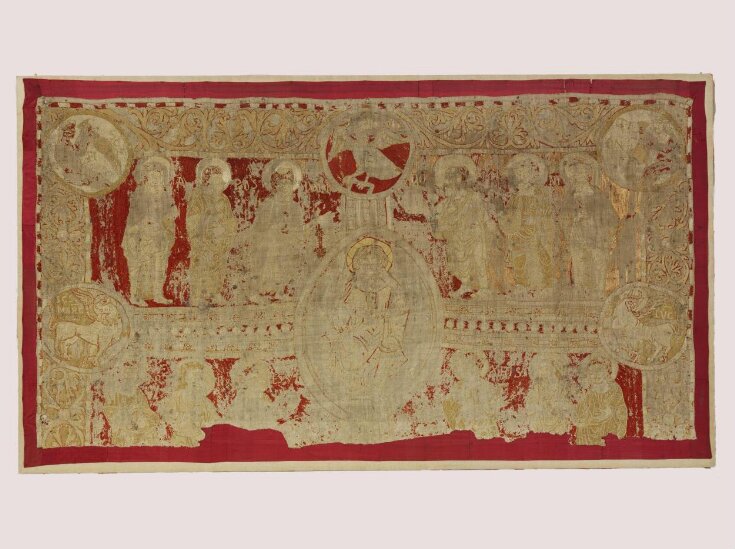
The frontal is of linen, embroidered with red, pink, yellow and white silk threads. The now much faded scene depicted on the frontal is that of Christ in Majesty, surrounded by the four evangelists and the twelve apostles; this is one of the more conventional subjects that constitutes part of the great wealth of Christian iconography.
While it is not known for whom the frontal was commissioned, we do know that it came from La Seo de Urgel in northern Catalonia, which has long been a seat of episcopal power for the Roman Catholic church.
The frontal is of linen, embroidered with red, pink, yellow and white silk threads. The now much faded scene depicted on the frontal is that of Christ in Majesty, surrounded by the four evangelists and the twelve apostles; this is one of the more conventional subjects that constitutes part of the great wealth of Christian iconography.
Object details
| Categories | |
| Object type | |
| Materials and techniques | Linen embroidered with silks |
| Brief description | Altar frontal, shows Christ in Majesty, Apostles, symbols of the Evangelists and allegorical depictions of the rivers of Paradise; embroidered silks on linen; Spanish Catalan; 12th century. |
| Physical description | Altar frontal of linen, embroidered with coloured silks in different shades of red and yellow. Rectangular, divided into four parts by two bands of decoration forming a cross: in each of the four smaller panels are three figures of apostles on a red ground, with a continuous inscription between their heads. In the centre of the cross is a vescia-shaped glory containing the seated figure of Christ in Majesty with traces of lettering on each side (see Marks/Subjects). At the ends of the crossed bands are medallions with the symbols of the evangelists, a lion, an eagle and an ox. In the corners are medallions with the Rivers of Paradise, which are represented by nude figures holding urns. Around the whole runs a broad band of conventional acrolling foliage, interrupted by the medallions, with a narrow chequered border. The ground is in two shades of dark and light red (now much worn). The bottom of the frontal containing the lower part of the second row of apostles, and the medallions with the symbols of S. Matthew, Hiddekel and Euphrates, is missing. Description taken from accession register. |
| Dimensions |
|
| Marks and inscriptions |
|
| Object history | The frontal came from la Seu d'Urgell in northern Catalonia. There is a silk-embroidered banner of St. Oth (Sant Ot) in the Design Museum of Barcelona (Museu del Disseny de Barcelona) that bears a strong resemblance to this altar frontal, indicating that both objects may be from the same workshop. Purchased for £42.17s.6d in the Bourgeois Sale, 1904. |
| Subjects depicted | |
| Summary | Altar frontals were introduced as liturgical furnishings in the fifth century. These textiles, often richly worked, introduced a welcome note of colour and ornament to the church interior, but their purpose was principally symbolic. The altar they covered, considered by the church to be Christ's table, was vested with a great spiritual significance. The sanctity of the altar was thus conveyed by the fine materials and elaborate techniques employed in the frontal that covered it. This particular altar frontal was identified by Donald King as the earliest example of its type in existence. While it is not known for whom the frontal was commissioned, we do know that it came from La Seo de Urgel in northern Catalonia, which has long been a seat of episcopal power for the Roman Catholic church. The frontal is of linen, embroidered with red, pink, yellow and white silk threads. The now much faded scene depicted on the frontal is that of Christ in Majesty, surrounded by the four evangelists and the twelve apostles; this is one of the more conventional subjects that constitutes part of the great wealth of Christian iconography. |
| Bibliographic references |
|
| Collection | |
| Accession number | 1387-1904 |
About this object record
Explore the Collections contains over a million catalogue records, and over half a million images. It is a working database that includes information compiled over the life of the museum. Some of our records may contain offensive and discriminatory language, or reflect outdated ideas, practice and analysis. We are committed to addressing these issues, and to review and update our records accordingly.
You can write to us to suggest improvements to the record.
Suggest feedback
You can write to us to suggest improvements to the record.
Suggest feedback
| Record created | August 2, 2006 |
| Record URL |
Download as: JSONIIIF Manifest
