
Locket
ca.1780 (made)
| Artist/Maker | |
| Place of origin |
Hair had long been important in sentimental jewellery, but during the 18th century it took on a new prominence. It could now form the centrepiece of a jewel, arranged in complicated motifs or as plain, woven sections. Tiny fragments of hair could even be incorporated into delicate paintings. Some designs were made by professionals, but many women chose to work the hair of loved ones themselves, using gum to secure their creations.
Hair jewels were worn to cherish the living as well as to remember the dead. The survival of many pieces celebrating love and friendship indicate their great social importance.
Hair jewels were worn to cherish the living as well as to remember the dead. The survival of many pieces celebrating love and friendship indicate their great social importance.
Object details
| Categories | |
| Object type | |
| Materials and techniques | Enamelled gold, ivory with a painted monogram and set with hair |
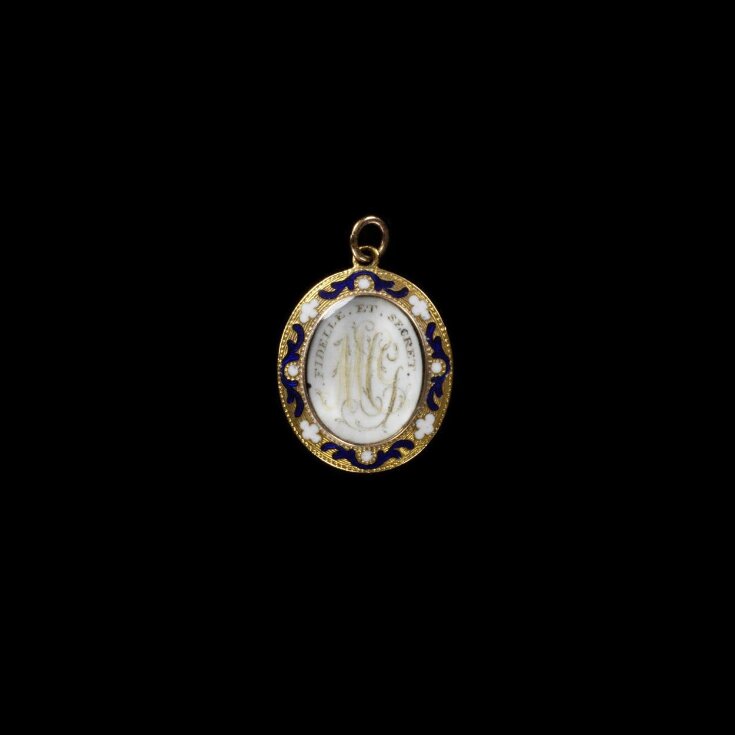
| Brief description | Enamelled gold locket, ivory painted in waterolour, monogram MCG decorated with hair and the motto FIDELLE ET SECRET, England, ca. 1780 |
| Physical description | Enamelled gold locket enamel and design in hair on ivory with watercolour inscription under glass. Painted monogram MCG decorated with hair and the motto Faithful and secret in French FIDELLE ET SECRET. The back set with hair. |
| Dimensions |
|
| Marks and inscriptions |
|
| Credit line | Bequeathed by Mrs Isobel Baynes |
| Subject depicted | |
| Summary | Hair had long been important in sentimental jewellery, but during the 18th century it took on a new prominence. It could now form the centrepiece of a jewel, arranged in complicated motifs or as plain, woven sections. Tiny fragments of hair could even be incorporated into delicate paintings. Some designs were made by professionals, but many women chose to work the hair of loved ones themselves, using gum to secure their creations. Hair jewels were worn to cherish the living as well as to remember the dead. The survival of many pieces celebrating love and friendship indicate their great social importance. |
| Collection | |
| Accession number | M.57-1950 |
About this object record
Explore the Collections contains over a million catalogue records, and over half a million images. It is a working database that includes information compiled over the life of the museum. Some of our records may contain offensive and discriminatory language, or reflect outdated ideas, practice and analysis. We are committed to addressing these issues, and to review and update our records accordingly.
You can write to us to suggest improvements to the record.
Suggest feedback
You can write to us to suggest improvements to the record.
Suggest feedback
| Record created | July 19, 2006 |
| Record URL |
Download as: JSONIIIF Manifest
