
Slide
1775-1800 (made)
| Artist/Maker | |
| Place of origin |
Memorial jewellery to honour the dead is one of the largest categories of 18th- century jewellery to survive. Many mourning jewels have inscriptions that record the name and dates of the dead person.
From 1760 there was a new vogue for memorial medallions or lockets. These became especially popular in Britain, though similar work was produced throughout Europe.
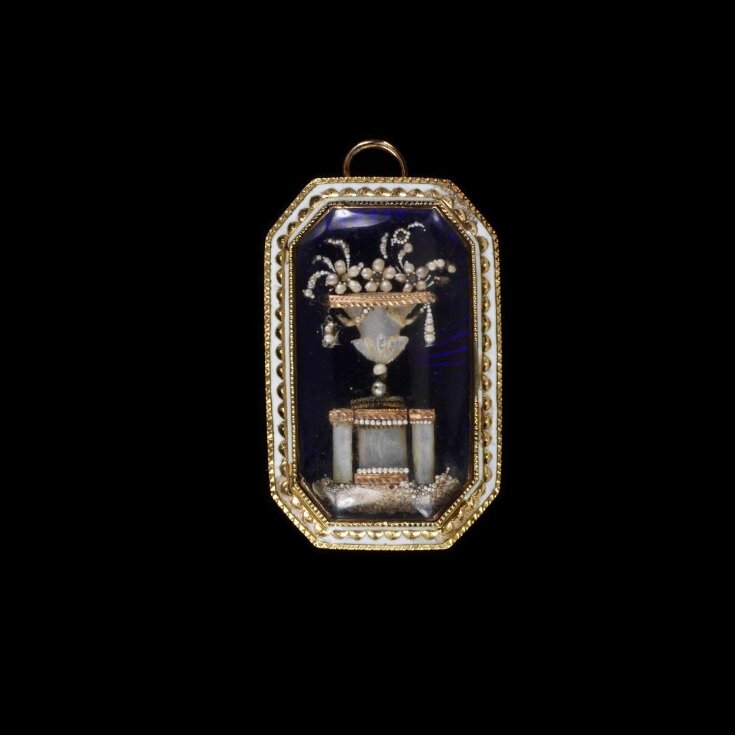
The lockets could be bought ready made, and the designs were standardised. Neo-classical motifs of funerary urns, plinths and obelisks joined the more traditional cherubs, angels and weeping willows. Hair was preserved as curls within the locket, or cut up and used to create designs.
From 1760 there was a new vogue for memorial medallions or lockets. These became especially popular in Britain, though similar work was produced throughout Europe.
The lockets could be bought ready made, and the designs were standardised. Neo-classical motifs of funerary urns, plinths and obelisks joined the more traditional cherubs, angels and weeping willows. Hair was preserved as curls within the locket, or cut up and used to create designs.
Object details
| Categories | |
| Object type | |
| Materials and techniques | Enamelled gold, seed pearls and mother of pearl under glass |
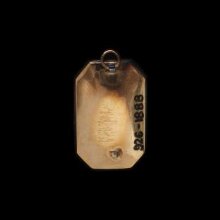
| Brief description | Locket with an enamelled gold frame, with enamel decoration enclosing a composition of an urn in gold, seed pearls and mother of pearl under glass, possibly France, 1775-1800 |
| Physical description | Locket with an enamelled gold frame, with enamel decoration enclosing a composition of an urn in gold, seed pearls and mother of pearl under glass |
| Dimensions |
|
| Object history | Part of a group of memorial and mourning jewels bought from Dr Marco Guastalla, acting on behalf of 'an English lady residing in Italy' (museum numbers 846-1888 to 989-1888) |
| Subject depicted | |
| Summary | Memorial jewellery to honour the dead is one of the largest categories of 18th- century jewellery to survive. Many mourning jewels have inscriptions that record the name and dates of the dead person. From 1760 there was a new vogue for memorial medallions or lockets. These became especially popular in Britain, though similar work was produced throughout Europe. The lockets could be bought ready made, and the designs were standardised. Neo-classical motifs of funerary urns, plinths and obelisks joined the more traditional cherubs, angels and weeping willows. Hair was preserved as curls within the locket, or cut up and used to create designs. |
| Collection | |
| Accession number | 926-1888 |
About this object record
Explore the Collections contains over a million catalogue records, and over half a million images. It is a working database that includes information compiled over the life of the museum. Some of our records may contain offensive and discriminatory language, or reflect outdated ideas, practice and analysis. We are committed to addressing these issues, and to review and update our records accordingly.
You can write to us to suggest improvements to the record.
Suggest feedback
You can write to us to suggest improvements to the record.
Suggest feedback
| Record created | July 18, 2006 |
| Record URL |
Download as: JSONIIIF Manifest
