
Beads
19th century (made)
| Artist/Maker | |
| Place of origin |
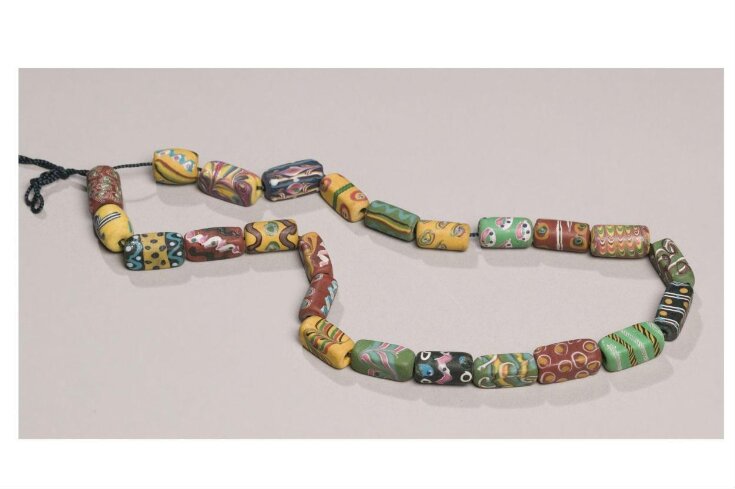
These glass beads are of the kind known as ‘trade’, ‘aggry’ or, sometimes, ‘slave’ beads. They are usually associated with West Africa but were originally created in Europe, particularly Venice, Bohemia and the Netherlands. The history of trade beads dates to the 15th century when Portuguese trading ships arrived on the coast of West Africa to exploit its many resources, including gold, slaves, ivory and palm oil. At that time, beads were a major part of the currency exchanged for people and products. Over the following four centuries millions of beads were traded to Africa and by the 19th century European bead makers were producing a wide variety of designs specifically for the African trade.
Some designs were particularly popular, such as the millefiori (‘thousand flower’) form seen here, which reinvented an ancient technique from western Asia to produce colourful beads formed of many small cross-sections of multicoloured canes fused together or embedded into a matrix.
Some designs were particularly popular, such as the millefiori (‘thousand flower’) form seen here, which reinvented an ancient technique from western Asia to produce colourful beads formed of many small cross-sections of multicoloured canes fused together or embedded into a matrix.
Object details
| Categories | |
| Object type | |
| Materials and techniques | Millefiori glass |
| Brief description | 24 glass 'trade' beads, made in Italy (Venice), 19th century, for European trade in Africa (part of set of 56 beads) |
| Physical description | 24 glass beads of opaque variegated glass (millefiori technique) |
| Credit line | Transferred from the Museum of Practical Geology |
| Object history | These beads were given to the Museum of Practical Geology, located at Jermyn Street, London. The Museum was established in 1835 to illustrate 'the mineral wealth of the United Kingdom and [its] colonies' and contained examples of industrial and artistic products made from raw materials mined from the earth. Its displays included glass and ceramic ware. Some of the collections were transferred to the Victoria and Albert Museum in 1901. The donor of the beads was Moses Lewin Levin, a London bead merchant whose import-export business operated from 1839 to 1913. Most of the beads he dealt in appear to be Venetian although in 1898 the Levin Company was listed as an importer of Venetian, Bohemian and German beads. The British Museum has an important collection of glass trade beads (including some on sample cards) acquired in 1865 from Lewin Levin. (See – The History of Beads, from 30,000 BC to the Present, Lois Sherr Dubin, London: Thames & Hudson, 1987, p10.) |
| Historical context | The accessions register notes that the beads were 'made in imitation of ancient Egyptian beads for use in the African slave trade'. |
| Summary | These glass beads are of the kind known as ‘trade’, ‘aggry’ or, sometimes, ‘slave’ beads. They are usually associated with West Africa but were originally created in Europe, particularly Venice, Bohemia and the Netherlands. The history of trade beads dates to the 15th century when Portuguese trading ships arrived on the coast of West Africa to exploit its many resources, including gold, slaves, ivory and palm oil. At that time, beads were a major part of the currency exchanged for people and products. Over the following four centuries millions of beads were traded to Africa and by the 19th century European bead makers were producing a wide variety of designs specifically for the African trade. Some designs were particularly popular, such as the millefiori (‘thousand flower’) form seen here, which reinvented an ancient technique from western Asia to produce colourful beads formed of many small cross-sections of multicoloured canes fused together or embedded into a matrix. |
| Associated object | 4552:1-1901 (Set) |
| Collection | |
| Accession number | 4552:2-1901 |
About this object record
Explore the Collections contains over a million catalogue records, and over half a million images. It is a working database that includes information compiled over the life of the museum. Some of our records may contain offensive and discriminatory language, or reflect outdated ideas, practice and analysis. We are committed to addressing these issues, and to review and update our records accordingly.
You can write to us to suggest improvements to the record.
Suggest feedback
You can write to us to suggest improvements to the record.
Suggest feedback
| Record created | July 12, 2006 |
| Record URL |
Download as: JSONIIIF Manifest
