
Embroidered Casket
c. 1660s (made)
| Artist/Maker | |
| Place of origin |
This casket came originally from the Smart family of Norcott Hall, Hertfordshire. Family history associates it with a visit to the house by Charles II. It passed by inheritance to Elizabeth Smart, who married John Loxley in the 19th century.
The embroidery on the casket is in exceptionally fine condition. The casket has come to the museum with its wooden protective case, lined with marbled paper, and a pink silk slip cover, made to protect the delicate surfaces of the embroidery. Together these have helped to preserve it from damage and the fading of its fresh colours.
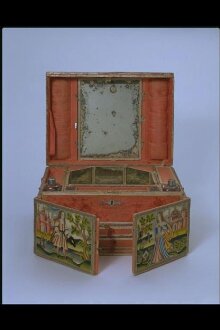
The panels of the casket would have been worked by a young girl, of about the age of 11 or 12, as the culmination of her needlework education, which would have begun with samplers, and the decoration of small objects like pin cushions. She would embroider a series of small panels drawn or printed with pictorial scenes, which would then be sent to a cabinet maker to be made up into a casket, the edges bound with braid. The caskets were fitted with a variety of drawers and compartments, suitable for keeping jewellery, writing equipment and letters, needlework tools, tiny toys or keepsakes. They often had one or two secret drawers, for their young owners' most precious or private possessions; this casket has five, concealed with considerable ingenuity.
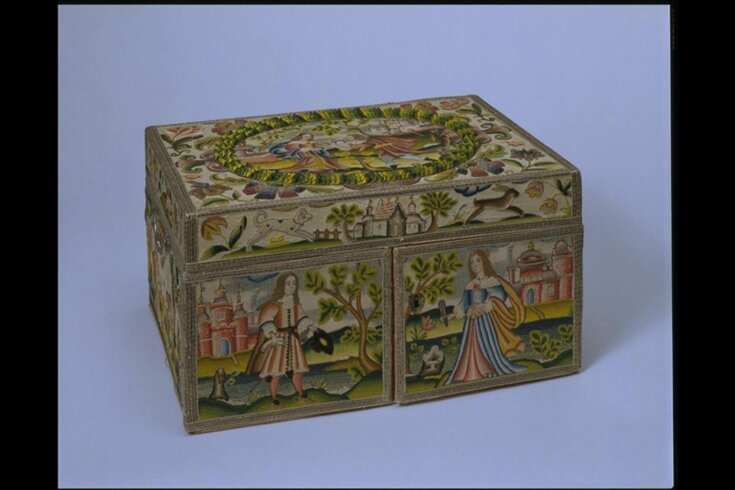
Biblical scenes were the most common choice for this type of embroidery, and this example has episodes from the story of Tobias and the Archangel Raphael round some of its sides, with Rebecca and Elizir on the lid. Rebecca may be an Old Testament heroine, but the young girl who embroidered her image here has brought her right up to date, dressing her in the high heels, lace collar and elaborate ringlets of a Stuart lady.
The embroidery on the casket is in exceptionally fine condition. The casket has come to the museum with its wooden protective case, lined with marbled paper, and a pink silk slip cover, made to protect the delicate surfaces of the embroidery. Together these have helped to preserve it from damage and the fading of its fresh colours.
The panels of the casket would have been worked by a young girl, of about the age of 11 or 12, as the culmination of her needlework education, which would have begun with samplers, and the decoration of small objects like pin cushions. She would embroider a series of small panels drawn or printed with pictorial scenes, which would then be sent to a cabinet maker to be made up into a casket, the edges bound with braid. The caskets were fitted with a variety of drawers and compartments, suitable for keeping jewellery, writing equipment and letters, needlework tools, tiny toys or keepsakes. They often had one or two secret drawers, for their young owners' most precious or private possessions; this casket has five, concealed with considerable ingenuity.
Biblical scenes were the most common choice for this type of embroidery, and this example has episodes from the story of Tobias and the Archangel Raphael round some of its sides, with Rebecca and Elizir on the lid. Rebecca may be an Old Testament heroine, but the young girl who embroidered her image here has brought her right up to date, dressing her in the high heels, lace collar and elaborate ringlets of a Stuart lady.
Object details
| Categories | |
| Object type | |
| Materials and techniques | Embroidery on silk panels, mounted onto a wooden base |
| Brief description | Embroidered casket, top depicts Rebecca at the Well, English c. 1660s |
| Physical description | Wooden casket with embroidered panels Decoration & Design Satin worked with silk thread. The panels are edged with silver braid. The casket has handles on either side and is missing feet. The panels are all decorated in biblical scenes. The top depicts Rebekah at the Well giving Eliezer a drink, the left door shows Eliezer taking leave of Abraham and the right shows him journeying, leading a camel. On the right side Eliezer is shown meeting Laban and Rebekah, on the back Eliezer leads Rebekah on a camel, and on the left side is the meeting of Issac and Rebekah. The sides of the lid are decorated with insects, animals and flowers. The interior is lined with pink silk and the front of the drawers are covered with pink silk velvet. The edges of the compartment and the mirror surround are painted purple and stamped with silver. The drawers are edged with silver braid. Construction The casket is rectangular, the lid hinges upwards and has a space for a mirror. The main compartment has multiple smaller compartments including a mirrored compartment set with a print. The base of the casket has one long drawer surmounted by 3 smaller drawers. Thre further drawers can be found behind the top panel, which can be removed by turning the key and lifting at the same time. |
| Dimensions |
|
| Credit line | Accepted in lieu of inheritance tax from the estate of Mrs Lavender Loxley by HM Government and allocated to the Victoria and Albert Museum |
| Object history | Lady Bingham of Cornhill, the daughter of Elizabeth Loxley, from whose estate the casket came, gave the following verbal account of its history : The casket came from the Smart family of Norcott Hall, Hertfordshire. Family history associates it with a visit to the house by Charles II, to commemorate which it was said to have been made. It passed by inheritance to Elizabeth Smart, who married John Loxley in the 19th century. He demolished Norcott Hall. [nb the Christies valuation on the RF names this lady as Elizabeth Stuart, and the house as Norcott Court, but Smart and Norcott Hall were the names given by Lady Bingham.] |
| Summary | This casket came originally from the Smart family of Norcott Hall, Hertfordshire. Family history associates it with a visit to the house by Charles II. It passed by inheritance to Elizabeth Smart, who married John Loxley in the 19th century. The embroidery on the casket is in exceptionally fine condition. The casket has come to the museum with its wooden protective case, lined with marbled paper, and a pink silk slip cover, made to protect the delicate surfaces of the embroidery. Together these have helped to preserve it from damage and the fading of its fresh colours. The panels of the casket would have been worked by a young girl, of about the age of 11 or 12, as the culmination of her needlework education, which would have begun with samplers, and the decoration of small objects like pin cushions. She would embroider a series of small panels drawn or printed with pictorial scenes, which would then be sent to a cabinet maker to be made up into a casket, the edges bound with braid. The caskets were fitted with a variety of drawers and compartments, suitable for keeping jewellery, writing equipment and letters, needlework tools, tiny toys or keepsakes. They often had one or two secret drawers, for their young owners' most precious or private possessions; this casket has five, concealed with considerable ingenuity. Biblical scenes were the most common choice for this type of embroidery, and this example has episodes from the story of Tobias and the Archangel Raphael round some of its sides, with Rebecca and Elizir on the lid. Rebecca may be an Old Testament heroine, but the young girl who embroidered her image here has brought her right up to date, dressing her in the high heels, lace collar and elaborate ringlets of a Stuart lady. |
| Collection | |
| Accession number | T.114:1-1999 |
About this object record
Explore the Collections contains over a million catalogue records, and over half a million images. It is a working database that includes information compiled over the life of the museum. Some of our records may contain offensive and discriminatory language, or reflect outdated ideas, practice and analysis. We are committed to addressing these issues, and to review and update our records accordingly.
You can write to us to suggest improvements to the record.
Suggest feedback
You can write to us to suggest improvements to the record.
Suggest feedback
| Record created | December 10, 1999 |
| Record URL |
Download as: JSONIIIF Manifest
