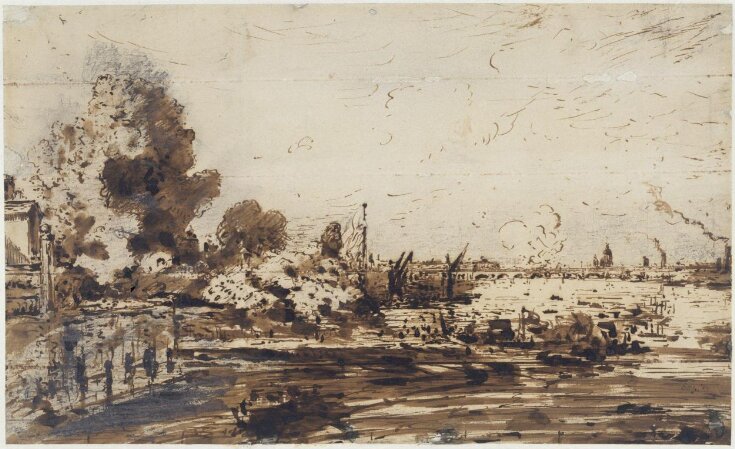

The Thames with Waterloo Bridge
Drawing
ca. 1819 (made)
ca. 1819 (made)
| Artist/Maker | |
| Place of origin |
Drawing of waterloo bridge with trees and boats.
Object details
| Categories | |
| Object type | |
| Title | The Thames with Waterloo Bridge (popular title) |
| Materials and techniques | Pen and bistre, with alterations in pencil and repairs in Indian ink |
| Brief description | Drawing, 'The Thames with Waterloo Bridge' by John Constable, pen and bistre, ca. 1819 |
| Physical description | Drawing of waterloo bridge with trees and boats. |
| Dimensions |
|
| Credit line | Given by Isabel Constable, daughter of the artist |
| Historical context | In 1819 Constable exhibited at the Royal Academy 'A scene on the River Stour' ('The White Horse'), bought by John Fisher, and now in the Frick Collection, New York (see the sketch-book No. 132, pp. 66 and 70). His second child Maria Louisa (Minna) was born on 19 July. He took a house at Hampstead for the first time at the end of the summer. He was elected A.R.A. on 1 November. [G Reynolds, 1973, p. 121] |
| Place depicted | |
| Bibliographic references |
|
| Other number | 175, plate 139 - Reynolds catalogue no. |
| Collection | |
| Accession number | 604-1888 |
About this object record
Explore the Collections contains over a million catalogue records, and over half a million images. It is a working database that includes information compiled over the life of the museum. Some of our records may contain offensive and discriminatory language, or reflect outdated ideas, practice and analysis. We are committed to addressing these issues, and to review and update our records accordingly.
You can write to us to suggest improvements to the record.
Suggest feedback
You can write to us to suggest improvements to the record.
Suggest feedback
| Record created | July 7, 2006 |
| Record URL |
Download as: JSONIIIF Manifest
