
Wedding Dress
1841 (made)
| Artist/Maker | |
| Place of origin |
Sarah Maria Wright (1817 – 1908) wore this dress for her marriage to Daniel Neal (1816 – 1907) on 27 July 1841 at St. Nicholas' Church in Skirbeck, Lincolnshire. It was donated together with a spelling book which she inscribed with her name on February 15th, 1826.
In the 1851 census Daniel is described as living at Woad Farm House in Skirbeck, Lincolnshire, where he was probably working as a labourer in the production of woad. The dress therefore reveals the type of clothing rural labourers' wives might wear for their weddings. Such objects tend to survive in much smaller quantities than fashionable wedding dress as they would have been worn for Sunday best long after the event, or handed down.
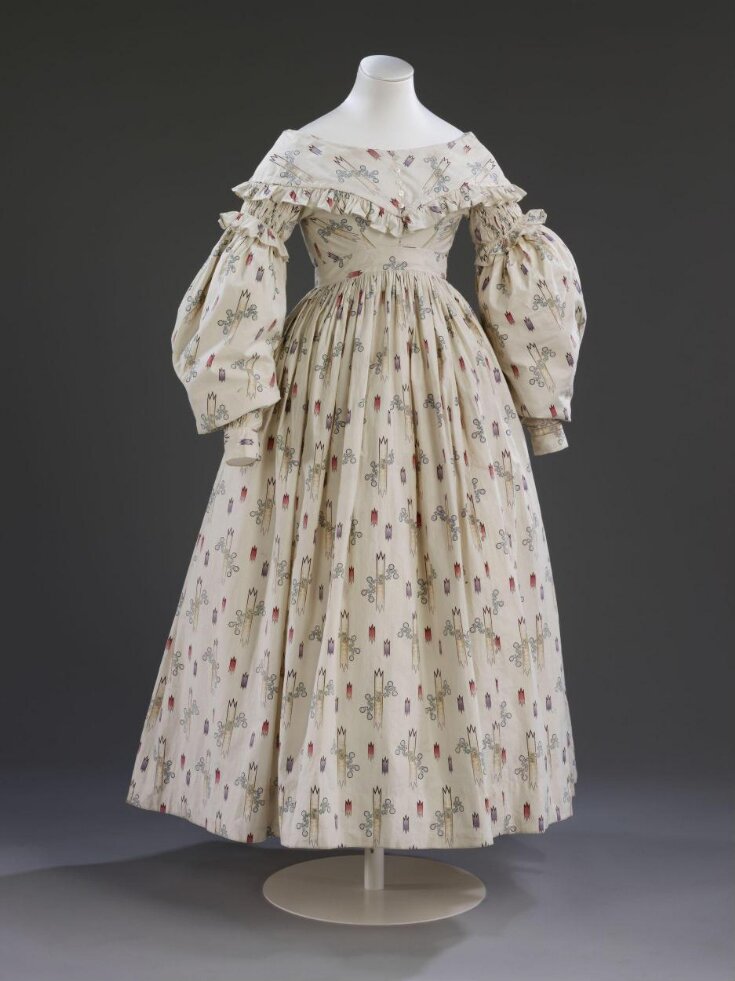
Sarah chose a fashionable design for her dress with its full sleeves, low neckline, gathered shoulders and full skirt. It is, however, made of printed cotton which would have been cheaper than the silks and challis fabrics of costlier wedding dresses. The print is a copy of more expensive designs which again adds interest as such textiles do not tend to survive.
In the 1851 census Daniel is described as living at Woad Farm House in Skirbeck, Lincolnshire, where he was probably working as a labourer in the production of woad. The dress therefore reveals the type of clothing rural labourers' wives might wear for their weddings. Such objects tend to survive in much smaller quantities than fashionable wedding dress as they would have been worn for Sunday best long after the event, or handed down.
Sarah chose a fashionable design for her dress with its full sleeves, low neckline, gathered shoulders and full skirt. It is, however, made of printed cotton which would have been cheaper than the silks and challis fabrics of costlier wedding dresses. The print is a copy of more expensive designs which again adds interest as such textiles do not tend to survive.
Object details
| Categories | |
| Object type | |
| Materials and techniques | Block-printed cotton, part-lined with linen, hand sewn |
| Brief description | Wedding dress, white cotton block-printed with ribbons and bubbles in cream, pink, blue and purple ink, worn 1840-50, made in England. |
| Physical description | This long day dress has a low neck and sleeves which are gathered at the shoulder and then full to the wrist. It also has a narrow waist and gathered skirts. The white fabric is printed with an abstract design resembling ribbons and bubbles in cream, pink, blue and and purple ink. The bodice has been carefully enlarged. |
| Dimensions |
|
| Gallery label | Cotton print wedding dress
Britain
1841, with later alterations
Many women, particularly those with less money, wore coloured wedding dresses, which were more practical than white. When Sarah Maria Wright married Daniel Neal, a farm labourer from Lincolnshire, she chose washable printed cotton. The pattern is up-to-date but the cut of the dress follows the silhouette of the mid- to late-1830s, reflecting the slower pace of changing fashion in rural communities.
Block-printed cotton, lined with linen
Given by Sheila Battram and Linda Grantham
V&A: T.27-2006(2011) |
| Credit line | Given by Sheila Battram and Linda Grantham |
| Object history | This dress was worn by Sarah Maria Wright (1817-1908) at her marriage to Daniel Neal (1816-1907) which took place at St. Nicholas Skirbeck on 27 July 1841. In the 1851 census the couple were living with their son William at Woad House Farm, Skirbeck. Daniel is described as an agricultural labourer. In the 1841 census Sarah is listed as living with her family at Skirbeck Bank. They include Daniel Wright, aged 38, also an agricultural labourer. Woad was producded in Skirbeck until 1932. Dr. Philip Sykas has dated the block-printed cotton to c. 1840. The 'ribbon' motifs may have been printed from an ombre (rainbowed) block, and could be an example of the use of the toby tub to print several colours at once, thus reducing the cost of the print. It appears to be a middle-quality print, from the spring season, and no more than one year out of date as ombre styles were being revived around the start of the 1840s. Historical significance: This dress is a rare example of a dress chosen by a working-class bride for her wedding. |
| Summary | Sarah Maria Wright (1817 – 1908) wore this dress for her marriage to Daniel Neal (1816 – 1907) on 27 July 1841 at St. Nicholas' Church in Skirbeck, Lincolnshire. It was donated together with a spelling book which she inscribed with her name on February 15th, 1826. In the 1851 census Daniel is described as living at Woad Farm House in Skirbeck, Lincolnshire, where he was probably working as a labourer in the production of woad. The dress therefore reveals the type of clothing rural labourers' wives might wear for their weddings. Such objects tend to survive in much smaller quantities than fashionable wedding dress as they would have been worn for Sunday best long after the event, or handed down. Sarah chose a fashionable design for her dress with its full sleeves, low neckline, gathered shoulders and full skirt. It is, however, made of printed cotton which would have been cheaper than the silks and challis fabrics of costlier wedding dresses. The print is a copy of more expensive designs which again adds interest as such textiles do not tend to survive. |
| Associated object | |
| Collection | |
| Accession number | T.27-2006 |
About this object record
Explore the Collections contains over a million catalogue records, and over half a million images. It is a working database that includes information compiled over the life of the museum. Some of our records may contain offensive and discriminatory language, or reflect outdated ideas, practice and analysis. We are committed to addressing these issues, and to review and update our records accordingly.
You can write to us to suggest improvements to the record.
Suggest feedback
You can write to us to suggest improvements to the record.
Suggest feedback
| Record created | June 19, 2006 |
| Record URL |
Download as: JSONIIIF Manifest
