Casket
1608-1615 (made)
| Artist/Maker | |
| Place of origin |
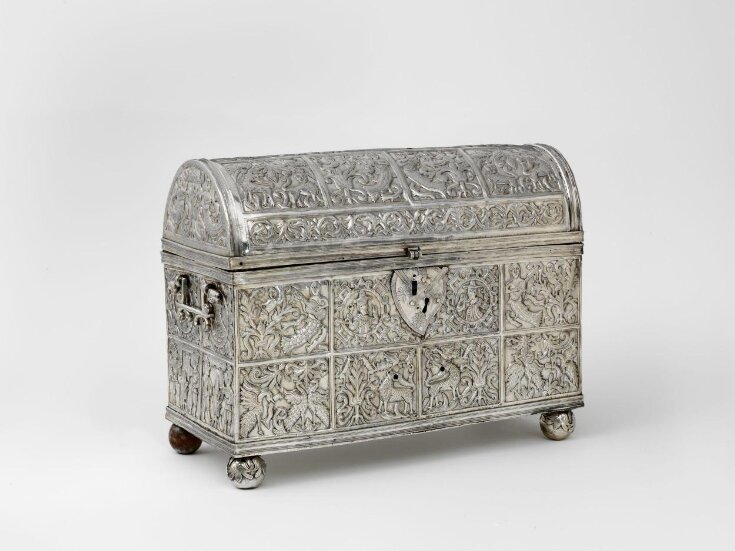
This casket (Spanish 'arqueta') for personal possessions was made in an unidentified workshop in the Spanish colony of Alto Perú (the Andean region of modern Bolivia and Peru). The decoration includes mermaids playing the 'charango' (a type of Peruvian guitar), viscachas (a South American rodent) and catfish. The town and maker's marks stamped on the base had originally suggested to scholars that the casket was made in Toledo (the silversmith Antonio Pérez de Montalto, whose mark appears here, was also assay master there between 1654 and 1685). However, as the ornament on this casket closely resembles other examples on silverware, furnishings and textiles made in the Andean region of colonial Spain, the Spanish marks represent tests on the quality of the silver made when the casket was imported to Europe.
An inscription on the lid identifies its original owner as a woman called Mensia Tenorio. She is probably same lady who is recorded in a list of the household of the Marquis of Montesclaros drawn up in 1607, and would have sailed with him from Seville to Peru when he took up his post as Viceroy there in 1608.
An inscription on the lid identifies its original owner as a woman called Mensia Tenorio. She is probably same lady who is recorded in a list of the household of the Marquis of Montesclaros drawn up in 1607, and would have sailed with him from Seville to Peru when he took up his post as Viceroy there in 1608.
Object details
| Category | |
| Object type | |
| Materials and techniques | silver, embossing, chasing |
| Brief description | Silver, Peru or Bolivia, 1608-1615, and stamped on base with mark of Antonio Pérez de Montalto (assay master 1654-85) and town mark of Toledo. |
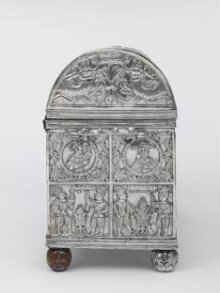
| Physical description | Oblong casket of silver with arched top and drop handles (the handle on the lid missing). Embossed and engraved with a mixture of Andean Indian and Western motifs, including mermaids, monkeys, catfish, viscachas, the sacred heart emblem of the Augustinian order (which also forms the lock plate) and male figures in seventeenth-century Western dress who play a ball game around a flower or bush. |
| Dimensions |
|
| Marks and inscriptions |
|
| Gallery label | Casket
About 1608–15
The Spanish noblewoman who owned this casket sailed from Spain to the Viceroyalty of Peru in 1608. The lock-plate representing the Sacred Heart is flanked by European men holding keys. The design below includes various creatures that are messengers of the divine in the spirit lore of the South American Andes, including birds of paradise and a rodent called a viscacha. The local goldsmith must have adapted the fish tails and guitars of the mermaids from European prints and textiles.
Alto Perú, now Bolivia
Inscribed in Spanish on the lid ‘This casket [belongs to] my lady Mensia Tenorio’
Silver(09.12.2015) |
| Object history | The casket was made in an unidentified workshop in the Spanish colony of Alto Perú (the Andean region of modern Bolivia and Peru). The original owner was a woman called Mensia Tenorio, who may be the lady of the same name identified as a servant of Don Diego Núñez de Ovando in Seville in 1607. Ovando was chamberlain to the Marquis of Montesclaros, governor of Peru between 1608-1615; Mensia was part of the retinue who followed the governor and his household to Peru in 1608 (Esteras Martín: 2006, p.197). The marks stamped on the underside of the casket show it was sent to Spain at an unspecified date before 1685 and presented at the Toledo assay office for testing. Antonio de Montalto, whose mark appears here, was assay master at Toledo between 1654 and 1685. The Museum purchased the casket in 1879 for £92 'from a convent at Toledo' (Special Loan Exhibition, cat. no. 884). The form of this casket (Spanish, 'arqueta') was popular in Spain and Spanish America from the sixteenth to the eighteenth centuries (cf. for example cat. nos 67 and 133 in The Colonial Andes.) Given the wealth of the Spanish colonial empire during the seventeenth century, these caskets were typically constructed of thick silver plates (as here), rather than of silver plaques nailed to a wooden core (see Esteras Martín, cat. entry 133 in The Colonial Andes). The piece is unusual because it is engraved with the name of its owner, Mensia Tenorio. Another silver casket of different form but also bearing Mensia's name and with similar decoration survives in a Peruvian private collection (Asociación Cultural Enrico Poli, Lima: see Esteras Martín, 2006, p.196). The town and maker's marks stamped on the base had originally suggested to scholars that the casket was made in Toledo, and English and Spanish writers have argued the source of the unusual iconography lies in Portuguese Sri Lanka (Oman: 1968) or in Islamic Spain (for a summary of the arguments, see Esteras Martín: 2004, p.195). The most recent research (Esteras Martín: 2006 and Hecht: 2004) places the mermaid and animal motifs in the context of the silversmithing workshops of the Viceroyalty of Peru, in the area known as 'Alto Perú' (today the Andean region of Bolivia and Peru). |
| Historical context | Silver caskets of this type generally held personal possessions but could also be used in an ecclesiastical context to store the consecrated bread wafers, or Hosts, essential to the Christian celebration of mass (for an example see The Colonial Andes, cat. no. 133). Esteras Martín (2006, p.196) suggests the figures of men playing and losing a ball game depicted on the sides reflect the casket's role as a prize in a wager. The fact the Museum purchased the casket from a religious institution in Toledo in the nineteenth century may imply it was originally brought to Spain by a Spaniard who was entering holy orders (Esteras Martín 2006, p.200). |
| Production | The maker's mark of Antonio Pérez and the Toledo town mark were added when the casket was brought back to Spain and assayed. |
| Subjects depicted | |
| Summary | This casket (Spanish 'arqueta') for personal possessions was made in an unidentified workshop in the Spanish colony of Alto Perú (the Andean region of modern Bolivia and Peru). The decoration includes mermaids playing the 'charango' (a type of Peruvian guitar), viscachas (a South American rodent) and catfish. The town and maker's marks stamped on the base had originally suggested to scholars that the casket was made in Toledo (the silversmith Antonio Pérez de Montalto, whose mark appears here, was also assay master there between 1654 and 1685). However, as the ornament on this casket closely resembles other examples on silverware, furnishings and textiles made in the Andean region of colonial Spain, the Spanish marks represent tests on the quality of the silver made when the casket was imported to Europe. An inscription on the lid identifies its original owner as a woman called Mensia Tenorio. She is probably same lady who is recorded in a list of the household of the Marquis of Montesclaros drawn up in 1607, and would have sailed with him from Seville to Peru when he took up his post as Viceroy there in 1608. |
| Bibliographic references |
|
| Collection | |
| Accession number | 275-1879 |
About this object record
Explore the Collections contains over a million catalogue records, and over half a million images. It is a working database that includes information compiled over the life of the museum. Some of our records may contain offensive and discriminatory language, or reflect outdated ideas, practice and analysis. We are committed to addressing these issues, and to review and update our records accordingly.
You can write to us to suggest improvements to the record.
Suggest feedback
You can write to us to suggest improvements to the record.
Suggest feedback
| Record created | May 24, 2006 |
| Record URL |
Download as: JSONIIIF Manifest
