
The Thames from Millbank
Oil Painting
ca. 1836 (painted)
ca. 1836 (painted)
| Artist/Maker |
Richard Redgrave (1804-1888) entered the Royal Academy Schools in 1826. During his lifetime he exhibited 141 works at the Royal Academy, 17 at the British Institute and 20 at the Society of British Artists. He was elected a Royal Academician in 1851. Redgrave began his official career in art education in 1847 when he became Master at the Government School of Design, by 1874 he held the post of Director. He was also Inspector of the Queen's Pictures and compiled a catalogue of the Royal Collection between 1857 and 1879.
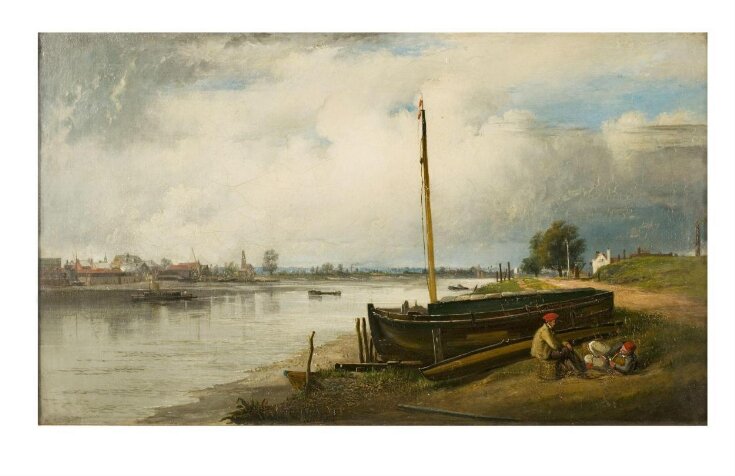
This particular painting was exhibited at the British Institute in 1836. The view depicted appears to be from the north by Lambeth Bridge looking across to what is now the Albert Embankment. Redgrave seems to have forsaken topographical accuracy in making the right (north bank) appear more rural than it probably was, as well as eliminating Vauxhaul Bridge and the Penitentiary.
This particular painting was exhibited at the British Institute in 1836. The view depicted appears to be from the north by Lambeth Bridge looking across to what is now the Albert Embankment. Redgrave seems to have forsaken topographical accuracy in making the right (north bank) appear more rural than it probably was, as well as eliminating Vauxhaul Bridge and the Penitentiary.
Object details
| Category | |
| Object type | |
| Title | The Thames from Millbank (generic title) |
| Materials and techniques | Oil on canvas |
| Brief description | Oil painting on canvas, 'The Thames from Millbank', Richard Redgrave, ca. 1836 |
| Physical description | In the right foreground a boat has been pulled up onto the banks of the River Thames. In front of it, to the right, are two men, each wearing a red hat - the one on the left sits on an ?upturned barrel (or something like this) while the other lies down in the grass. To their right is a path next to a grassy slope, behind which, in the distance is a white building and some trees. Three small boats sit on the glassy water of the Thames and in the distance on the left bank are a number of buildings, some with red roofs. A cloudy sky. |
| Dimensions |
|
| Object history | Purchased, 1887 Redgrave exhibited 'The Thames at Millbank' as no.83 at the British Institution in 1836. |
| Subjects depicted | |
| Place depicted | |
| Summary | Richard Redgrave (1804-1888) entered the Royal Academy Schools in 1826. During his lifetime he exhibited 141 works at the Royal Academy, 17 at the British Institute and 20 at the Society of British Artists. He was elected a Royal Academician in 1851. Redgrave began his official career in art education in 1847 when he became Master at the Government School of Design, by 1874 he held the post of Director. He was also Inspector of the Queen's Pictures and compiled a catalogue of the Royal Collection between 1857 and 1879. This particular painting was exhibited at the British Institute in 1836. The view depicted appears to be from the north by Lambeth Bridge looking across to what is now the Albert Embankment. Redgrave seems to have forsaken topographical accuracy in making the right (north bank) appear more rural than it probably was, as well as eliminating Vauxhaul Bridge and the Penitentiary. |
| Bibliographic references |
|
| Collection | |
| Accession number | 211-1887 |
About this object record
Explore the Collections contains over a million catalogue records, and over half a million images. It is a working database that includes information compiled over the life of the museum. Some of our records may contain offensive and discriminatory language, or reflect outdated ideas, practice and analysis. We are committed to addressing these issues, and to review and update our records accordingly.
You can write to us to suggest improvements to the record.
Suggest feedback
You can write to us to suggest improvements to the record.
Suggest feedback
| Record created | May 18, 2006 |
| Record URL |
Download as: JSONIIIF Manifest
