
Cassone
1500-1600 (made)
| Artist/Maker | |
| Place of origin |
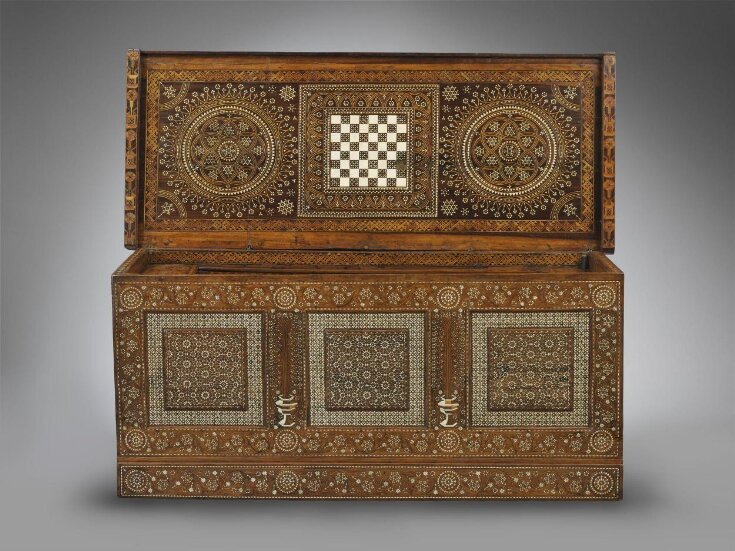
The practice of decorating wooden furniture wood with contrasting inlays was used by the craftsmen of Ancient Egypt. It continued to flourish during the Medieval period in Islamic cities such as Cairo and Damascus, where dense patterns were created using tiny inlaid pieces of bone or ivory and various woods. The technique seems to have been adopted in both Spain and Italy, particularly Venice from about 1450, and used particularly on boxes and chests like this one. References in Italian 16th-century inventories to chests alla veneziana (in the Venetian style) may refer to this style of decoration. During the 19th-century it came to be known as alla certosina work, because it was thought that Carthusian monks specialised in the technique, though there is no good evidence of it.
This chest once belonged to Jules Soulages (d. 1856) who created a notable collection of Renaissance artworks from about 1825, which he kept at his home in Paris, (and later in Toulouse). This chest was restored in Toulouse during his ownership. His collection was considered so important that it was exhibited in London (1857), and then purchased for the South Kensington Museum (which later became the Victoria and Albert Museum).
This chest once belonged to Jules Soulages (d. 1856) who created a notable collection of Renaissance artworks from about 1825, which he kept at his home in Paris, (and later in Toulouse). This chest was restored in Toulouse during his ownership. His collection was considered so important that it was exhibited in London (1857), and then purchased for the South Kensington Museum (which later became the Victoria and Albert Museum).
Object details
| Categories | |
| Object type | |
| Materials and techniques | Walnut, and rosewood, inlaid with bone and coloured woods |
| Brief description | Chest made using the certosina inlay technique |
| Physical description | Chest on low plinth decorated with geometrical inlay, containing three compartments which are fitted with lids and some small drawers. The back is plain. The underside of the lid, and the show surfaces of the internal compartments are decorated. The compartment insides are plain as are the inner faces of the chest boards except for traces of a white lining paper. The three-sided plinth (presumed to be a 19th century addition since it uses much fresher wood than the rest of the chest), projects along its front edge and is cut with ogee arch openings at both ends. The left compartment has a full-height partition front, and is fitted with a hinged lid. The right compartment is shallow, and contains a small, central drawer below a 'false' bottom. Its lid is extended at the rear end into an 'ear' possibly to serve as a prop to the chest lid. The rear compartment (with an added glue block support underneath) has a single long lid on two twisted wire hinges. It has four small drawers below the false bottom. All the internal small drawers have leather or canvas pulls. Construction - The carcase is dovetailed (showing 6 tails), with reinforcing nails. The back (with scrub plane marks visible), sides and bottom are all apparently formed from single wide boards, while the front board consists of 2 butted planks. X-rays would be needed to tell whether the lid is a single board. The lid has two end cleats (fixed with nails), with an applied batten along the front edge; it is held on four ring hinges (originally five). Decoration The inlay is apparently a mix of small pieces directly inlaid into the ground wood, and applied veneers with inlay. Bone and ivory tesserae are used extensively on the chest front and both faces of the lid, but not on the chest sides and internal compartments. The chest front with three raised square panels appears to have been created by cutting shallow channels around the 'panels', with two applied stiles and two muntins (approx. 2mm thick, using vertically grained, darker wood). Modifications - The plinth added. Extensive restoration to the inlay. Patches to the chest bottom and back Internal lockplate filled. Drawer pulls added Design The chest front appears to be panelled but these three square 'panels' are actually integral with the front board, and 'framed' by thin strips of walnut(?), which are inset and nailed into areas excavated from the solid wood. All three panels contain the same dense pattern of pointed stars, each panel set within a wide border of dense geometrical pattern of ‘Maltese’ crosses and stars. What reads as the framework is decorated with a regular pattern of scrolling stems with geometrical flowers, divided at regular intervals by concentric circles of geometric inlay. Both 'muntins' display distinctive attenuated plant stems with hexagonal flowers rising from a white hexagonal well-head. On both sides of the chest, set within a border of octagons is a geometrical design of a central six-pointed star within a circle enclosed by interlocking semi-circles. The upper surface of the lid has a narrow outer border of octagonal stars (tarsia a toppo) and is divided into three large circles which overlap slightly: a central circle with a square of flowers surrounded by a grid of small squares, borders of small triangles and diamond, larger triangles with ball finials alternating with flowers; two flanking circles with a central roundel surrounded by triangles with ball finials alternating with flowers, borders of diamonds and triangles, interlocking semi-circles with hexagonal flowers. Around the three large circles are four small geometric circles, smaller ‘snowflakes’ and corner ¼ circles each containing a ‘snowflake’. The front lip of the lid no longer sits over the chest front. It has a simple inlay design of six-pointed stars. The two side edges of the lid (including the cleats) are veneered on the outside face with a band of octagonal stars (tarsia a toppo), and on their underside with a repeat design of a ‘well-head’ and wheel. The underside of the lid displays three square compartments: a central chessboard (8x8) surrounded by interlocking arches and narrow borders of triangles and diamonds; two identical circles with interlace cord containing circles and triangles, surrounded by interlocking semi-circles with hexagonal flowers and corner ‘snowflakes’. Around the outside is a border of linked diamonds (tarsia a toppo). Running around the upper edges of the chest front, back and sides are three bands of zig-zag, and one band (at left) of alternating solid and open-work diamonds; around the top inner edge of the chest (sides and back) runs a border of linked diamonds (left and back), and octagonal stars (right), all tarsia a toppo. Plinth The outer faces of the plinth are inlaid with (front) – scrolling stems with white flowers and four large circles, and (sides) two circles with Maltese crosses flanking the ogee arch cut-out. Internal compartments The lids of all three compartments are inlaid with linked circles interspersed with a simple cross motif. The fronts (with small, plain drawers) show linked circles with ‘Maltese’ crosses and simple borders of stringing, triangles, rhombuses and crosses. The front of the full-height compartment on the left is inlaid with a circle bordered by interlacing semi-circles with hexagonal finials and crosses on stems, within a simple rhombus border. Inlay decoration Comparison with other unrestored examples of this type of chest suggests that the inlay consists of individual pieces of bone or wood inset and glued into hollows (2.5 to 3mm deep) cut into the matrix wood. Where these are square or nearly square, the hollows are flat-bottomed, and where visible cut roughly, presumably with a narrow chisel. Where there is stringing, the hollow is cut in a V-shape, presumably with a burin or V- blade chisel. The applied strips were presumably inlaid with individual tesserae before being glued to the carcase. Applied strips of ‘tarsia a toppo’ marquetry would simply have been glued. |
| Dimensions |
|
| Style | |
| Marks and inscriptions | RESTAURÉ PAR LADOUSE PÈRE & FILS CHEF D' ATELIER DE L'INSTITUT DES SOURDS-
MUETS TOULOUSE (Engraved on an oval metal plaque affixed to interior of chest) |
| Gallery label |
|
| Object history | Bought for £40. Formerly in the collection of Jules Soulages of Toulouse |
| Historical context | Other V&A examples of the same type of chest are: 7223-1860, 7822-1861 and 128-1892 At the time of writing 20 comparable chests are known (many with a north Italian provenance), which appear to display the same essential features: dimensions HWD: 46-49, 113-130, 47-54cm; construction: dovetail construction in walnut (very close to other walnut chests strongly associated with NE Italy (Friuli-Veneto); decorative technique: geometrical inlay in bone/ivory; smaller borders of rod-cut geometrical marquetry may also be found on the sides, the lid edges or underside, and around the interior of the chest as a frieze. Inlay materials used have not been studied consistently: rosewood, maple and fruitwood are said to have been used. design: a solid front with 3 ‘panels’ divided by two muntins decorated with the distinctive motif of a tree of life growing from a well; fitted interior compartments; the iconography includes variations of: square ‘pavement’ of tiny star-shaped flowers, interlace circles, stars within circles, IHS sacred monogram (often within a six-pointed star), chess boards on the lid. Variations among the group are: Some sit on low plinths (of two principal forms), with similar inlay on the front and sides. Where these exist the inlay tends to be of similar quality to the chest itself, suggesting that the plinths are not later additions. The front surface of the chest front is sometimes built up with applied (pegged) thicknesses of wood forming muntins and lower rail The extent of interior fitted compartments varies On the front ‘panels’ the central raised section has a sunken border; sometimes this is inlaid in the same manner as the ‘panels’, sometimes with rod-cut geometrical marquetry. The evidence (such as it currently recorded) may suggest that the type originated in NE Italy, but that it was made over an extended period of decades, during which time variations in technique were introduced; over this period it may be that more internal compartments were added, and greater use made of rod cut marquetry, accompanied by a decline in quality (seen in the greater size and lower precision of inlay). Whether the presence of the IHS motif indicates an effort, perhaps after c1540, to ‘Christianise’ decoration that was recognised as Islamic in origin is purely speculative. The presence of chess boards (usually on the upper surface of the chest lid) appears to make it less likely that chests with IHS were made for ecclesiastical settings. The rich decoration and internal compartments point to this type of chest being conceived as a luxurious, foreign-looking piece of domestic storage. Peter Thornton, in The Italian Renaissance Interior 1400-1600 (London 1991), p.92 suggests that geometric inlay (also developed as marquetry), in a style derived from the Near East, was confined to small panels until the early 15th century. He uses the term 'lavoro di intarsio', noting 9n.6) that 'allo certosino' is the frequently used 20th century term: "It was such a widespread technique that it cannot have been confined to workshops in Carthusian monasteries - or to monasteries generally. On the other hand, a surprising number of monks became celebrated experts in the fully-developed [figurative] 'lavoro di intarsio' during the second half of the 15th century. Many travelled and set up workshops whenever needed; few were confined to monasteries during their active life." He illustrates (fig. 122) the Birth of the Virgin by Paolo di Giovanni Fei, (1380s), with bed chests with inlaid decoration of six-pointed stars, squares, rectangles and circles. See also fig. 173, Birth of St John the Baptist by Pinturrichio (Siena Cathedral), c1504 (?) with inlaid 8-pointed stars. |
| Production | Certosina was traditionally thought to be made in northern Italy, in Genoa or the Veneto. More likely to be Spanish production - the designs are always non-figurative, based on abstract geometric ornament, especially starbursts, and sometimes floral motifs. The sixteenth-century date is indicated by the occasional use of Renaissance motifs, such as the elaborate flower pots on the front of this chest. (M. Rosser-Owen, 2010). |
| Subject depicted | |
| Summary | The practice of decorating wooden furniture wood with contrasting inlays was used by the craftsmen of Ancient Egypt. It continued to flourish during the Medieval period in Islamic cities such as Cairo and Damascus, where dense patterns were created using tiny inlaid pieces of bone or ivory and various woods. The technique seems to have been adopted in both Spain and Italy, particularly Venice from about 1450, and used particularly on boxes and chests like this one. References in Italian 16th-century inventories to chests alla veneziana (in the Venetian style) may refer to this style of decoration. During the 19th-century it came to be known as alla certosina work, because it was thought that Carthusian monks specialised in the technique, though there is no good evidence of it. This chest once belonged to Jules Soulages (d. 1856) who created a notable collection of Renaissance artworks from about 1825, which he kept at his home in Paris, (and later in Toulouse). This chest was restored in Toulouse during his ownership. His collection was considered so important that it was exhibited in London (1857), and then purchased for the South Kensington Museum (which later became the Victoria and Albert Museum). |
| Bibliographic references |
|
| Collection | |
| Accession number | 7224-1860 |
About this object record
Explore the Collections contains over a million catalogue records, and over half a million images. It is a working database that includes information compiled over the life of the museum. Some of our records may contain offensive and discriminatory language, or reflect outdated ideas, practice and analysis. We are committed to addressing these issues, and to review and update our records accordingly.
You can write to us to suggest improvements to the record.
Suggest feedback
You can write to us to suggest improvements to the record.
Suggest feedback
| Record created | May 4, 2006 |
| Record URL |
Download as: JSONIIIF Manifest
