Figure
ca. 1780 (made)
| Artist/Maker | |
| Place of origin |
The earliest porcelain figures were made for the dessert course of grand dinners and replaced the sugar paste and wax figures made since medieval times for royal feasts. Originally intended as expressions of dynastic power and to celebrate political allegiances, allegorical themes had been introduced into these table settings by the 16th century. By the 18th century many were entirely decorative.
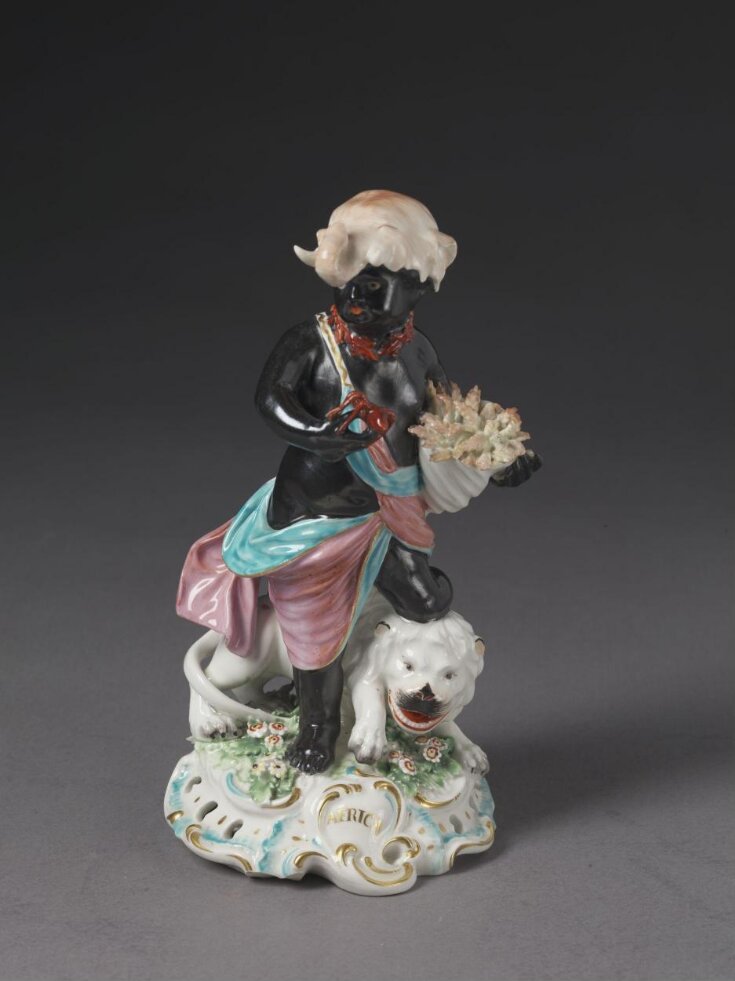
A convention for depicting the Four Continents as female figures was used as early as the Counter-Reformation to symbolise the worldwide spread of Catholic Christendom. The figures were given wider appeal through their inclusion in the Iconologia of Cesare Ripa, an illustrated book of emblems widely used by artists from the early 17th century. ‘Africa’ was conventionally depicted as a black woman with ‘an Elephant’s Head for her Crest; a Necklace of Coral; and Pendents [sic] of the same, at her Ears; a Scorpion in her right Hand, and a Cornucopia, with Ears of Corn, in her left; a fierce Lion by her, on one Side, and a Viper and Serpent on the other.’ Here ‘Africa’ takes the form of a black child.
A convention for depicting the Four Continents as female figures was used as early as the Counter-Reformation to symbolise the worldwide spread of Catholic Christendom. The figures were given wider appeal through their inclusion in the Iconologia of Cesare Ripa, an illustrated book of emblems widely used by artists from the early 17th century. ‘Africa’ was conventionally depicted as a black woman with ‘an Elephant’s Head for her Crest; a Necklace of Coral; and Pendents [sic] of the same, at her Ears; a Scorpion in her right Hand, and a Cornucopia, with Ears of Corn, in her left; a fierce Lion by her, on one Side, and a Viper and Serpent on the other.’ Here ‘Africa’ takes the form of a black child.
Object details
| Categories | |
| Object type | |
| Materials and techniques | Soft-paste porcelain painted in enamels and gilded |
| Brief description | Figure in soft-paste porcelain painted in enamels of a black boy representing 'Africa', Derby, ca. 1780 |
| Physical description | Figure of Africa, from a set of Continents, in soft-paste porcelain painted in enamels and gilded. The figure of a black boy stands on a circular mound formed by pierced scrollwork. He stands on one leg, with one knee resting on the head of a lion. He wears a coral necklace and a pink and turquoise robe, hanging loosely about the hips. He holds a lobster in one hand and a cornucopia full of corn under the other arm. He wears an elephant's head hat. The side of the mound is inscribed AFRICA in gilding. |
| Dimensions |
|
| Marks and inscriptions | 'AFRICA' (Written in gilding on the base.) |
| Credit line | Bequeathed by R. E. Jerome |
| Subjects depicted | |
| Place depicted | |
| Summary | The earliest porcelain figures were made for the dessert course of grand dinners and replaced the sugar paste and wax figures made since medieval times for royal feasts. Originally intended as expressions of dynastic power and to celebrate political allegiances, allegorical themes had been introduced into these table settings by the 16th century. By the 18th century many were entirely decorative. A convention for depicting the Four Continents as female figures was used as early as the Counter-Reformation to symbolise the worldwide spread of Catholic Christendom. The figures were given wider appeal through their inclusion in the Iconologia of Cesare Ripa, an illustrated book of emblems widely used by artists from the early 17th century. ‘Africa’ was conventionally depicted as a black woman with ‘an Elephant’s Head for her Crest; a Necklace of Coral; and Pendents [sic] of the same, at her Ears; a Scorpion in her right Hand, and a Cornucopia, with Ears of Corn, in her left; a fierce Lion by her, on one Side, and a Viper and Serpent on the other.’ Here ‘Africa’ takes the form of a black child. |
| Associated objects | |
| Collection | |
| Accession number | C.19-1985 |
About this object record
Explore the Collections contains over a million catalogue records, and over half a million images. It is a working database that includes information compiled over the life of the museum. Some of our records may contain offensive and discriminatory language, or reflect outdated ideas, practice and analysis. We are committed to addressing these issues, and to review and update our records accordingly.
You can write to us to suggest improvements to the record.
Suggest feedback
You can write to us to suggest improvements to the record.
Suggest feedback
| Record created | April 27, 2006 |
| Record URL |
Download as: JSONIIIF Manifest
