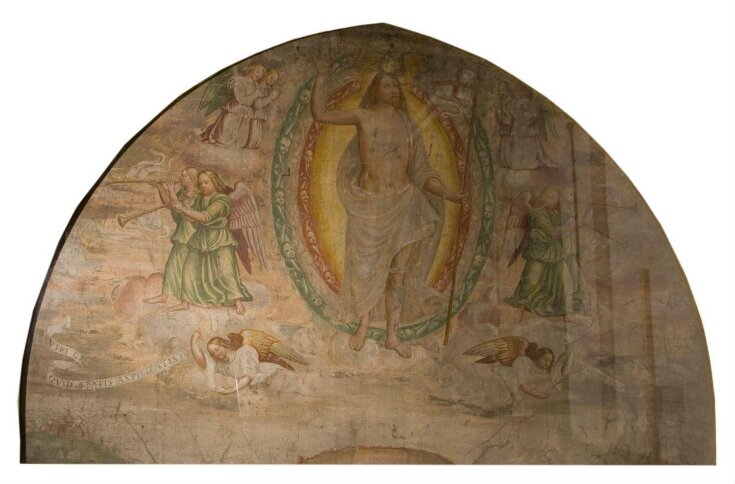

Christ ascending
Fresco
ca. 1520-1550 (painted)
ca. 1520-1550 (painted)
| Artist/Maker | |
| Place of origin |
This fresco fragment, depicting Christ surrounded by angels ascending into heaven, once formed the upper part of a lunette depicting the Ascension of Christ. It was originally in the Oratory of Santa Maria della Passione, next to San Ambrogio, Milan. Painted in the style of the Milanese painter and draughtsman Bernardino Luini (born ca 1480–85; died before 1 July 1532) it probably dates to the second quarter of the sixteenth century.
The Oratory of Santa Maria della Passione was sold to the Administration of San Ambrogio in 1812 and turned into a cloth factory. In 1869 it passed into private ownership and it was at this time that the main scenes of the wall decoration were detached. Part of the series re-appeared in England in 1898 when a group of nine fragments were sold through Fosters' sales rooms. Three of these were purchased by the South Kensington Museum, now the Victoria and Albert Museum.
The Oratory of Santa Maria della Passione was sold to the Administration of San Ambrogio in 1812 and turned into a cloth factory. In 1869 it passed into private ownership and it was at this time that the main scenes of the wall decoration were detached. Part of the series re-appeared in England in 1898 when a group of nine fragments were sold through Fosters' sales rooms. Three of these were purchased by the South Kensington Museum, now the Victoria and Albert Museum.
Object details
| Categories | |
| Object type | |
| Title | Christ ascending (generic title) |
| Materials and techniques | Fresco transferred to canvas |
| Brief description | Fresco fragment transferred to canvas; lunette depicting the Ascension of Christ; originally located in the Oratory of Santa Maria della Passione, Milan; follower of Bernardino Luini; ca 1520 - 1550 |
| Physical description | Fresco |
| Dimensions |
|
| Marks and inscriptions | VIRI GA[LILAEI] QUID STATIS ASPICIENTES IN [CAELUM]/
HIC IESUS QUI [ASSUMPTUS EST A] VOBIS IN CAELUM (Inscribed on scrolls held by angels) |
| Object history | Purchased by V&A, along with two related fragments (360 and 361-1898), from Fosters' sale rooms in 1898 |
| Subjects depicted | |
| Literary reference | Bible - Acts I.II |
| Summary | This fresco fragment, depicting Christ surrounded by angels ascending into heaven, once formed the upper part of a lunette depicting the Ascension of Christ. It was originally in the Oratory of Santa Maria della Passione, next to San Ambrogio, Milan. Painted in the style of the Milanese painter and draughtsman Bernardino Luini (born ca 1480–85; died before 1 July 1532) it probably dates to the second quarter of the sixteenth century. The Oratory of Santa Maria della Passione was sold to the Administration of San Ambrogio in 1812 and turned into a cloth factory. In 1869 it passed into private ownership and it was at this time that the main scenes of the wall decoration were detached. Part of the series re-appeared in England in 1898 when a group of nine fragments were sold through Fosters' sales rooms. Three of these were purchased by the South Kensington Museum, now the Victoria and Albert Museum. |
| Associated objects | |
| Bibliographic reference | Kauffmann, C.M., Catalogue of Foreign Paintings, I. Before 1800. London: Victoria and Albert Museum, 1973, pp. 175-6, cat. no. 216. |
| Collection | |
| Accession number | 359-1898 |
About this object record
Explore the Collections contains over a million catalogue records, and over half a million images. It is a working database that includes information compiled over the life of the museum. Some of our records may contain offensive and discriminatory language, or reflect outdated ideas, practice and analysis. We are committed to addressing these issues, and to review and update our records accordingly.
You can write to us to suggest improvements to the record.
Suggest feedback
You can write to us to suggest improvements to the record.
Suggest feedback
| Record created | March 21, 2006 |
| Record URL |
Download as: JSONIIIF Manifest
