
Inkstand
1550-1560 (made)
| Artist/Maker | |
| Place of origin |
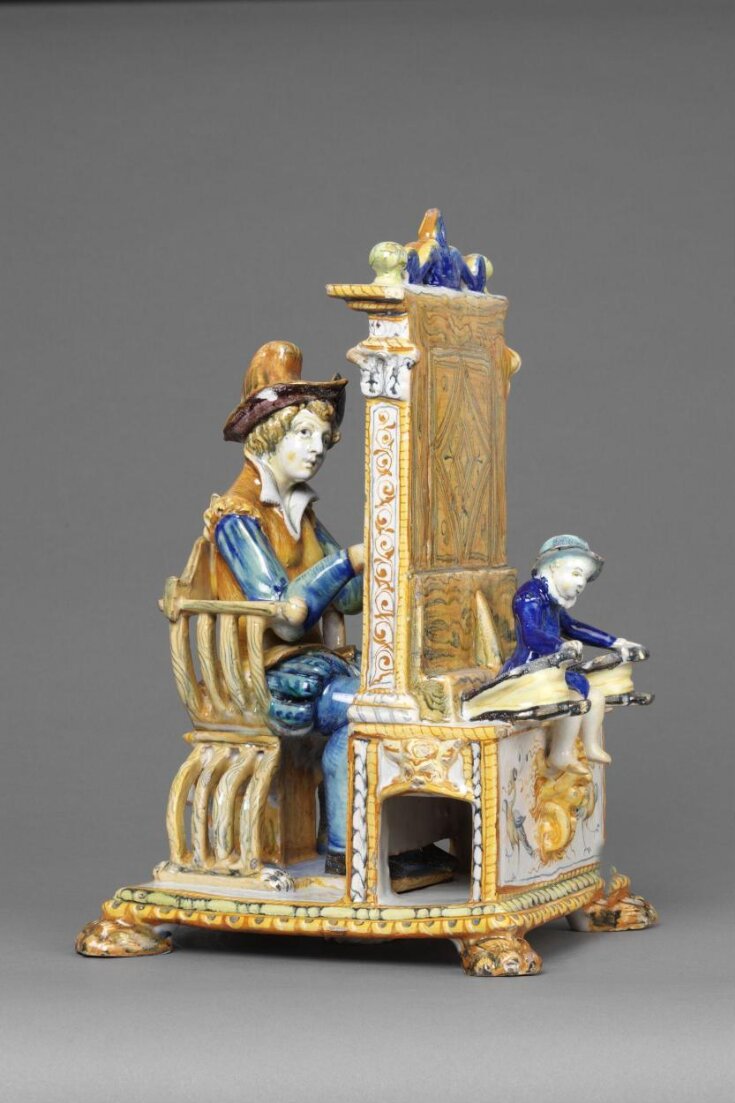
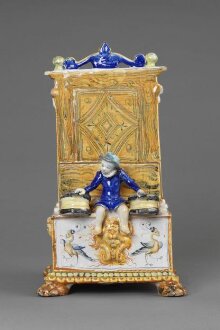
This colourful inkstand is surmounted by a young man playing an organ. A spaniel sits under his chair, scratching its ear. On a shelf at the back of the organ sits a young boy who is working two bellows. Most noblemen, wealthy professionals and merchants would have had a study or an area where then could undertake business. Special furnishings and equipment were required for the study space. Inkstands appeared in a wide variety of shapes, sizes and formats, usually combining decorative and functional elements successfully. They helped store the necessary materials for writing which included a pen, ink, pounce, pen knife and scissors for cutting paper. This ceramic example had a sliding drawer which is now missing
Object details
| Category | |
| Object type | |
| Materials and techniques | Tin-glazed earthenware |
| Brief description | Ceramic inkstand modelled in the form of a man playing an organ, Urbino, 1560-70 |
| Physical description | The inkstand is modelled in the form of a young man wearing a hat, doublet and hose of the period. He is seated on a folded chair in front of an organ which he is playing. On a shelf at the back of the organ sits a young boy who is working two bellows. A spaniel sits under the chair, scratching its ear. The organ is of architectural design framed by pilasters painted with grotesque figures and vases, the upper part of the back being painted to simulate painted wood. Below the shelf is an oblong receptacle for a sliding drawer which is now missing. On the back of the chair is a heart enclosing a monogram of two interlaced V's and surmounted by a cross pendant. Below the keyboard is a cartouche of feronnerie design is the name VRBINO. The whole group rests on a rectangular stand supported by lion's paws at the corners. The inkstand is painted in blue, yellow, brownish orange, bluish copper green, manganese purples, black and opaque white. There is restoration on one support of the chair, the brim of the hat, one capital of the organ pilaster, the toe of the boy and both bellows. |
| Dimensions |
|
| Style | |
| Marks and inscriptions | VRBINO (Below the keyboard in a cartouche)
|
| Gallery label | Label transcribed 16-10-2006:
Inkstand, modelled in the form of a man playing an organ
Earthenware
Inscribed: URBINO, and interlaced V's surmounted by a cross.
ITALIAN: (URBINO, Fontana workshop); about 1550-60
Cat. No. 852 8400-1863 |
| Object history | Soulages Collection Soulages Collection reports, 1856, p. 5, nr. 84 'The organ player' |
| Historical context | Most noblemen, wealthy professionals and merchants would have a study or an area where then could undertake business. This type of activity required special furnishings and equipment. The inkstand emerged as a new type of object for the urban elite of Renaissance Italy. Inkstands could embody social values and were intended to make a statement about the literacy, refinement and level of culture of their owner. Inkstands were produced in significant numbers and in a range of materials including bronze, silver, terracotta and maiolica. They appeared in a wide variety of shapes, sizes and formats, usually combining decorative and functional elements successfully. They helped store the necessary materials for writing, including the quill pen, ink, pounce, pen knife and scissors for cutting paper. Some inkstands were clearly made as collectors' pieces, others were given as gifts. There is evidence that some sixteenth-century maiolica inkstands were commissioned as part of the rituals associated with marriage, specifically when the written marriage contract was signed. |
| Subjects depicted | |
| Summary | This colourful inkstand is surmounted by a young man playing an organ. A spaniel sits under his chair, scratching its ear. On a shelf at the back of the organ sits a young boy who is working two bellows. Most noblemen, wealthy professionals and merchants would have had a study or an area where then could undertake business. Special furnishings and equipment were required for the study space. Inkstands appeared in a wide variety of shapes, sizes and formats, usually combining decorative and functional elements successfully. They helped store the necessary materials for writing which included a pen, ink, pounce, pen knife and scissors for cutting paper. This ceramic example had a sliding drawer which is now missing |
| Bibliographic references |
|
| Other number | 852 - Rackham (1977) |
| Collection | |
| Accession number | 8400-1863 |
About this object record
Explore the Collections contains over a million catalogue records, and over half a million images. It is a working database that includes information compiled over the life of the museum. Some of our records may contain offensive and discriminatory language, or reflect outdated ideas, practice and analysis. We are committed to addressing these issues, and to review and update our records accordingly.
You can write to us to suggest improvements to the record.
Suggest feedback
You can write to us to suggest improvements to the record.
Suggest feedback
| Record created | March 16, 2006 |
| Record URL |
Download as: JSONIIIF Manifest
