Drug Jar
ca. 1480 (made)
| Artist/Maker | |
| Place of origin |
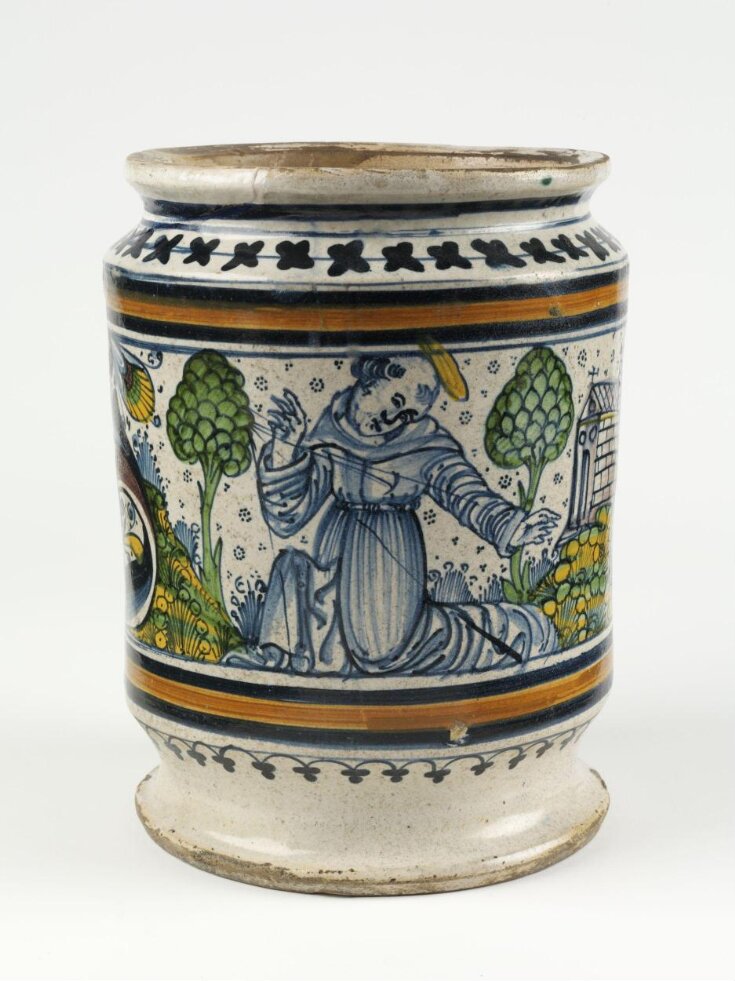
This jar is an example of the type called an albarello. Inscriptions on many examples show that they were particularly used in spice stores and hospital pharmacies. The depictions of religious subjects on these and other maiolica wares served as devotional prompts enabling the layman to participate more directly in religious life, one of the foremost spiritual aspirations of the Renaissance.
The popularity of Saint Francis of Assisi (ca 1182-1226) stemmed from his devotion to prayer, poverty, repentance and obedience. During a period of illness, after a failed military campaign of the Assisians against Perugia, Francis's mind had begun to turn towards God. Some time later, following a series of dreams, St Francis renounced his life as a wealthy merchant's son and chose to follow the example of Christ, living among the poor and destitute. Towards the end of his life St Francis received the Stigmata, the physical wounds of Christ's Crucifixion.
The image of St Francis receiving the Stigmata on this drug-jar served to prompt the beholder to recall both the illness of St Francis, his subsequent commitment to the religious life, and the sufferings of Christ.
The popularity of Saint Francis of Assisi (ca 1182-1226) stemmed from his devotion to prayer, poverty, repentance and obedience. During a period of illness, after a failed military campaign of the Assisians against Perugia, Francis's mind had begun to turn towards God. Some time later, following a series of dreams, St Francis renounced his life as a wealthy merchant's son and chose to follow the example of Christ, living among the poor and destitute. Towards the end of his life St Francis received the Stigmata, the physical wounds of Christ's Crucifixion.
The image of St Francis receiving the Stigmata on this drug-jar served to prompt the beholder to recall both the illness of St Francis, his subsequent commitment to the religious life, and the sufferings of Christ.
Object details
| Category | |
| Object type | |
| Materials and techniques | Tin-glazed earthenware |
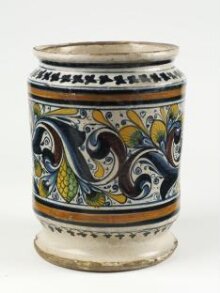
| Brief description | Drug jar, St. Francis receiving the stigmata and gothic foliage, probably made in Pesaro, ca 1480 |
| Physical description | Drug jar, albarello, painted in dark blue, yellow, deep orange, copper green and dark manganese purple. |
| Dimensions |
|
| Object history | Damiron Sale Sotheby's 16th June 1938, lot 36 Historical significance: The popularity of Saint Francis of Assisi (ca 1182-1226) stemmed from his devotion to prayer, poverty, repentance and obedience. During a period of illness, after a failed military campaign of the Assisians against Perugia, Francis's mind had begun to turn towards God. Some time later, following a series of dreams, St Francis renounced his life as a wealthy merchant's son and chose to follow the example of Christ, living among the poor and destitute. Towards the end of his life St Francis received the Stigmata, the physical wounds of Christ's Crucifixion. The image of St Francis receiving the Stigmata on this drug-jar served to prompt the beholder to recall both the illness of St Francis, his subsequent commitment to the religious life, and the sufferings of Christ. |
| Historical context | This jar is an example of the type called an albarello. Inscriptions on many examples show that they were particularly used in spice stores and hospital pharmacies. The depictions of religious subjects on these and other maiolica wares served as devotional prompts enabling the layman to participate more directly in religious life, one of the foremost spiritual aspirations of the Renaissance. |
| Subjects depicted | |
| Summary | This jar is an example of the type called an albarello. Inscriptions on many examples show that they were particularly used in spice stores and hospital pharmacies. The depictions of religious subjects on these and other maiolica wares served as devotional prompts enabling the layman to participate more directly in religious life, one of the foremost spiritual aspirations of the Renaissance. The popularity of Saint Francis of Assisi (ca 1182-1226) stemmed from his devotion to prayer, poverty, repentance and obedience. During a period of illness, after a failed military campaign of the Assisians against Perugia, Francis's mind had begun to turn towards God. Some time later, following a series of dreams, St Francis renounced his life as a wealthy merchant's son and chose to follow the example of Christ, living among the poor and destitute. Towards the end of his life St Francis received the Stigmata, the physical wounds of Christ's Crucifixion. The image of St Francis receiving the Stigmata on this drug-jar served to prompt the beholder to recall both the illness of St Francis, his subsequent commitment to the religious life, and the sufferings of Christ. |
| Bibliographic reference | Berardi, P.L’antica maiolica di Pesaro: Dal XIV al XVII secolo, Florence 1984
Cora, G., Storia della maiolica di Firenze e del contado: Secoli xiv e xv, Florence 1973
Rackham B., Italian Maiolica, London, Faber &Faber, 1952
|
| Other number | 110A - Rackham (1977) |
| Collection | |
| Accession number | C.227-1938 |
About this object record
Explore the Collections contains over a million catalogue records, and over half a million images. It is a working database that includes information compiled over the life of the museum. Some of our records may contain offensive and discriminatory language, or reflect outdated ideas, practice and analysis. We are committed to addressing these issues, and to review and update our records accordingly.
You can write to us to suggest improvements to the record.
Suggest feedback
You can write to us to suggest improvements to the record.
Suggest feedback
| Record created | March 14, 2006 |
| Record URL |
Download as: JSONIIIF Manifest
