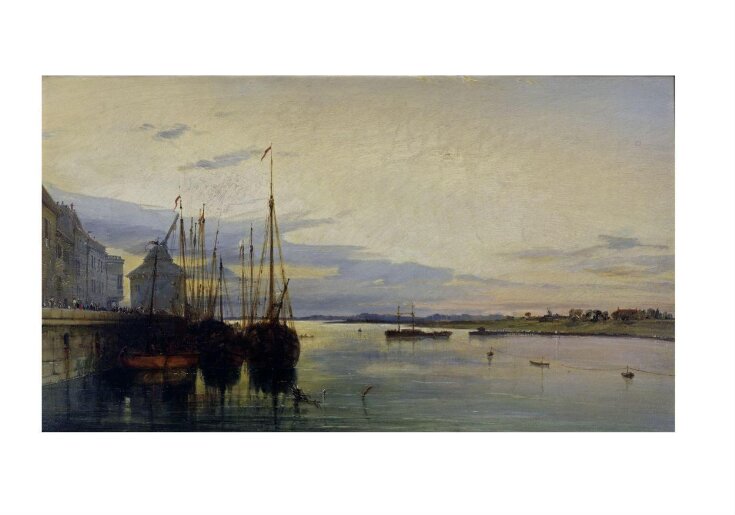

Nimeguen, on the Rhine
Oil Painting
ca. 1837 (painted)
ca. 1837 (painted)
| Artist/Maker | |
| Place of origin |
James Holland (1799-1870) was probably taught to paint by his mother who was a painter of flowers on porcelain at James Davenport’s pottery works in Staffordshire. He moved to London in 1819, where he initially earned a living as a pottery painter at one of the Deptford works. His early work also included paintings of flowers, one of which was his first work, in 1824, to be exhibited at the Royal Academy. From that time on he became a regular exhibitor at the Royal Academy, the Society of British Artists and the Society of Painters in Water Colours. Throughout his career Holland travelled extensively and became a notable landscape artist of scenes from countries such as the Netherlands, Italy (especially Venice), Portugal and Egypt.
This oil painting on canvas was first exhibited by Holland at the British Institute in 1837 under the title ‘Nimeguen, on the Rhine’. Nijmegen (modern spelling) is known as the oldest city in the Netherlands and was the Imperial residence of the Emperor Charlemagne in the eighth century. It is approximately 60 miles east of Rotterdam and is located on the River Waal, a branch of the River Rhine. It is likely that this painting is the view from the quay at Nijmegen looking northwards across the river towards Arnhem.
The painting is one of around 500 oil paintings, watercolours and drawings given to the V&A by the art collector John Sheepshanks in 1857.
This oil painting on canvas was first exhibited by Holland at the British Institute in 1837 under the title ‘Nimeguen, on the Rhine’. Nijmegen (modern spelling) is known as the oldest city in the Netherlands and was the Imperial residence of the Emperor Charlemagne in the eighth century. It is approximately 60 miles east of Rotterdam and is located on the River Waal, a branch of the River Rhine. It is likely that this painting is the view from the quay at Nijmegen looking northwards across the river towards Arnhem.
The painting is one of around 500 oil paintings, watercolours and drawings given to the V&A by the art collector John Sheepshanks in 1857.
Object details
| Category | |
| Object type | |
| Titles |
|
| Materials and techniques | Oil on canvas |
| Brief description | Oil painting on canvas entitled 'Nijmegen' in the Netherlands, by James Holland. British School, ca. 1837. |
| Physical description | On the left of the image is a terrace of buildings of different shapes and sizes, the one on the end jutting out like a large semi-circular bay window. The terrace is set back from the quayside which is lined with people looking out over the water. At the far end of the quay is a circular building with a round, two-tiered, pitched roof. Three or more reasonably large boats are moored at the quayside. From the tree-lined shore on the opposite side of the river from the quay, a long wooden jetty extends out into the water. In the water in front of the end of the jetty is a boat with rope attached to it. The rope is strung out in a line over the water from this larger boat to three much smaller boats (small rowing boats) until it disappears off the lower right edge of the image. The whole scene is dominated by a large expanse of sky. |
| Dimensions |
|
| Style | |
| Credit line | Given by John Sheepshanks, 1857 |
| Object history | Given by John Sheepshanks, 1857 |
| Subjects depicted | |
| Places depicted | |
| Summary | James Holland (1799-1870) was probably taught to paint by his mother who was a painter of flowers on porcelain at James Davenport’s pottery works in Staffordshire. He moved to London in 1819, where he initially earned a living as a pottery painter at one of the Deptford works. His early work also included paintings of flowers, one of which was his first work, in 1824, to be exhibited at the Royal Academy. From that time on he became a regular exhibitor at the Royal Academy, the Society of British Artists and the Society of Painters in Water Colours. Throughout his career Holland travelled extensively and became a notable landscape artist of scenes from countries such as the Netherlands, Italy (especially Venice), Portugal and Egypt. This oil painting on canvas was first exhibited by Holland at the British Institute in 1837 under the title ‘Nimeguen, on the Rhine’. Nijmegen (modern spelling) is known as the oldest city in the Netherlands and was the Imperial residence of the Emperor Charlemagne in the eighth century. It is approximately 60 miles east of Rotterdam and is located on the River Waal, a branch of the River Rhine. It is likely that this painting is the view from the quay at Nijmegen looking northwards across the river towards Arnhem. The painting is one of around 500 oil paintings, watercolours and drawings given to the V&A by the art collector John Sheepshanks in 1857. |
| Bibliographic reference | Parkinson, R., Victoria and Albert Museum, Catalogue of British Oil Paintings 1820-1860, London: HMSO, 1990, p. 127 |
| Collection | |
| Accession number | FA.80[O] |
About this object record
Explore the Collections contains over a million catalogue records, and over half a million images. It is a working database that includes information compiled over the life of the museum. Some of our records may contain offensive and discriminatory language, or reflect outdated ideas, practice and analysis. We are committed to addressing these issues, and to review and update our records accordingly.
You can write to us to suggest improvements to the record.
Suggest feedback
You can write to us to suggest improvements to the record.
Suggest feedback
| Record created | February 17, 2006 |
| Record URL |
Download as: JSONIIIF Manifest
