
Infanta Maria Teresa
Oil Painting
18th century (painted)
18th century (painted)
| Artist/Maker |
Diego Velazquez (1599-1660) was born in Seville where he received his first artistic training in the studio of Francisco de Herrera the elder (ca.1576-1656) and subsequently with Francisco Pacheco (1564-ca. 1644). He produced bodegones (genre scenes), religious paintings and portraits. He became from 1623 court painter of King Philip IV of Spain for whom he painted many state portraits. Although he had no immediate followers, his son-in-law, Juan Bautista Martínez del Mazo (1613-1667), can be considered as his disciple.
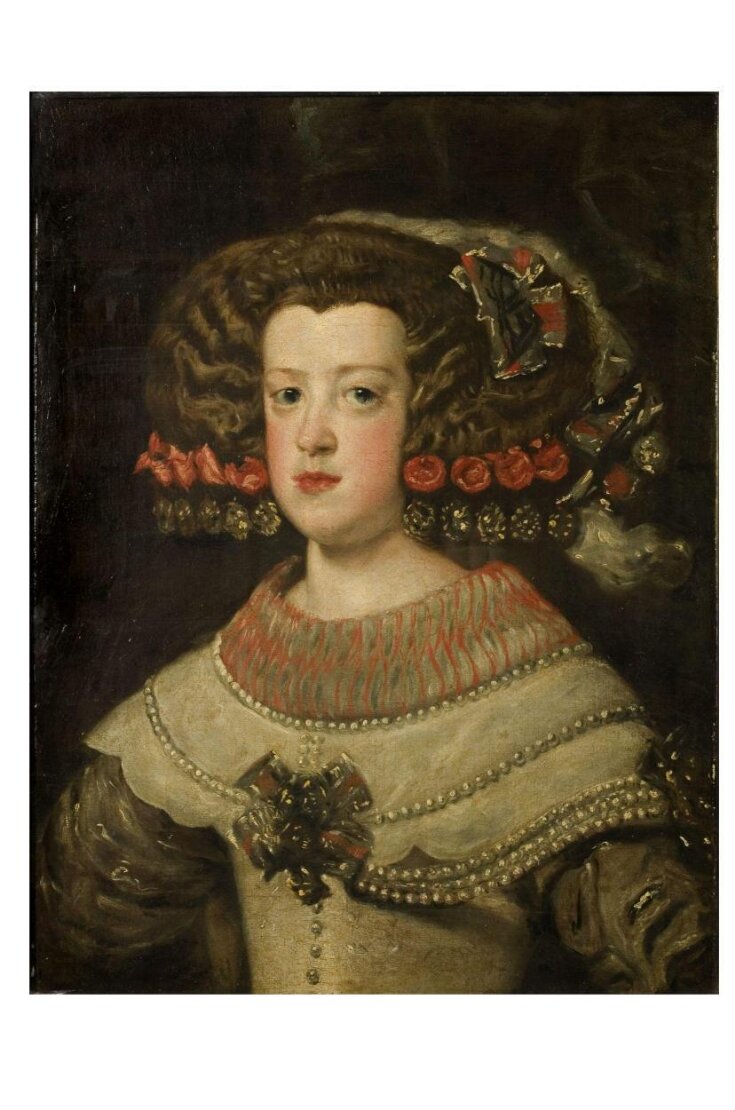
This painting is a copy of the upper of Velazquez’ full-length Portrait of the Infanta Maria Teresa, of which three versions exist. It depicts the portrait bust of the Spanish princess, daughter of Philip IV, King of Spain, and Elisabeth of France, who was to marry Louis XIV, king of France. She is here portrayed in a lavish Baroque dress with her imposing headdress, typical of the fashion of the Madrid court in the mid 17th century. The copy may date from the 18th century although a precise dating remains difficult to assert.
This painting is a copy of the upper of Velazquez’ full-length Portrait of the Infanta Maria Teresa, of which three versions exist. It depicts the portrait bust of the Spanish princess, daughter of Philip IV, King of Spain, and Elisabeth of France, who was to marry Louis XIV, king of France. She is here portrayed in a lavish Baroque dress with her imposing headdress, typical of the fashion of the Madrid court in the mid 17th century. The copy may date from the 18th century although a precise dating remains difficult to assert.
Object details
| Categories | |
| Object type | |
| Title | Infanta Maria Teresa |
| Materials and techniques | Oil on canvas |
| Brief description | Oil painting on canvas, 'Portrait of the Infanta Maria Teresa' after Velázquez, 18th century |
| Physical description | Half-length portrait of a young girl wearing a white, pearl-trimmed mantle-like collar with a pinky/silvery bow at the centre over a white bodice with pearls and a voluminous headdress. |
| Dimensions |
|
| Styles | |
| Credit line | Bequeathed by George Mitchell |
| Object history | Bequeathed by George Mitchell, 1878 Historical significance: This painting is a copy of the upper part of the full-length portrait of the Infanta Maria Teresa depicted by Velazquez in 1652-53. The Infanta Maria Teresa (1638-1683) was the daughter of Philip IV, King of Spain (1605-1665) and Elizabeth of France (1602-1644). Philip IV commissioned three portraits of the princess to be sent to potential suitors. The paintings were sent to the Emperor Ferdinand III in Vienna (Kunsthistorisches Museum, Vienna - Inv. 618), the Archduke Leopold William in Brussels (Museum of fine Arts, Boston - Inv. 21.2593) and the King of France, Louis XIV (Louvre, Paris - Inv. M.I.898, which appears now cut off notably the lower part). The original painting is generally thought to be the Vienna version whereas the other two appears to be workshop copies. Maria Teresa eventually married Louis XIV (1638-1715), King of France, in 1660 and was the mother of the Grand Dauphin, heir to the French throne. She is here depicted at the age of 15 in a lavish Baroque dress made of grey silk with white and silver hues and pink on a dark neutral background. The dress as well as her voluminous and richly decorated headdress was typical of the fashion of the Madrid court in the mid 17th century in Spain. Velazquez executed several portraits of the Infanta Maria Teresa at various stages of her life but he also portrayed her step-mother, second wife of Philip IV, who was also her blood cousin and was only four years older, in a very similar manner which emphasizes their physical resemblance (see Portrait of the Queen Mariana, dated 1652-53, Prado, Madrid - Inv. 1191). |
| Historical context | In his encyclopaedic work, Historia Naturalis, the ancient Roman author Pliny the Elder described the origins of painting in the outlining of a man's projected shadow in profile. In the ancient period, profile portraits were found primarily in imperial coins. With the rediscovery and the increasing interest in the Antique during the early Renaissance, artists and craftsmen looked back to this ancient tradition and created medals with profile portraits on the obverse and personal devise on the reverse in order to commemorate and celebrate the sitter. Over time these profile portraits were also depicted on panels and canvas, and progressively evolved towards three-quarter and eventually frontal portraits. These portraits differ in many ways from the notion of portraiture commonly held today as they especially aimed to represent an idealised image of the sitter and reflect therefore a different conception of identity. The sitter's likeness was more or less recognisable but his particular status and familiar role were represented in his garments and attributes referring to his character. The 16th century especially developed the ideal of metaphorical and visual attributes through the elaboration of highly complex portrait paintings in many formats including at the end of the century full-length portraiture. In Spain, portraiture developed considerably under the impact of Velázquez' art probably influenced by earlier Flemish examples such as Rubens (1577-1640) and Van Dyck (1599-1641). Portrait paintings were still fashionable during the following centuries and extended to the rising bourgeoisie and eventually to common people, especially during the social and political transformations of the 19th century. At the end of the 19th century and during the 20th century, painted portraits were challenged and eventually supplanted by the development of new media such as photography. |
| Subjects depicted | |
| Summary | Diego Velazquez (1599-1660) was born in Seville where he received his first artistic training in the studio of Francisco de Herrera the elder (ca.1576-1656) and subsequently with Francisco Pacheco (1564-ca. 1644). He produced bodegones (genre scenes), religious paintings and portraits. He became from 1623 court painter of King Philip IV of Spain for whom he painted many state portraits. Although he had no immediate followers, his son-in-law, Juan Bautista Martínez del Mazo (1613-1667), can be considered as his disciple. This painting is a copy of the upper of Velazquez’ full-length Portrait of the Infanta Maria Teresa, of which three versions exist. It depicts the portrait bust of the Spanish princess, daughter of Philip IV, King of Spain, and Elisabeth of France, who was to marry Louis XIV, king of France. She is here portrayed in a lavish Baroque dress with her imposing headdress, typical of the fashion of the Madrid court in the mid 17th century. The copy may date from the 18th century although a precise dating remains difficult to assert. |
| Bibliographic references |
|
| Collection | |
| Accession number | 342-1878 |
About this object record
Explore the Collections contains over a million catalogue records, and over half a million images. It is a working database that includes information compiled over the life of the museum. Some of our records may contain offensive and discriminatory language, or reflect outdated ideas, practice and analysis. We are committed to addressing these issues, and to review and update our records accordingly.
You can write to us to suggest improvements to the record.
Suggest feedback
You can write to us to suggest improvements to the record.
Suggest feedback
| Record created | February 16, 2006 |
| Record URL |
Download as: JSONIIIF Manifest
