Signet Ring
1275-1325 (made), 100 BC - 1 BC (made)
| Artist/Maker | |
| Place of origin |
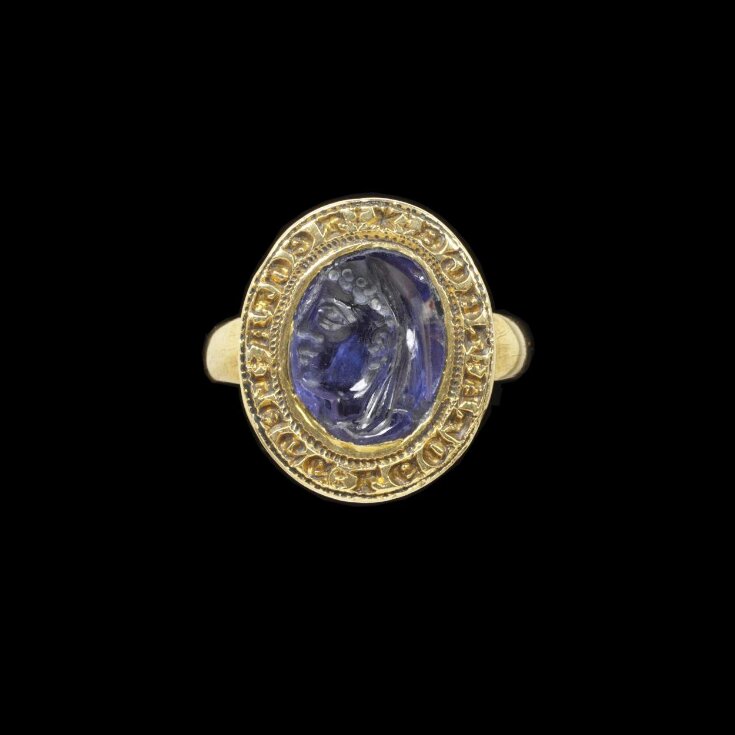
This medieval ring is set with a much earlier sapphire intaglio, probably carved in the Greek World around the first century BC. In the Middle Ages, between the 12th and 14th century, ancient gems were frequently re-set for use as personal seals, authenticating letters and legal documents. Roman or Hellenistic images of gods or mythological figures were not so much misunderstood as re-interpreted in a Christian framework. A Ptolomaic princess such as the one on this seal, might therefore be used to symbolise the Virgin Mary, often shown with a veil over her head. In medieval Constantinople, gemstones engraved with subjects from classical antiquity were sometimes labelled with the names of Christian saints such as an amethyst portrait of the Roman emperor Caracalla which was recut and renamed as Saint Peter.
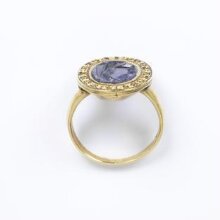
The inscription around the bezel of the ring: 'Tecta lege, lecta tege' is translated as 'Read what is written, hide what is read' and shows the ring's use as a personal signet. The sapphire is set in an open-backed mount, allowing it to touch the skin of the wearer. Direct contact of the stone with the skin was believed to convey a medicinal or amuletic benefit. A lapidary describing the powers and uses of gemstones, written by Marbode, the eleventh century bishop of Rennes claimed that sapphires had the power to dispel envy, detect fraud and prevent witchcraft.
This ring forms part of a collection of 760 rings and engraved gems from the collection of Edmund Waterton (1830-87). Waterton was one of the foremost ring collectors of the nineteenth century and was the author of several articles on rings, a book on English devotion to the Virgin Mary and an unfinished catalogue of his collection (the manuscript is now the National Art Library). Waterton was noted for his extravagance and financial troubles caused him to place his collection in pawn with the London jeweller Robert Phillips. When he was unable to repay the loan, Phillips offered to sell the collection to the Museum and it was acquired in 1871. A small group of rings which Waterton had held back were acquired in 1899.
The inscription around the bezel of the ring: 'Tecta lege, lecta tege' is translated as 'Read what is written, hide what is read' and shows the ring's use as a personal signet. The sapphire is set in an open-backed mount, allowing it to touch the skin of the wearer. Direct contact of the stone with the skin was believed to convey a medicinal or amuletic benefit. A lapidary describing the powers and uses of gemstones, written by Marbode, the eleventh century bishop of Rennes claimed that sapphires had the power to dispel envy, detect fraud and prevent witchcraft.
This ring forms part of a collection of 760 rings and engraved gems from the collection of Edmund Waterton (1830-87). Waterton was one of the foremost ring collectors of the nineteenth century and was the author of several articles on rings, a book on English devotion to the Virgin Mary and an unfinished catalogue of his collection (the manuscript is now the National Art Library). Waterton was noted for his extravagance and financial troubles caused him to place his collection in pawn with the London jeweller Robert Phillips. When he was unable to repay the loan, Phillips offered to sell the collection to the Museum and it was acquired in 1871. A small group of rings which Waterton had held back were acquired in 1899.
Object details
| Categories | |
| Object type | |
| Materials and techniques | Gold, engraved; sapphire, carved |
| Brief description | Gold signet set with a sapphire intaglio of a woman's head. Inscribed around the bezel :*TECTA: LEGE: LECTA: TEGE. Possibly set in England, 1275-1325 |
| Physical description | Signet ring, gold, set with a sapphire. Around the oval bezel is engraved in Latin in Lombardic lettering* TECTA: LEGE: LECTA; TEGE. The hoop of the ring is open at the back of the bezel so that the finger can touch the sapphire. The sapphire intaglio in the centre of the bezel is engraved with a head in profile of a lady in a veil. |
| Dimensions |
|
| Marks and inscriptions | '*TECTA: LEGE: LECTA: TEGE' (Engraved around the rim of the bezel, in Latin, in Lombardic lettering)
|
| Object history | Found in a well in Hereford in 1824. Exhibited at the Society of Antiquaries by the Rev. Charles J. Bird, FSA and documented in the Gentleman's Magazine, 1830,vol. 100, part1, p.65. Also exhibited by Edmund Waterton to the Society of Antiquaries, Thursday March 8th, 1855 and recorded in the Proceedings: ‘Edmund Waterton , Esq. F.S.A. exhibited Seven Rings, five of gold and two of silver, from his Collection, found at different places. One, of the gold, representing the Holy Trinity, the Virgin Mary, and St Anne and a Pieta, dug up at Offord Abbey; and another set with a Sapphire on which is engraved a veiled female head, around which is the legend in Gothic characterss, TECTA. LEGE. LECTA. TEGE. One of the silver rings, dug up at Bury St Edmund’s in 1853, had a monogram.’ Shown at the 1862 Special Loan Exhibition at the South Kensington Museum. The sapphire was identified by Dr Martin Henig in 2006 as a high quality Hellenistic carving, possibly cut down from a larger stone. A comparable example is cat. 387 in Dmitri Plantzos 'Hellenistic engraved gems', Oxford, 1999. |
| Production | Intaglio probably Greek World, Alexandria, 100-0 BC. |
| Summary | This medieval ring is set with a much earlier sapphire intaglio, probably carved in the Greek World around the first century BC. In the Middle Ages, between the 12th and 14th century, ancient gems were frequently re-set for use as personal seals, authenticating letters and legal documents. Roman or Hellenistic images of gods or mythological figures were not so much misunderstood as re-interpreted in a Christian framework. A Ptolomaic princess such as the one on this seal, might therefore be used to symbolise the Virgin Mary, often shown with a veil over her head. In medieval Constantinople, gemstones engraved with subjects from classical antiquity were sometimes labelled with the names of Christian saints such as an amethyst portrait of the Roman emperor Caracalla which was recut and renamed as Saint Peter. The inscription around the bezel of the ring: 'Tecta lege, lecta tege' is translated as 'Read what is written, hide what is read' and shows the ring's use as a personal signet. The sapphire is set in an open-backed mount, allowing it to touch the skin of the wearer. Direct contact of the stone with the skin was believed to convey a medicinal or amuletic benefit. A lapidary describing the powers and uses of gemstones, written by Marbode, the eleventh century bishop of Rennes claimed that sapphires had the power to dispel envy, detect fraud and prevent witchcraft. This ring forms part of a collection of 760 rings and engraved gems from the collection of Edmund Waterton (1830-87). Waterton was one of the foremost ring collectors of the nineteenth century and was the author of several articles on rings, a book on English devotion to the Virgin Mary and an unfinished catalogue of his collection (the manuscript is now the National Art Library). Waterton was noted for his extravagance and financial troubles caused him to place his collection in pawn with the London jeweller Robert Phillips. When he was unable to repay the loan, Phillips offered to sell the collection to the Museum and it was acquired in 1871. A small group of rings which Waterton had held back were acquired in 1899. |
| Bibliographic references |
|
| Collection | |
| Accession number | 89-1899 |
About this object record
Explore the Collections contains over a million catalogue records, and over half a million images. It is a working database that includes information compiled over the life of the museum. Some of our records may contain offensive and discriminatory language, or reflect outdated ideas, practice and analysis. We are committed to addressing these issues, and to review and update our records accordingly.
You can write to us to suggest improvements to the record.
Suggest feedback
You can write to us to suggest improvements to the record.
Suggest feedback
| Record created | February 15, 2006 |
| Record URL |
Download as: JSONIIIF Manifest
