
Mechanical Globe Clock
1584 (made)
| Artist/Maker | |
| Place of origin |
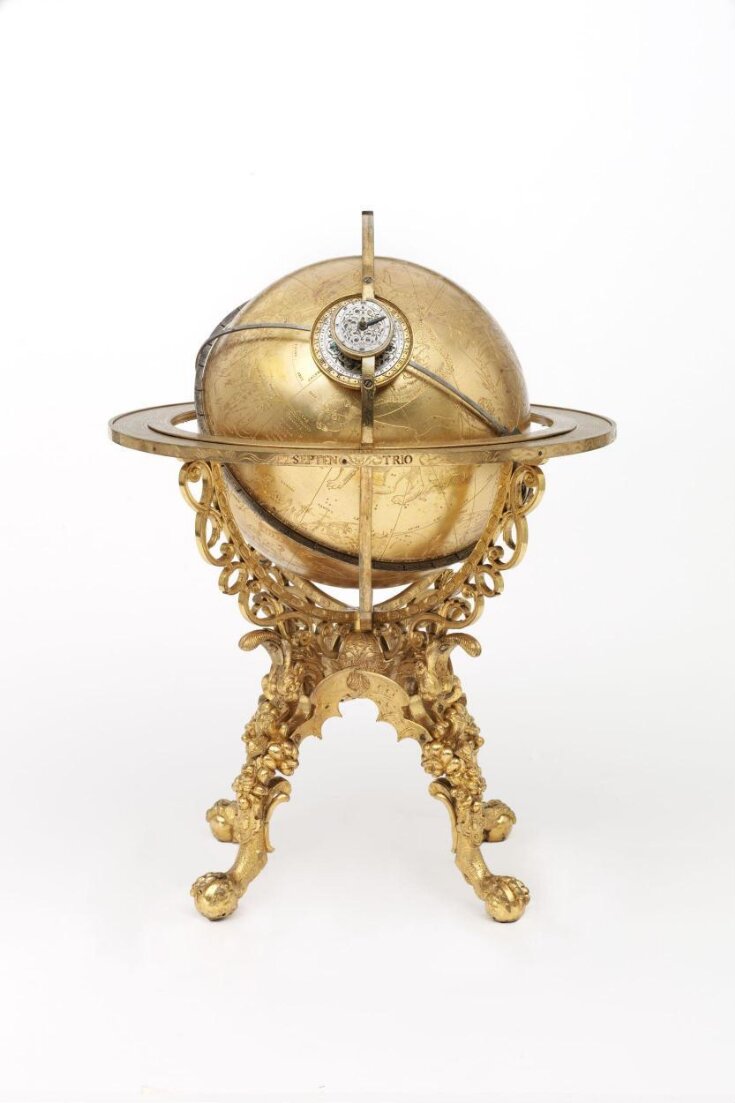
This mechanical clock was bought by the Emperor Rudolph II in 1584 and housed in the Imperial Treasury in Prague. The globe served as a model of the universe simulating the movements of the sun, the moon and the stars. It could predict the movements of celestial bodies at any time in the past and the future and could tell the time by the position of the stars.
This clock, with its finely engraved dials, enamelled clockfaces and elaborately cast legs, was not simply a functional household item but more a treasury piece, bought primarily for its craftsmanship and technical ingenuity. Clocks were luxury items designed to impress as well as educate. By the 1550s it was fashionable for wealthy noblemen to have a sound understanding of all branches of learning, from art and literature to mathematics and the natural sciences. Clocks such as this were housed alongside automatons and scientific instruments such as astrolabes and sundials in Scientifica, collections celebrating human ability to control nature.
Rudolf II had one of the greatest collections of all. Born in 1552 he was King of Hungary and Bohemia, and from 1576, Holy Roman Emperor. Under Rudolf's guidance, Prague became one of the leading centres of the arts and sciences in Europe.
Rudolph's was a hard taste to please and this clock became the subject of a heated dispute. Made by Georg Roll and Johannes Reinhold of Augsburg, it was bought by Rudolph in 1584. A second similar globe by the same makers (now in the Kunsthistorichesmuseum in Vienna) was bought by the Emperor's brother, Archduke Ernst for a greater price. The Emperor accused Roll of selling him an inferior piece and instructed the City Council of Augsburg, to imprison him for treating him 'in a scurvy manner'. Roll wrote a lengthy appeal to the Emperor supported by appeals to the Council by his two closest colleagues, the clockmakers Johannes Reinhold and Hans Marquart. They stated that the globes were almost identical and that the cheaper price was offered to the Emperor as Roll was seeking further business at the Imperial court. The Emperor begrudgingly released Roll for the sake of the twenty-five journeymen employees who relied on him for their livelihoods but warned him as to his future conduct.
This clock, with its finely engraved dials, enamelled clockfaces and elaborately cast legs, was not simply a functional household item but more a treasury piece, bought primarily for its craftsmanship and technical ingenuity. Clocks were luxury items designed to impress as well as educate. By the 1550s it was fashionable for wealthy noblemen to have a sound understanding of all branches of learning, from art and literature to mathematics and the natural sciences. Clocks such as this were housed alongside automatons and scientific instruments such as astrolabes and sundials in Scientifica, collections celebrating human ability to control nature.
Rudolf II had one of the greatest collections of all. Born in 1552 he was King of Hungary and Bohemia, and from 1576, Holy Roman Emperor. Under Rudolf's guidance, Prague became one of the leading centres of the arts and sciences in Europe.
Rudolph's was a hard taste to please and this clock became the subject of a heated dispute. Made by Georg Roll and Johannes Reinhold of Augsburg, it was bought by Rudolph in 1584. A second similar globe by the same makers (now in the Kunsthistorichesmuseum in Vienna) was bought by the Emperor's brother, Archduke Ernst for a greater price. The Emperor accused Roll of selling him an inferior piece and instructed the City Council of Augsburg, to imprison him for treating him 'in a scurvy manner'. Roll wrote a lengthy appeal to the Emperor supported by appeals to the Council by his two closest colleagues, the clockmakers Johannes Reinhold and Hans Marquart. They stated that the globes were almost identical and that the cheaper price was offered to the Emperor as Roll was seeking further business at the Imperial court. The Emperor begrudgingly released Roll for the sake of the twenty-five journeymen employees who relied on him for their livelihoods but warned him as to his future conduct.
Object details
| Categories | |
| Object type | |
| Parts | This object consists of 11 parts.
|
| Materials and techniques | Copper alloy, cast, engraved, punched and gilt |
| Brief description | Astrological clock in the form of a celestial globe, of gilt metal, made in Augsburg in 1584 by Georg Roll and Johannes Reinhold |
| Physical description | Astrological clock in the form of a celestial globe, of gilt metal, made in Augsburg in 1584 by Georg Roll and Johannes Reinhold. The internal clockwork movement is separate. There are also 9 bags of small fragments removed during restoration work in 1977. The globe served as a mechanical model of the cosmos simulating the movements of the sun, the moon and the stars. It could also predict the movements of the celestial bodies at any time in the past and the future and could tell the time by the position of the stars. |
| Marks and inscriptions | 'ELABORABAT GEORGIVS ROLL ET JOHANNES REINHOLD IN AUGUSTA ANNO DOMINI 1584' (Signed in cartouche.) |
| Object history | This astrological clock, made by Georg Roll and Johannes Reinhold of Augsburg, was bought by Emperor Rudolph II of Prague at Christmas in 1584. A second similar globe by the same makers (now in the Kunsthistorichesmuseum in Vienna) was bought by the Emperor's brother, Archduke Ernst for a greater price. The Emperor accused Roll of selling him an inferior piece and instructed the City Council of Augsburg, to imprison him for treating him 'in a scurvy manner'. Roll wrote a lengthy appeal to the Emperor supported by appeals to the Council by his two closest colleagues, the clockmakers Johannes Reinhold and Hans Marquart. They stated that the globes were almost identical and that the cheaper price was offered to the Emperor as Roll was seeking further business at the Imperial court. The Emperor begrudgingly released Roll for the sake of the twenty-five journeymen employees who relied on him for their livelihoods but warned him as to his future conduct. On Ernst's death the two globes were probably united as the Emperor obtained most of his collection. Hayward (1973, p.96) suggests that the incompleteness of this globe (the original base, lower globe and finials are missing) might be a result of damage sustained during the looting of the Imperial collections in Prague by Swedish troops in 1648. The clock was presented to the Museum in August 1865. An attempted theft in 1977 led to structural damage to one of the legs. During subsequent restoration work a flat circular hoop was fitted under the feet to stabilise the legs and the heavy internal movement and a number of small fragments were separated. Historical significance: Dated 1584, this is one of the two earliest of a group of six surviving astrological clocks based on this model by Roll, and Reinhold. This clock was bought by the Emperor Rudolph II in Prague in 1584. Rudolf II was described by a noted contemporary as "the greatest art patron in the world." Born in 1552 he was king of Hungary and Bohemia, and from 1576, Holy Roman Emperor. He raised court patronage in post-Renaissance Europe to a new level of breadth and extravagance. The thriving city and era over which he reigned, from 1583 until his death twenty-nine years later, is known as Rudolfine Prague. Seat of the emperor almost uninterruptedly from the mid-fourteenth century, Prague became, under Rudolf's guidance, one of the leading centers of the arts and sciences on the continent. His taste for outstanding decoration and fantastic imagery were legendary, while his ambition and insight as a patron and collector changed the way art would be viewed by future generations. The closest example to this globe, also dated 1584, is in the Kunsthistorischesmuseum, Vienna, and was originally bought by Archduke Ernst, Rudolph II's brother. The descriptions of two globes in an inventory of Rudolph's collections, dated 1607-11, probably refer to this pair. The V&A's example is missing parts described in the inventory including a small sphere. The four other variations on this example are: 1. Dated 1586: Staatliche Kunstammlungen, Dresden 2. Dated 1588: Conservatoire National des Arts et Métiers, Paris 3. Dated 1589: Osservatorio Astronomico di Capodimonte, Naples 4. Undated: Hermitage, St. Petersburg One of the Roll and Reinhold globes is depicted in Jan Brueghel the Elder's Sense of Hearing, 1618, in the Prado, Madrid. |
| Historical context | This clock, with its finely engraved dials, enamelled clockfaces and elaborately cast legs, should not be seen as simply a functional household item but more as a treasury piece, bought primarily for its craftsmanship and technical ingenuity. Clocks were luxury items designed to impress as well as educate. By the 1550s it was fashionable for wealthy gentlemen to have a sound understanding of all branches of learning, from art and literature to mathematics and the natural sciences. Clocks such as this were housed alongside automatons and scientific instruments such as astrolabes and sundials in Scientifica, collections celebrating human ability to control nature. Rudolph II's clocks and instruments were his most treasured collections. He owned around 60 clocks and 120 astronomical and geometrical instruments. The celebrated Danish astronomer, Tycho Brahe and his pupil, Johannes Kepler, worked at Rudolph's court. Rudolph also searched far and wide for instruments, acquiring or commissioning them from specialist makers in Augsburg and Nuremberg. |
| Association | |
| Summary | This mechanical clock was bought by the Emperor Rudolph II in 1584 and housed in the Imperial Treasury in Prague. The globe served as a model of the universe simulating the movements of the sun, the moon and the stars. It could predict the movements of celestial bodies at any time in the past and the future and could tell the time by the position of the stars. This clock, with its finely engraved dials, enamelled clockfaces and elaborately cast legs, was not simply a functional household item but more a treasury piece, bought primarily for its craftsmanship and technical ingenuity. Clocks were luxury items designed to impress as well as educate. By the 1550s it was fashionable for wealthy noblemen to have a sound understanding of all branches of learning, from art and literature to mathematics and the natural sciences. Clocks such as this were housed alongside automatons and scientific instruments such as astrolabes and sundials in Scientifica, collections celebrating human ability to control nature. Rudolf II had one of the greatest collections of all. Born in 1552 he was King of Hungary and Bohemia, and from 1576, Holy Roman Emperor. Under Rudolf's guidance, Prague became one of the leading centres of the arts and sciences in Europe. Rudolph's was a hard taste to please and this clock became the subject of a heated dispute. Made by Georg Roll and Johannes Reinhold of Augsburg, it was bought by Rudolph in 1584. A second similar globe by the same makers (now in the Kunsthistorichesmuseum in Vienna) was bought by the Emperor's brother, Archduke Ernst for a greater price. The Emperor accused Roll of selling him an inferior piece and instructed the City Council of Augsburg, to imprison him for treating him 'in a scurvy manner'. Roll wrote a lengthy appeal to the Emperor supported by appeals to the Council by his two closest colleagues, the clockmakers Johannes Reinhold and Hans Marquart. They stated that the globes were almost identical and that the cheaper price was offered to the Emperor as Roll was seeking further business at the Imperial court. The Emperor begrudgingly released Roll for the sake of the twenty-five journeymen employees who relied on him for their livelihoods but warned him as to his future conduct. |
| Bibliographic references |
|
| Collection | |
| Accession number | 246-1865 |
About this object record
Explore the Collections contains over a million catalogue records, and over half a million images. It is a working database that includes information compiled over the life of the museum. Some of our records may contain offensive and discriminatory language, or reflect outdated ideas, practice and analysis. We are committed to addressing these issues, and to review and update our records accordingly.
You can write to us to suggest improvements to the record.
Suggest feedback
You can write to us to suggest improvements to the record.
Suggest feedback
| Record created | February 8, 2006 |
| Record URL |
Download as: JSONIIIF Manifest
