Reliquary
1505-1510 (made)
| Artist/Maker | |
| Place of origin |
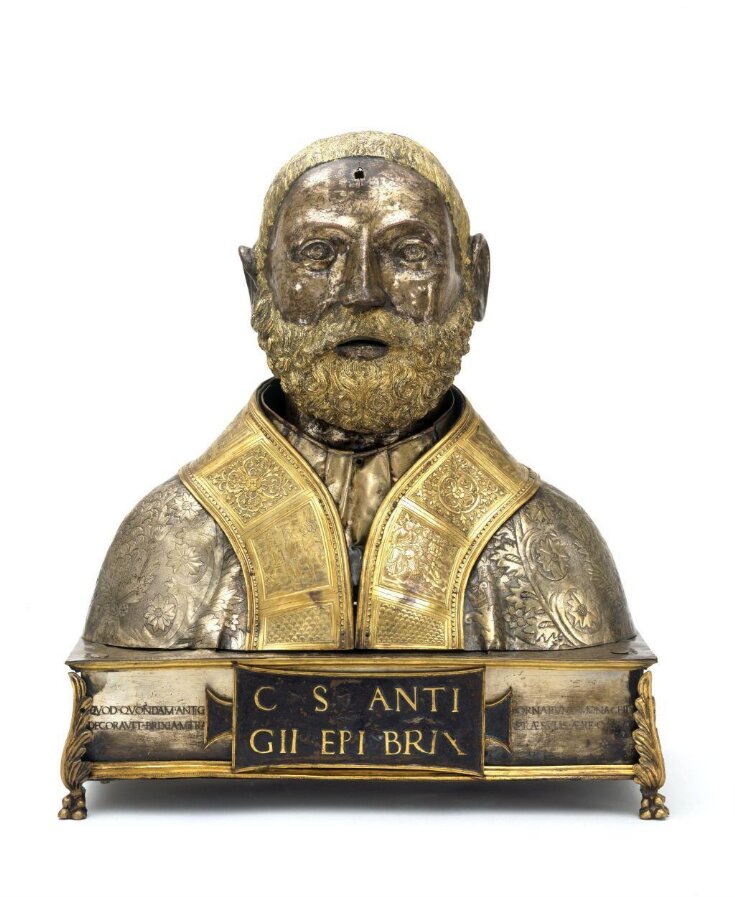
This reliquary forms the head and shoulders of St Antigius, legendary bishop of Brescia, and would have held his relics inside, as the inscription makes clear. The inscription shows that the bust was commissioned by the monastery of San Faustino e San Giovito, in Brescia, northern Italy where the bones of St Antigius were described in 1658 as being preserved "divided, but honorably enshrined".
The bones associated with the saints and the possessions associated with Christ are known as relics. In the Middle Ages they were generally believed to have miraculous powers and were greatly venerated. Relics were kept in precious metal containers called reliquaries, and safe-guarded in church treasuries. Relics attracted pilgrims who made gifts and monetary donations to the Church in which they were held. Local people also gave in honour of their saint and to gain protection and healing for themselves and their town.
The bones associated with the saints and the possessions associated with Christ are known as relics. In the Middle Ages they were generally believed to have miraculous powers and were greatly venerated. Relics were kept in precious metal containers called reliquaries, and safe-guarded in church treasuries. Relics attracted pilgrims who made gifts and monetary donations to the Church in which they were held. Local people also gave in honour of their saint and to gain protection and healing for themselves and their town.
Object details
| Categories | |
| Object type | |
| Materials and techniques | Copper, tinned or gilt |
| Brief description | Copper, silvered or gilt bust of St Antigius, made in Italy, ca. 1500 |
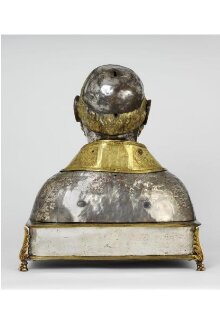
| Physical description | The head bust and base are made separately. The head is that of an old man, tonsured, with gilt hair and gilt curling beard; the remainder silvered. The bust is shown as wearing a richly patterned silver cope, decorated with floral designs borrowed from contemporary Italian textiles. The bust is separately made, and is of gilt copper. It is engraved with scale patterns, flowers and scenes from the Passion (left: the Flagellation, Christ before Pilate: right, St Peter cutting off the servant's ear, Christ in the Garden of Gethsemane: back, the Resurrection). Under the cope appear the folds of a vestment (possibly later). The base is formed by an oblong casket with applied gilt moulded rim: this is supported on four cast feet whose upper sections are formed as palm leaves. To its front is applied a cast plaque with an inscription. On either side of this plaque is engraved another inscription. An XRF taken January 2007 showed that the body and base are of copper with a very small amount of lead and tin. The body is tinned, not silvered. The XRF also confirmed that the gilding was indeed gold. |
| Dimensions |
|
| Marks and inscriptions |
|
| Gallery label |
|
| Object history | Historical significance: Reliquaries had a complex symbolic meaning. They were believed to be imbued with the holiness of the relic they preserved. The faithful believed that by touching a reliquary, they would receive some of this holy quality. Reliquaries were central features of the Medieval Church Treasury. They symbolised the status and authority of the Church. Relics attracted pilgrims who made gifts and monetary donations to the Church in which they were held. Local people also gave in honour of their saint and to gain protection for themselves and their town. Thus relics could often give a sense of identity within the church community. Some reliquaries were used in religious precessions or festivals, which both involved the community and also reinforced the status of the Church. St Antigius was a saint of unknown date whose body was transferred from Burgundy, probably in the 9th century to the monastery of SS. Faustino e Giovita, Brescia. At some date in the Middle Ages, his true origin being forgotten, his name was included into the list of bishops of Brescia, from which it was only removed in the 18th century. The inscription shows that the bust was commisioned by the monastery of SS. Faustino e Giovita, where the bones of the saint were described in 1658 as "divided, but honorably being preserved enshrined". |
| Historical context | The bones associated with the saints and the possessions associated with Christ are known as relics. In the Middle Ages they were generally believed to have miraculous powers and were greatly venerated. Relics were kept in containers called reliquaries. Reliquaries took many forms. Some were shaped to represent the saint or various parts of the body such as an arm or finger (so-called 'speaking image' reliquaries). Others were designed as a monstrance, which placed the relic on view inside a glass cylinder (monstrare= to show). Another style of reliquary, was the tempietto reliquary, which means "little temple". These receptacles had an architectural design in the form of a shrine or church. This reliquary is an example of a 'speaking image' reliquary. It probably contained the head bone of St Antigius. |
| Subjects depicted | |
| Summary | This reliquary forms the head and shoulders of St Antigius, legendary bishop of Brescia, and would have held his relics inside, as the inscription makes clear. The inscription shows that the bust was commissioned by the monastery of San Faustino e San Giovito, in Brescia, northern Italy where the bones of St Antigius were described in 1658 as being preserved "divided, but honorably enshrined". The bones associated with the saints and the possessions associated with Christ are known as relics. In the Middle Ages they were generally believed to have miraculous powers and were greatly venerated. Relics were kept in precious metal containers called reliquaries, and safe-guarded in church treasuries. Relics attracted pilgrims who made gifts and monetary donations to the Church in which they were held. Local people also gave in honour of their saint and to gain protection and healing for themselves and their town. |
| Bibliographic references |
|
| Collection | |
| Accession number | M.52-1967 |
About this object record
Explore the Collections contains over a million catalogue records, and over half a million images. It is a working database that includes information compiled over the life of the museum. Some of our records may contain offensive and discriminatory language, or reflect outdated ideas, practice and analysis. We are committed to addressing these issues, and to review and update our records accordingly.
You can write to us to suggest improvements to the record.
Suggest feedback
You can write to us to suggest improvements to the record.
Suggest feedback
| Record created | January 27, 2006 |
| Record URL |
Download as: JSONIIIF Manifest
