
Evening Dress
1950-1955 (made)
| Artist/Maker | |
| Place of origin |
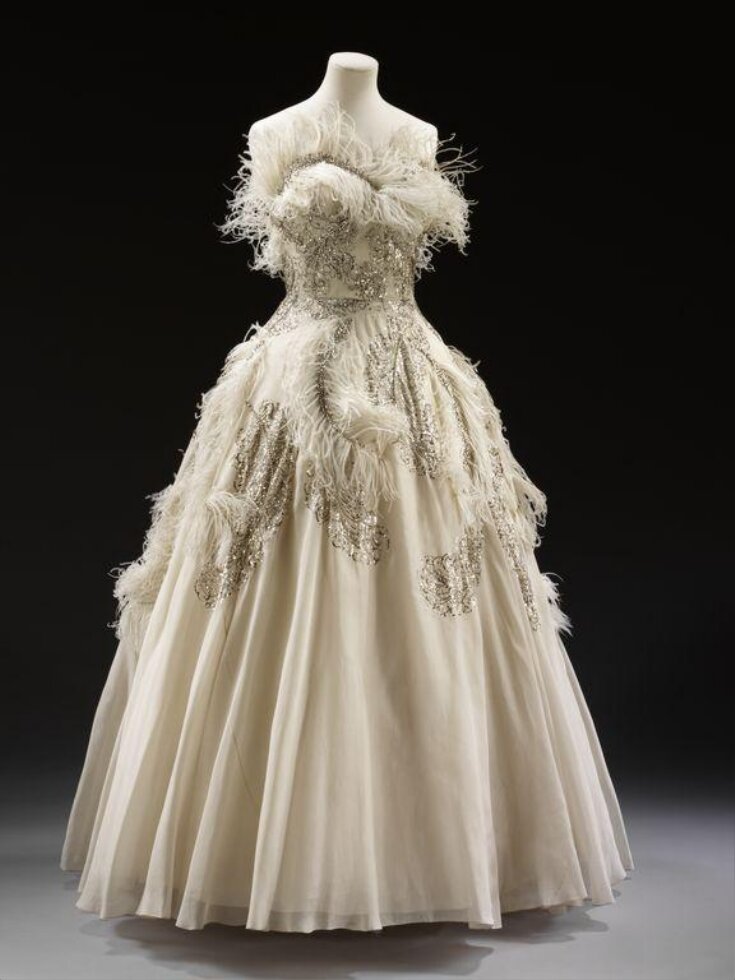
This evening gown was designed by Pierre Balmain (1914-82). The gown is embellished with ostrich feathers, sequins and rhinestones.
Working such a light-weight fabric required great skill, and would have been commissioned from a specialist workshop such as Lesage or Rebe. Balmain’s fellow couturier Christian Dior (1905-1957) explained, 'a ball dress may be entirely covered with millions of paillettes, or pearls, each one of which has to be put on separately'.
Working such a light-weight fabric required great skill, and would have been commissioned from a specialist workshop such as Lesage or Rebe. Balmain’s fellow couturier Christian Dior (1905-1957) explained, 'a ball dress may be entirely covered with millions of paillettes, or pearls, each one of which has to be put on separately'.
Delve deeper
Discover more about this object

Object details
| Categories | |
| Object type | |
| Materials and techniques | Embroidered silk organza trimmed with sequins, rhinestones and ostrich feather plumes, boned, supported by silk, nylon and tulle, metal.
It is highly likely that the ostrich feathers, 26-30 in total, are farmed and produced by a professional business that supplied the Paris haute couture trade in the mid-20th c. |
| Brief description | Evening dress of embroidered silk organza, designed by Pierre Balmain, Paris, 1950-1955 |
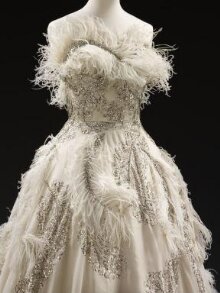
| Physical description | Evening dress made from embroidered white silk organza. The dress has a strapless bodice and a heart shaped neckline. The very full skirt flares from a hip yoke which is high at the front and lower on the hips at the back. The bodice and skirt are trimmed with a feather pattern in silver sequins and rhinestones interspersed with ostrich feathers with rhinestone centres. The design is most densely clustered on the bodice, becomes larger and sparser on the skirt and ceases at knee level in the front and just above the hem at the back. There are ostrich feathers stitched around the bodice. The bodice is lined with satin and boned with 's' boning at the breast. It fastens with hooks and eyes and a zip. The skirt is mounted on a white silk underskirt over which is a small nylon bustle, a stiff nylon petticoat and two layers of soft nylon tulle. The waist has been extensively altered. |
| Production type | Haute couture |
| Gallery label | EMBROIDERY
Paris was the home of a luxury trade in fashion goods. Entire streets were devoted to glove makers, shoe makers and furriers while feathers, floral accessories and ribbon work were worked by hand in small workshops, much as they had been since the 18th century.
Embroidery specialists created a range of samples each season. Once selected, a design remained for the exclusive use of the couturier. Hubert de Givenchy said these samples served as 'the springboard to creation'.
Gowns that were to be embroidered were usually simply cut to show off their sumptuous surface detail. Their embellishment required meticulous patience, for as Dior explained, 'a ball dress may be entirely covered with millions of paillettes, or pearls, each one of which has to be put on separately'.
Evening dress
Pierre Balmain (1914-82)
Paris
About 1950
This evening dress was made for a court ball. The pieces were embroidered and finished with feather-work by different workshops, then reassembled. The process of transforming a plain garment to the star of a collection could take up to a month. [41 words]
Silk organza with ostrich feathers, sequins and rhinestones, lined with silk, silk tulle and a stiff nylon petticoat
Worn by the Hon. Mrs Pleydell-Bouverie and given by Miss Karslake
V&A: T.176-1969(22/09/2007) |
| Credit line | Given by Miss Karslake |
| Object history | Donor states made for her aunt Hon. Mrs Pleydell-Bouverie by Balmain for a court ball in early 1950s. |
| Subject depicted | |
| Association | |
| Summary | This evening gown was designed by Pierre Balmain (1914-82). The gown is embellished with ostrich feathers, sequins and rhinestones. Working such a light-weight fabric required great skill, and would have been commissioned from a specialist workshop such as Lesage or Rebe. Balmain’s fellow couturier Christian Dior (1905-1957) explained, 'a ball dress may be entirely covered with millions of paillettes, or pearls, each one of which has to be put on separately'. |
| Bibliographic reference | Wilcox, C., ed., The Golden Age of Couture: Paris and London 1947-57 (V&A Publications: 2007), p. 136 and pl. 5.20 |
| Collection | |
| Accession number | T.176-1969 |
About this object record
Explore the Collections contains over a million catalogue records, and over half a million images. It is a working database that includes information compiled over the life of the museum. Some of our records may contain offensive and discriminatory language, or reflect outdated ideas, practice and analysis. We are committed to addressing these issues, and to review and update our records accordingly.
You can write to us to suggest improvements to the record.
Suggest feedback
You can write to us to suggest improvements to the record.
Suggest feedback
| Record created | January 19, 2006 |
| Record URL |
Download as: JSON
