
Dress
1949-1950 (made)
| Artist/Maker | |
| Place of origin |
Lady Alexandra Howard-Johnston (later Lady Dacre) was the wife of the Naval Attaché to Paris at the end of the 1940s. She required an extensive wardrobe for the many formal dinners and state functions that she had to attend. She dressed exclusively at the French couturier Jacques Fath (1912-54).
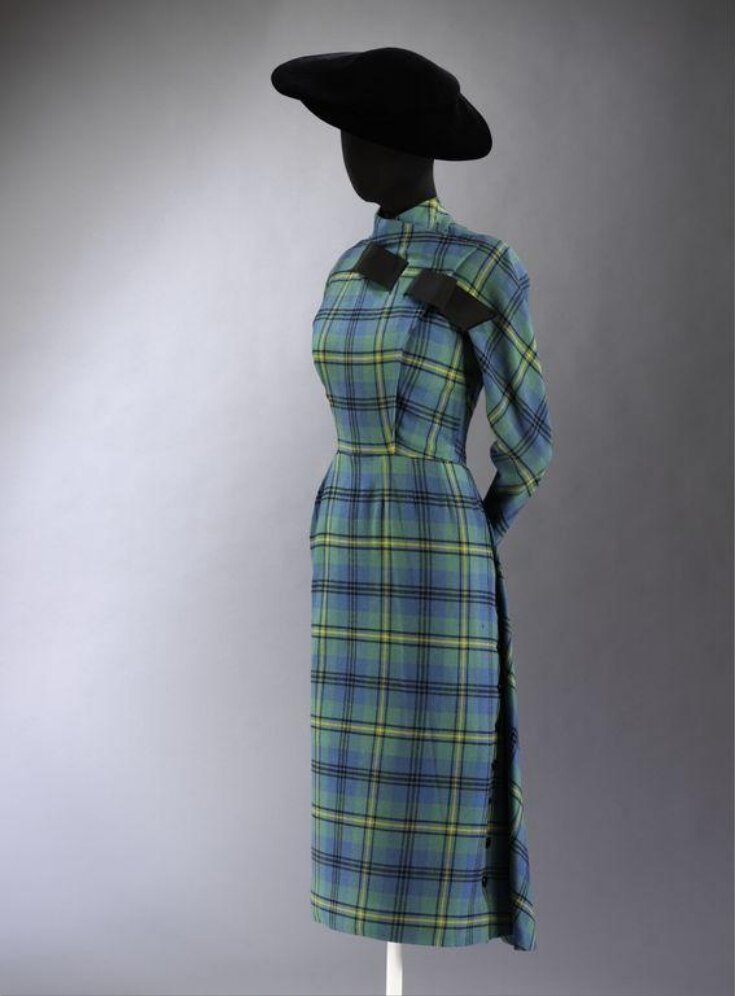
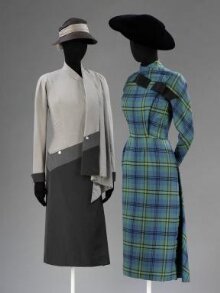
In 1949, Lady Alexandra commissioned one of Fath's most popular designs of the season, but requested that it be made up in her husband's family tartan. She purchased the hand-woven and naturally-dyed fabric from Scotland herself. The design features typical Fath motifs such as a flying panel at the back and decorative buttons and bows.
Lady Alexandra wore this dress frequently, especially to lunch, and accessorised it with a black hat and pearls.
In 1949, Lady Alexandra commissioned one of Fath's most popular designs of the season, but requested that it be made up in her husband's family tartan. She purchased the hand-woven and naturally-dyed fabric from Scotland herself. The design features typical Fath motifs such as a flying panel at the back and decorative buttons and bows.
Lady Alexandra wore this dress frequently, especially to lunch, and accessorised it with a black hat and pearls.
Object details
| Categories | |
| Object type | |
| Materials and techniques | Wool lined with net and silk, petersham |
| Brief description | Day dress of Johnston woollen tartan, designed by Jacques Fath, Paris, 1949-1950 |
| Physical description | Day dress of green woollen tartan in blue, black and yellow. It has a high neck with a mandarin collar. The front of the dress has a right flap, overlapping left cut diagonally from shoulder to waist and is secured in place by black petersham flat bow threaded through top left. It has long sleeves with an underarm gusset, tapering to the wrist with a zipper fastening. The skirt is of an A-line shape with folds of material at the back left, secured in place by buttons and button-holes, and sewn through a couple of layers. A further fold hides the extension of the centre back zipper into the skirt, attached to the waistline with a hook and eye. There is a pocket on the right side of the front of skirt. The skirt is lined with black net and grey silk to the waist. All natural vegetable dyes. |
| Dimensions |
|
| Production type | Haute couture |
| Gallery label | Dress and hat
Jacques Fath (1912-54)
Paris
1949
This dress was made for Lady Alexandra Howard-Johnston (later Lady Dacre). The Johnston tartan was made in Scotland, using natural colours as synthetic dye made the yellow too bright.
Dress: woollen tartan, lined with net and silk
Hat: velvet
Given by Lady Dacre
V&A: T.180, 270A-1974(22/09/2007) |
| Credit line | Given by Lady Alexandra Trevor-Roper |
| Object history | Lady Alexandra, (married first to Captian (later Rear Admiral) Clarence Howard-Johnston), purchased the Johnston tartan in Scotland for this dress. Her daughter recalls that she wore it very frequently out to lunch, most likely with a black hat. The textile is made with natural vegetable dyes as Lady Alexandra favoured the yellowish colour created. It is very typical of Fath's style - tight fitting, with flying panels, and decorative (or exaggerated) bows and buttons. |
| Historical context | Lady Trevor-Roper favoured designs by Jacques Fath for her wardrobe, and contributed the vast proportion of the V&A's Fath collection. |
| Production | The textile was manufactured in Scotland by Johnson. Reason For Production: Commission |
| Subject depicted | |
| Association | |
| Summary | Lady Alexandra Howard-Johnston (later Lady Dacre) was the wife of the Naval Attaché to Paris at the end of the 1940s. She required an extensive wardrobe for the many formal dinners and state functions that she had to attend. She dressed exclusively at the French couturier Jacques Fath (1912-54). In 1949, Lady Alexandra commissioned one of Fath's most popular designs of the season, but requested that it be made up in her husband's family tartan. She purchased the hand-woven and naturally-dyed fabric from Scotland herself. The design features typical Fath motifs such as a flying panel at the back and decorative buttons and bows. Lady Alexandra wore this dress frequently, especially to lunch, and accessorised it with a black hat and pearls. |
| Bibliographic references |
|
| Collection | |
| Accession number | T.180-1974 |
About this object record
Explore the Collections contains over a million catalogue records, and over half a million images. It is a working database that includes information compiled over the life of the museum. Some of our records may contain offensive and discriminatory language, or reflect outdated ideas, practice and analysis. We are committed to addressing these issues, and to review and update our records accordingly.
You can write to us to suggest improvements to the record.
Suggest feedback
You can write to us to suggest improvements to the record.
Suggest feedback
| Record created | January 11, 2006 |
| Record URL |
Download as: JSON
