
Evening Dress
1948 (made)
| Artist/Maker | |
| Place of origin |
Lady Alexandra Howard-Johnston (1907-97) was the wife of the Naval Attaché to Paris at the end of the 1940s. She required an extensive wardrobe for the many formal dinners and state functions that she had to attend.
Lady Alexandra dressed exclusively at the house of Jacques Fath (1912-54). The designer lent her evening and day dresses each season, aware of the publicity that this would give his house. She recalled 'If there was a dress I wanted to keep, I could pay sale price at the end of the season. I was not allowed to go to any other couturier, but I did not want to – Fath was perfection.'
Fath designed this dress for Lady Alexandra to wear for the official visit of Princess Elizabeth and Prince Philip to Paris in May 1948. Lady Alexandra recalled that when she arrived at the Théâtre de l’Opéra with her husband, the Garde Nationale suddenly sprang to attention. ‘I realised they had mistaken us for the Princess and Duke. That was the effect made by my splendid Fath’
Lady Alexandra dressed exclusively at the house of Jacques Fath (1912-54). The designer lent her evening and day dresses each season, aware of the publicity that this would give his house. She recalled 'If there was a dress I wanted to keep, I could pay sale price at the end of the season. I was not allowed to go to any other couturier, but I did not want to – Fath was perfection.'
Fath designed this dress for Lady Alexandra to wear for the official visit of Princess Elizabeth and Prince Philip to Paris in May 1948. Lady Alexandra recalled that when she arrived at the Théâtre de l’Opéra with her husband, the Garde Nationale suddenly sprang to attention. ‘I realised they had mistaken us for the Princess and Duke. That was the effect made by my splendid Fath’
Object details
| Categories | |
| Object type | |
| Parts | This object consists of 2 parts.
|
| Materials and techniques | Embroidered slipper silk satin with sequins and beads, lined with net, and wire |
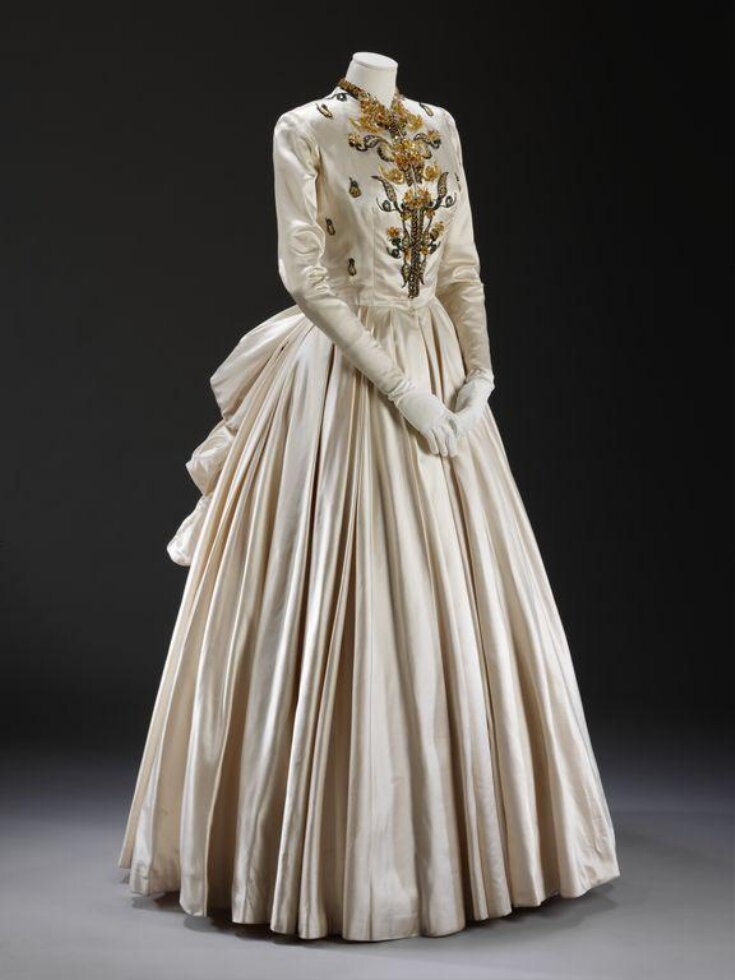
| Brief description | Full length evening dress in silk satin and petticoat, designed by Jacques Fath, embroidered by Rébé, Paris, 1948 |
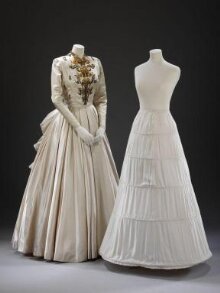
| Physical description | Full length evening dress in cream slipper silk satin. It has a close fitting bodice to the waist, with a high round neck with amber and dark grey coloured sequins and glass bead embroidery round the neck and down the centre of the bodice, and with smaller designs flanking the centre panel. It has a centre front zipper opening with a hook at the neck. Full skirt pleated into the bodice with a train at the rear looped up to form a triple fan shaped bustle, starting just below the back waistline. The sleeves are long and tight-fitting, with three darts at the elbow, and with a zipper fastening at the wrist. The skirt and back 'bustle' are lined with cream net. The bodice has circular bust pads and has shoulder pads. Worn with a full-length hoop petticoat in silk with wire hoops. |
| Dimensions |
|
| Production type | Haute couture |
| Marks and inscriptions | 'Jacques Fath Paris' (Label, machine woven, black on white) |
| Gallery label | Evening dress (robe de gala)
Jacques Fath (1912-54)
Paris
1948 spring/summer
Lady Alexandra wore this dress at the official visit of Princess Elizabeth and Prince Philip to Paris in May 1948. She recalled that when she arrived at the Théâtre de l'Opéra with her husband, the Garde Nationale suddenly sprang to attention. 'I realised they had mistaken us for the Princess and Duke. That was the effect made by my splendid Fath'.
Silk satin, embroidered by Rébé with sequins and beads
Given by Lady Alexandra Dacre
V&A: T.184&A-1974(22/09/2007) |
| Credit line | Given by Lady Alexandra Trevor-Roper |
| Object history | The donor, Lady Alexandra, recounts a story about the dress in her unpublished memoirs - when she wore it to a state occasion in honour of Princess Elizabeth's visit to Paris (May 1948), her arrival at the opera house prompted the guards on the staircase to present arms, believing her to be the princess. This dress may be the original mannequin dress (as seen in promotional photographs, such as those on the stairs of the Louvre in V. Guillaume's book), as Lady Alexandra was the same size as Fath's mannequins and often given model dresses to wear, which she would then buy at a reduced price at the end of the season. The Fath house mannequin was Louise. |
| Association | |
| Summary | Lady Alexandra Howard-Johnston (1907-97) was the wife of the Naval Attaché to Paris at the end of the 1940s. She required an extensive wardrobe for the many formal dinners and state functions that she had to attend. Lady Alexandra dressed exclusively at the house of Jacques Fath (1912-54). The designer lent her evening and day dresses each season, aware of the publicity that this would give his house. She recalled 'If there was a dress I wanted to keep, I could pay sale price at the end of the season. I was not allowed to go to any other couturier, but I did not want to – Fath was perfection.' Fath designed this dress for Lady Alexandra to wear for the official visit of Princess Elizabeth and Prince Philip to Paris in May 1948. Lady Alexandra recalled that when she arrived at the Théâtre de l’Opéra with her husband, the Garde Nationale suddenly sprang to attention. ‘I realised they had mistaken us for the Princess and Duke. That was the effect made by my splendid Fath’ |
| Bibliographic references |
|
| Collection | |
| Accession number | T.184&A-1974 |
About this object record
Explore the Collections contains over a million catalogue records, and over half a million images. It is a working database that includes information compiled over the life of the museum. Some of our records may contain offensive and discriminatory language, or reflect outdated ideas, practice and analysis. We are committed to addressing these issues, and to review and update our records accordingly.
You can write to us to suggest improvements to the record.
Suggest feedback
You can write to us to suggest improvements to the record.
Suggest feedback
| Record created | January 11, 2006 |
| Record URL |
Download as: JSON
