
Sand-Glass
1575-1625 (made)
| Artist/Maker | |
| Place of origin |
During the 16th and 17th centuries sandglasses were used in various situations: in churches, typically to time the sermon; on ships to time the length of the watches; in the kitchens of wealthy households, probably to help judge cooking times. They are often illustrated in scholars' studies where they served meditation, or simply helped judge the time of day.
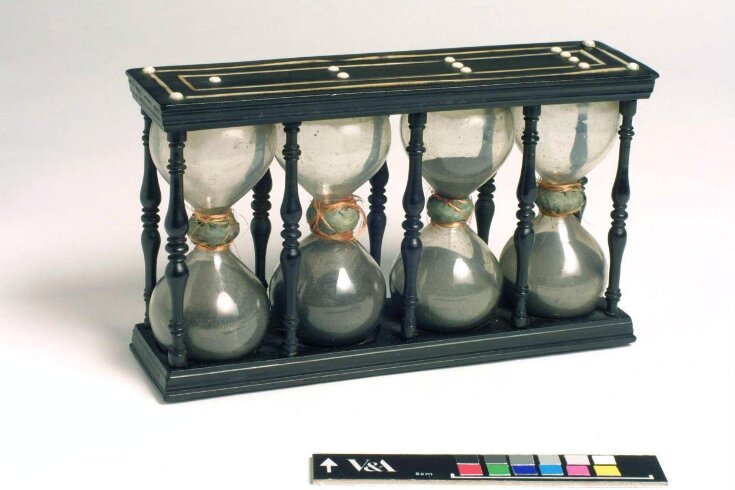
Sandglasses in this period were constructed from two matching glass ampoules sealed (often with wax or pitch) and bound with fabric at the joint. The 'sand' was usually a material less sensitive to moisture such as powdered metal, rock or eggshell.
These four sandglasses in a single frame run for different periods, probably subdivisions of an hour, but it has not been possible to time them precisely as the particles no longer run freely.
Sandglasses in this period were constructed from two matching glass ampoules sealed (often with wax or pitch) and bound with fabric at the joint. The 'sand' was usually a material less sensitive to moisture such as powdered metal, rock or eggshell.
These four sandglasses in a single frame run for different periods, probably subdivisions of an hour, but it has not been possible to time them precisely as the particles no longer run freely.
Object details
| Category | |
| Object type | |
| Materials and techniques | Blown glass in a frame of ebony inlaid with ivory (or bone) |
| Brief description | Sand-glass set (x4) fitted into an ebony case, inlaid with ivory. Italian, c1600 |
| Physical description | A sand-glass set or ‘battery’ of four glasses each composed of two ampoules or phials, mounted in a frame of ebony with ivory or bone inlay. |
| Dimensions |
|
| Object history | Bought for £3 from Mons. Fulgence, Paris. Display history: displayed in room 5 (case W.129) by 1925 (with 83-1880), and in room 74 (1964); in store (room 125s) by the 1980s. These four sandglasses in a single frame run for different periods, probably 15min, 30min, 45min & 1 hour, although 5, 10, 15 & 20 minutes are also possible; it is not possible to time them as the particles no longer run freely. It is likely to have been used for timing private study or personal devotions. |
| Historical context | Comparable sand-glasses See: C. F. C. Beeson, 'Sandglass in cloth of gold’, in Antiquarian Horology,_ 1968, 417-418 and and front cover picture (p. 385). With numbers for the quarter hours painted on the ampoules. Possibly the same piece as included in Anna, Dominique and Eric Delalande, Sabliers d’autrfefois... , Paris 2015, pp. 170-173 The portait by Hans Eworth of William Cecil, First Baron Burghley, c.1565 (Hatfield House) depicts a broadly similar sand-glass. |
| Summary | During the 16th and 17th centuries sandglasses were used in various situations: in churches, typically to time the sermon; on ships to time the length of the watches; in the kitchens of wealthy households, probably to help judge cooking times. They are often illustrated in scholars' studies where they served meditation, or simply helped judge the time of day. Sandglasses in this period were constructed from two matching glass ampoules sealed (often with wax or pitch) and bound with fabric at the joint. The 'sand' was usually a material less sensitive to moisture such as powdered metal, rock or eggshell. These four sandglasses in a single frame run for different periods, probably subdivisions of an hour, but it has not been possible to time them precisely as the particles no longer run freely. |
| Collection | |
| Accession number | 82-1880 |
About this object record
Explore the Collections contains over a million catalogue records, and over half a million images. It is a working database that includes information compiled over the life of the museum. Some of our records may contain offensive and discriminatory language, or reflect outdated ideas, practice and analysis. We are committed to addressing these issues, and to review and update our records accordingly.
You can write to us to suggest improvements to the record.
Suggest feedback
You can write to us to suggest improvements to the record.
Suggest feedback
| Record created | December 21, 2005 |
| Record URL |
Download as: JSONIIIF Manifest
