Drug Jar
1530-1550 (made)
| Artist/Maker | |
| Place of origin |
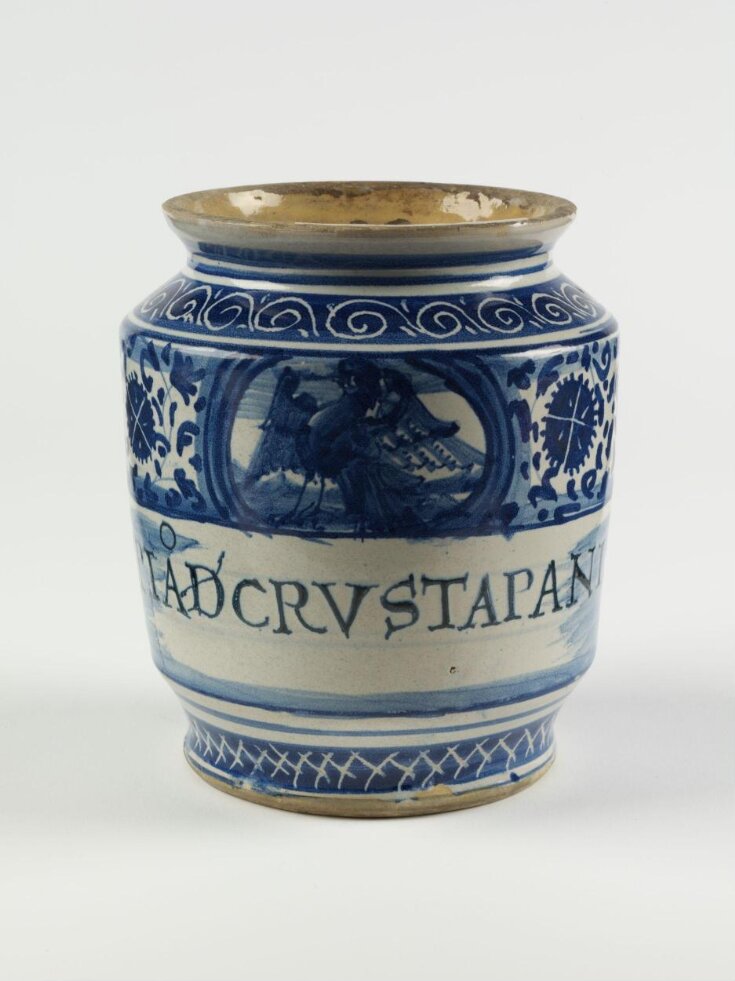
Jars of this type were used for storing drugs. It would have been part of a set of similar jars for different drugs, belonging to a pharmacy. The constriction just underneath the rim was used to close the pot off with a piece of parchment or paper and a string.
The Latin inscription on the painted label refers to the original contents of the jar: 'EMPIAO D CRVSTAPANIS', or bread-crust plaster, a poultice made from bread crusts, red coral, mastic, oil of quinces and other ingredients.
Pharmacies in the Renaissance period were usually run by a monastic orders as part of their hospitals, or somtimes by one of the leading local families.
The Latin inscription on the painted label refers to the original contents of the jar: 'EMPIAO D CRVSTAPANIS', or bread-crust plaster, a poultice made from bread crusts, red coral, mastic, oil of quinces and other ingredients.
Pharmacies in the Renaissance period were usually run by a monastic orders as part of their hospitals, or somtimes by one of the leading local families.
Object details
| Categories | |
| Object type | |
| Materials and techniques | Tin-glazed earthenware, painted and scratched decoration |
| Brief description | Drugjar, tin-glazed earthenware, painted in colours and with inscription: 'IERALOCODION', Italy, possibly The Marches, 1530-50 |
| Physical description | Drugjar of tin-glazed earthenware, painted in blue with a scroll, inscribed: 'EMPIAO D CRVSTAPANIS'. Above this, a bird in a compartiment, flanked by floral ornament. On the shoulder and above the base patterns are scratched through the blue to the white. |
| Dimensions |
|
| Marks and inscriptions |
|
| Object history | Purchased from the Wimbledon Park House Sale on 25th October 1901 |
| Historical context | The Latin inscription on the painted label refers to the original contents of the jar, bread-crust plaster, a poultice made from bread crusts, red coral, mastic, oil of quinces and other ingredients. The jar would have been part of a set of similar jars for different drugs, belonging to a pharmacy. A few more jars from the same set have survived. The constriction just underneath the rim was used to close the pot off with a piece of parchment or paper and a string. |
| Subject depicted | |
| Summary | Jars of this type were used for storing drugs. It would have been part of a set of similar jars for different drugs, belonging to a pharmacy. The constriction just underneath the rim was used to close the pot off with a piece of parchment or paper and a string. The Latin inscription on the painted label refers to the original contents of the jar: 'EMPIAO D CRVSTAPANIS', or bread-crust plaster, a poultice made from bread crusts, red coral, mastic, oil of quinces and other ingredients. Pharmacies in the Renaissance period were usually run by a monastic orders as part of their hospitals, or somtimes by one of the leading local families. |
| Bibliographic references |
|
| Other number | 203 - Rackham (1940) |
| Collection | |
| Accession number | 1117-1901 |
About this object record
Explore the Collections contains over a million catalogue records, and over half a million images. It is a working database that includes information compiled over the life of the museum. Some of our records may contain offensive and discriminatory language, or reflect outdated ideas, practice and analysis. We are committed to addressing these issues, and to review and update our records accordingly.
You can write to us to suggest improvements to the record.
Suggest feedback
You can write to us to suggest improvements to the record.
Suggest feedback
| Record created | December 14, 2005 |
| Record URL |
Download as: JSONIIIF Manifest
